Why Is Claude Code So Smart? The Secret Is the Harness, Not the Model

A pure-Python harness demo proves AI agent intelligence is driven by engineering architecture, not the model alone.
A YouTube creator built a minimal AI agent framework from scratch in pure Python, revealing the real reason Claude Code is so capable. The key isn't the model — it's the harness. Just ~10 lines of code for an agentic loop transforms a passive LLM into an observe-think-act agent. Adding MCP unlocks plug-and-play tools like live web fetching. Context engineering enables persistent memory that survives even a mid-conversation model swap to a free local model — proving that memory, tools, and the loop all live in the harness layer, not the model.
Where Does Claude Code's Intelligence Come From?
Many people assume Claude Code works so well simply because the underlying model is powerful enough. But one YouTube creator proved otherwise by building a "harness" (an agent runtime framework) from scratch in pure Python: what truly determines the ceiling of an AI agent's capabilities is often not the model itself, but the engineering structure wrapped around it.
His experiment started from the most basic form — a raw LLM call. You ask the model directly to read local files and analyze your code, and the result is useless: no tools, no memory, no awareness of the external environment. No matter how powerful the model is, trapped inside a closed dialog box, it can only output text — it can't actually do anything.
Agentic Loop: A Transformation in Ten Lines of Code
The first turning point in the demonstration came from adding an agentic loop. The author emphasized that this portion of code is minimal — "about 10 lines of Python" — but the impact is immediate.
With the loop in place, the model can begin autonomously initiating tool calls: listing directory contents, reading files, and then deciding what to do next based on what it finds. This is precisely what separates an agent from an ordinary chatbot. A chatbot only answers; an agent "observes, thinks, and acts," feeding the results of each action back into itself for the next round of decision-making.
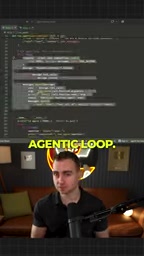
In other words, the first step to making an LLM "smarter" isn't switching to a larger model — it's giving it a closed loop that allows it to act repeatedly.
The "observe–think–act" cycle is academically known as the ReAct (Reasoning + Acting) paradigm, proposed by researchers from Google and Princeton in 2022. The core idea is to have the model first output its reasoning process (Thought), then decide which tool to call (Action), and upon receiving the tool's output (Observation), continue reasoning. This cycle repeats until the model determines the task is complete. Compared to single-pass generation, the fundamental breakthrough of the agentic loop is the introduction of external feedback — the model no longer imagines what's in a file; it actually reads the content before making a judgment, and errors can be self-corrected within the loop. This is why, even with a less capable model, a well-designed tool set and loop structure can significantly outperform a more powerful model with no tools.
MCP: Instantly Plug In Tools You Never Wrote
The second key component is an MCP (Model Context Protocol) client. The author notes this is the same underlying protocol used by Claude Code and most mainstream harnesses.
The value of MCP lies in standardized tool integration. With a single MCP connection, an agent instantly gains a suite of tool capabilities it "never had to build itself." In the demo, he added live web fetching to the agent through a single connection — no need to write a custom scraper or define interfaces. The protocol plugs the entire tool ecosystem directly in.
This explains why mature agent products are all betting on the protocol layer: whoever can extend tool capabilities at the lowest cost builds the most useful agent.
MCP (Model Context Protocol) is an open standard released by Anthropic in November 2024, aiming to become the "USB port" of AI tool calling. Before MCP, every AI application had to write custom adapter code for each external service, creating layers of duplicated, non-reusable glue code. MCP standardizes this process: a tool provider publishes an MCP Server, and any MCP-compatible client (including Claude and various open-source harnesses) can call those tools plug-and-play, without needing to understand the underlying implementation. The MCP ecosystem now covers hundreds of pre-built servers for browser control, database queries, code execution, file system operations, and more. This also explains why Claude Code can work with files and run terminal commands out of the box — these capabilities aren't hard-coded into the model weights; they're dynamically injected through the protocol layer.
Persistent Memory and Hot-Swapping Models
The third step involves giving the agent persistent memory through "context engineering" and a few additional tools. Conversations are no longer one-off exchanges — the agent can remember what happened across turns and across sessions.
The most compelling moment came at the end: mid-conversation, the author swapped out the entire model for a free local model, and the agent still "remembered everything."

This detail drives the core point home — memory, tools, and the loop all live in the harness layer, not locked inside any specific model. The model is more like a swappable reasoning engine; the harness is the true skeleton that carries intelligent behavior.
"Context Engineering" is a concept that has recently gained traction in AI application development. It refers to the deliberate design and management of the context fed to a model — including deciding which historical information to retain, how to compress and store it, and when to re-inject it into a conversation. Unlike prompt engineering, which focuses primarily on the wording of individual inputs, context engineering is concerned with the flow of information across multiple turns. Persistent memory is typically implemented in one of two ways: either writing key information as structured text to an external file and reading it back at the start of each conversation, or using a vector database for semantic retrieval to inject only relevant fragments into the context. The demo uses the former approach — more intuitive and easier to understand. Because memory is stored as text in the harness layer, switching the underlying model only requires changing the API call target; the memory content is fully visible to the new model, enabling seamless switching.
What This Means for Developers
This demonstration is brief, but it clearly unpacks an underappreciated truth: the capabilities of a modern AI agent are the product of both engineering architecture and model capability — and the engineering layer often has the greater leverage.
- If you want an LLM to actually do things, give it an agentic loop first — don't blindly chase a bigger model;
- If you want to quickly expand capability boundaries, prioritize standard protocols like MCP to reuse existing tool ecosystems;
- For a continuous, reliable experience, memory and context engineering must be designed separately and intentionally;
- Once memory and tools are embedded in the harness, models become freely swappable — you can even downgrade to a free local model to control costs.

For developers trying to understand why tools like Claude Code work so well, building a minimal viable harness yourself will likely be more illuminating than studying model parameters. The author has also published the complete build process on his channel, along with a free AI tech stack resource guide.
This article is based on a single YouTube source. For specific code implementations and resources, please refer to the original video.
Related articles

Amphibious Transforming Drone: Beyond 100x Power Savings, What Are the Real Needs?
Is the amphibious transforming drone just a gimmick? Starting from the 100x power difference of the M4 Morphobot, explore real application scenarios and thesis topic ideas, analyzing boundary conditions where pure drones and pure ground robots both fail.

Warhound Raises $200 Million: Genetically Engineered "War Dogs" Paired with Anduril Gear
Warhound raises $200M, backed by Ben Lamm and Palmer Luckey, to genetically engineer dogs for military and law enforcement use and equip them with Anduril gear. This article analyzes its technology direction, funding logic, and ethical controversy.

Claude API Comes to Google Cloud: IAM Integration and SDK Access Guide
Anthropic hosts the full Claude API on Google Cloud with IAM-controlled permissions and unified billing. This guide covers the Vertex AI and Anthropic-hosted entry points, IAM role configuration, and SDK access.