Why Is Gemini 3.5 Pro Missing? The Real Struggles Behind Google's New Model Releases

Google's new Gemini models reveal efficiency gains but expose deep struggles with the missing flagship Pro.
Google released Gemini 3.6 Flash and 3.5 Flash Lite but the anticipated 3.5 Pro remains absent, reportedly stuck on coding capability bottlenecks. Independent benchmarks show 3.6 Flash matches 3.5 Flash in intelligence while halving task time. Key departures including Noam Shazeer to OpenAI and John Jumper to Anthropic have compounded delays. Google may skip 3.5 Pro entirely and bet on Gemini 4 as its flagship comeback.
Google recently released two new models at once—Gemini 3.6 Flash and Gemini 3.5 Flash Lite—but the most anticipated flagship 3.5 Pro remains conspicuously absent. What appears to be a routine product lineup update actually exposes the real challenges Google faces in flagship model development. This article breaks down the actual performance of the two new models and analyzes the deeper reasons behind Pro's continued delay.
Gemini 3.5 Flash Lite: A Positioning Upgrade for the Budget Model
The most surprising player in this release is the lightweight Gemini 3.5 Flash Lite. Its performance has leapfrogged the previous 3.0 Flash, showing notable improvements in both code testing and long-context understanding—two critical capabilities.
Even more noteworthy is its speed—output reaches 350 tokens per second, making it the fastest among all of Google's current models. A token is the basic unit of text processing for large language models, with one token corresponding to roughly 3–4 English characters or 1–2 Chinese characters. At 350 tokens per second, the model can generate approximately 260 English words per second, which is crucial for scenarios requiring instant responses like real-time conversation and code completion. This extreme output speed typically relies on the synergy of multiple technical approaches, including Speculative Decoding, KV cache optimization, and underlying TPU hardware acceleration. Although pricing has increased compared to the previous generation, this speed advantage delivers enormous value in real-time interaction and high-concurrency scenarios.
Google has also, for the first time, tasked the Lite version with lightweight coding and Agent tasks, effectively elevating the capability positioning of the "budget model" by an entire tier. The logic behind this move is clear: with the flagship delayed, they're using a high-value entry-level product to stabilize the foundation of their developer ecosystem.
Gemini 3.6 Flash: Efficiency Optimization, Not a Full Generational Upgrade
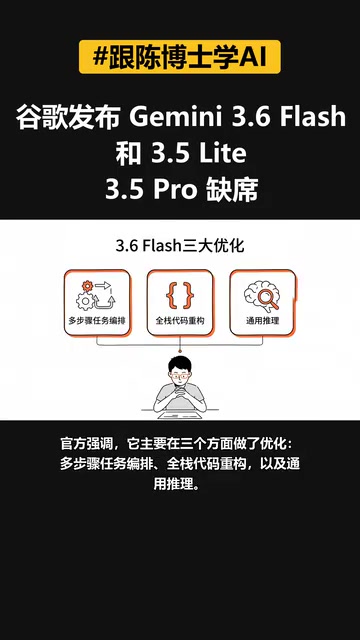
Gemini 3.6 Flash is the headliner of this release. Google emphasized optimizations in three areas: multi-step task orchestration, full-codebase refactoring, and general reasoning capabilities.
Core Improvement: More "Restrained" Agent Behavior
The most significant change in 3.6 Flash is the reduction of "action bias." In plain terms, the model has learned to "observe first, analyze second"—never modifying a user's files without explicit authorization.
Action bias is an important concept in AI agent research, referring to a model's tendency to immediately execute actions rather than first gathering sufficient information and analyzing the situation. In software development scenarios, an agent with high action bias might modify code files without fully understanding the context, triggering chain reactions that introduce new bugs or break existing functionality. Reducing action bias typically requires fine-tuning the model's decision-making strategy during the RLHF (Reinforcement Learning from Human Feedback) phase, teaching it to make more prudent judgments between "executing" and "asking for confirmation."
For developers, this restrained behavior pattern is genuinely practical, effectively preventing AI agents from causing uncontrollable damage during automated tasks.
Independent Benchmarks Reveal Awkward Numbers
However, independent benchmark data makes things a bit awkward. The intelligence score for 3.6 Flash is identical to 3.5 Flash—both at 50 points—meaning there's no substantive improvement in "how smart" it is.
The real progress shows up in efficiency: average task completion time dropped from 2.7 minutes to 1.3 minutes, nearly cut in half. For developers who need rapid iteration, this is a tangible win.
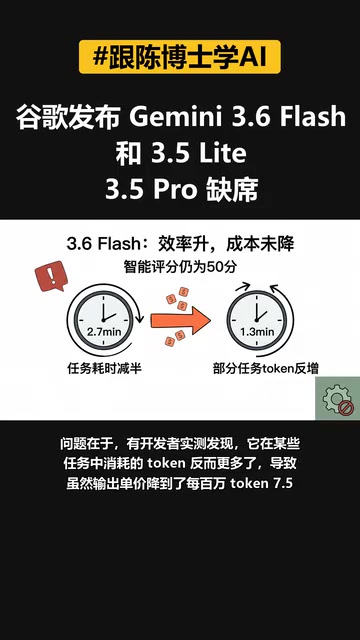
But problems follow. Some developers have discovered through testing that 3.6 Flash actually consumes more tokens on certain tasks. This means that while the per-unit output price has dropped to $7.50 per million tokens, the total cost per task doesn't necessarily decrease. This phenomenon likely stems from the model adding more "thinking steps" and intermediate reasoning processes after reducing action bias, causing the total token count to actually increase—essentially trading more computation for more cautious behavior.
Add to this the fact that 3.6 Flash doesn't yet support model fine-tuning, while 3.5 Flash has had this capability for a while, and many developers get the distinct impression that 3.6 Flash is more of a "prematurely deployed efficiency patch" than a complete generational update. Fine-tuning allows developers to perform secondary training on a pretrained model using domain-specific data, customizing a general model into a specialized industry tool. Without fine-tuning support, developers can only rely on prompt engineering to guide model behavior, which imposes limits on precision and consistency—a significant drawback for enterprise-level application deployment.
Where Exactly Is Gemini 3.5 Pro Stuck?
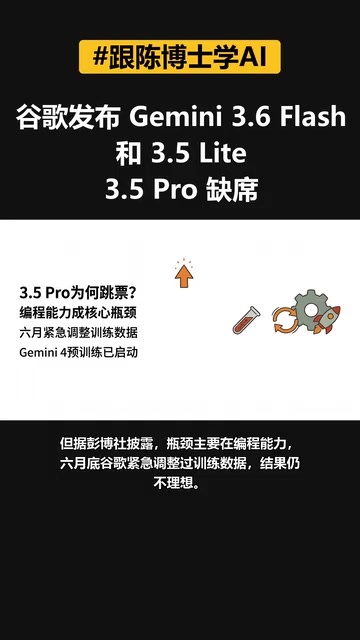
The real suspense centers on the still-absent 3.5 Pro. Google's official response is that it's "still being tested with partners," but according to Bloomberg, the real bottleneck is primarily in coding capabilities.
Reportedly, Google urgently adjusted its training data in late June in an attempt to improve Pro's coding performance, but the results remain unsatisfactory. A large model's programming ability is highly dependent on the quality, diversity, and scale of code corpora in its training data. Emergency training data adjustments may involve adding high-quality code repositories (such as rigorously reviewed open-source projects), generating synthetic code data through model self-play, and fine-tuning the ratio between code and natural language data. The reason coding capability is so hard to break through is partly because code reasoning demands strict logical consistency and long-chain reasoning from the model—a single tiny logical error in code can cause a program to fail entirely, which stands in fundamental contradiction with the degree of ambiguity tolerable in natural language writing.
3.5 Pro May Skip Directly to Gemini 4
An even more critical signal is that Google itself has revealed pretraining for the next-generation Gemini 4 has already begun, internally calling it "the most ambitious pretraining" effort. This essentially confirms what outsiders have speculated: 3.5 Pro will likely be skipped entirely, with Google waiting until the technology is polished before debuting it as Gemini 4 Pro.
This "generation-skipping" strategy isn't uncommon in the industry—rather than force-releasing an immature flagship version and damaging brand reputation, it's better to concentrate resources on getting the next generation right. Historically, Microsoft skipped Windows 9 and went straight to Windows 10, and Apple skipped iPhone 9. In the AI space, this strategy typically emerges when a major shift in technical direction occurs: rather than releasing a transitional product that forces users and developers to bear the costs of API migration and adaptation, it's better to accumulate improvements across multiple versions and release them all at once in the next major version—saving ecosystem adaptation costs while generating greater market buzz and anticipation.
The Hidden Impact of Talent Drain on Google's AI R&D
Personnel changes within Google's AI team over the past few months have also slowed the flagship model's development pace to some degree.
Gemini co-lead Noam Shazeer left for OpenAI in June, while DeepMind Vice President and Nobel Chemistry Prize laureate John Jumper went to Anthropic. The impact of multiple core members departing in succession on flagship model development is easy to imagine.
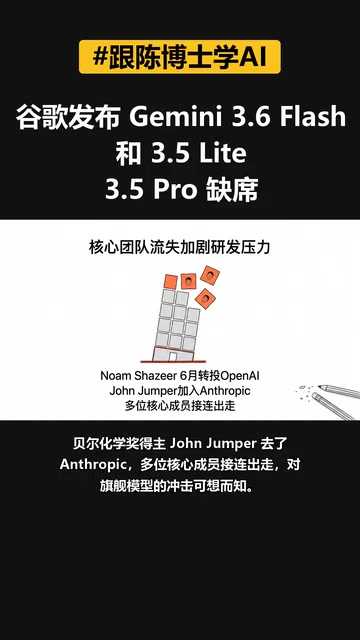
Noam Shazeer is one of eight co-authors of the groundbreaking 2017 paper Attention Is All You Need, from which the Transformer architecture was born—the technical foundation of all large language models today. He originally returned to Google in 2023 through its $2.6 billion acquisition of Character.AI, and his departure again carries symbolic significance far beyond the personal level. John Jumper won the 2024 Nobel Prize in Chemistry for leading the AlphaFold protein structure prediction project; his departure means Google has lost its most iconic leader in the AI for Science direction.
The rapid flow of top AI talent between leading companies is becoming a hidden but critical variable affecting large model development timelines. The talent war in the current AI industry has reached a fever pitch, with top researchers commanding annual salaries plus equity incentives ranging from millions to tens of millions of dollars. When core researchers leave, it often means disrupted technical roadmaps, lost team collaboration chemistry, and reorganization costs spanning months or longer. The deeper impact is that these top talents take with them not just explicit knowledge, but also vast amounts of experimental intuition and hyperparameter tuning experience that are nearly impossible to document.
Google's Strategy: Holding the Line, Not Flexing
Taking it all together, the core logic behind Google's latest releases isn't about "flexing"—it's about "holding the line":
- With the flagship Pro not ready for prime time, the Flash lineup steps up, pushing efficiency and cost-effectiveness to the extreme;
- Simultaneously, the more promising Lite version is elevated to guard the developer ecosystem's foundation;
- Limited R&D resources are concentrated on Gemini 4, building momentum for the real counterattack.
This strategy is essentially a gamble of "trading time for quality." In a competitive landscape where OpenAI, Anthropic, and Meta are all accelerating their iteration cycles, Google has chosen to temporarily sacrifice its flagship product line's update pace, betting everything on a technological breakthrough in the next-generation architecture. The risk of this choice is clear: if Gemini 4's delivery timeline stretches too long, the developer ecosystem may gradually migrate to competitors during the wait. But if Gemini 4 ultimately delivers a generational performance leap, Google will have the opportunity to redefine the competitive landscape.
Google has indeed hit a wall with its flagship model, but rather than sitting idle, they've chosen to ship what they can. As for whether the Gemini series can stage a comeback in this large model race, that depends on Gemini 4's real capabilities.
Key Takeaways
Related articles

Fei-Fei Li on AI: Visual Intelligence, the Boundaries of Creativity, and Human Agency
Stanford professor Fei-Fei Li discusses AI and visual science on Huberman Lab, explaining how ImageNet ignited modern AI, AI's capability boundaries, healthcare applications, and why human agency is the central question in AI development.

DeepSeek Harness Hands-On Review: Core Advantages of a Plugin-Based Agent Framework
Hands-on review of DeepSeek Harness open-source Agent framework, analyzing its plugin architecture, coding capabilities, deployment, and comparison with Claude Code.

Building a 500K Domain Search Engine for $10: Lessons from an Indie Developer's Weekend Project
An indie developer built a 500K domain vertical search engine in one weekend for $10. We analyze the tech stack, vertical search opportunities, and rapid validation methodology.