Why Is It So Hard to Stick with AI Learning? The Case for Community-Based Study

A Reddit user proposes a daily 15-minute AI study room to fight motivation decay through community accountability.
A Reddit user proposed a daily AI "learning room" — 15 minutes, fixed time, community-driven — to address the widespread problem of motivation decay among tech learners. The article argues that solo AI learning fails not due to lack of intelligence or time, but due to missing feedback loops, social commitment, and accountability. The 15-minute micro-habit format lowers the barrier to near zero while community participation fills the self-discipline gap through public accountability, real-time discussion, and mutual encouragement. The article also notes real challenges such as time zone friction and long-term engagement, but affirms the core principle: lower barriers, stay consistent, and leverage external forces to sustain learning.
It Started with a Reddit Post
In a tech community on Reddit, a user sparked a discussion about how to stay consistent with AI learning. The post was titled "Innovation starts from small steps," and while the content was straightforward, it hit on a pain point shared by countless AI learners: starting out with tremendous enthusiasm, only to see that motivation gradually fade — and eventually giving up entirely.
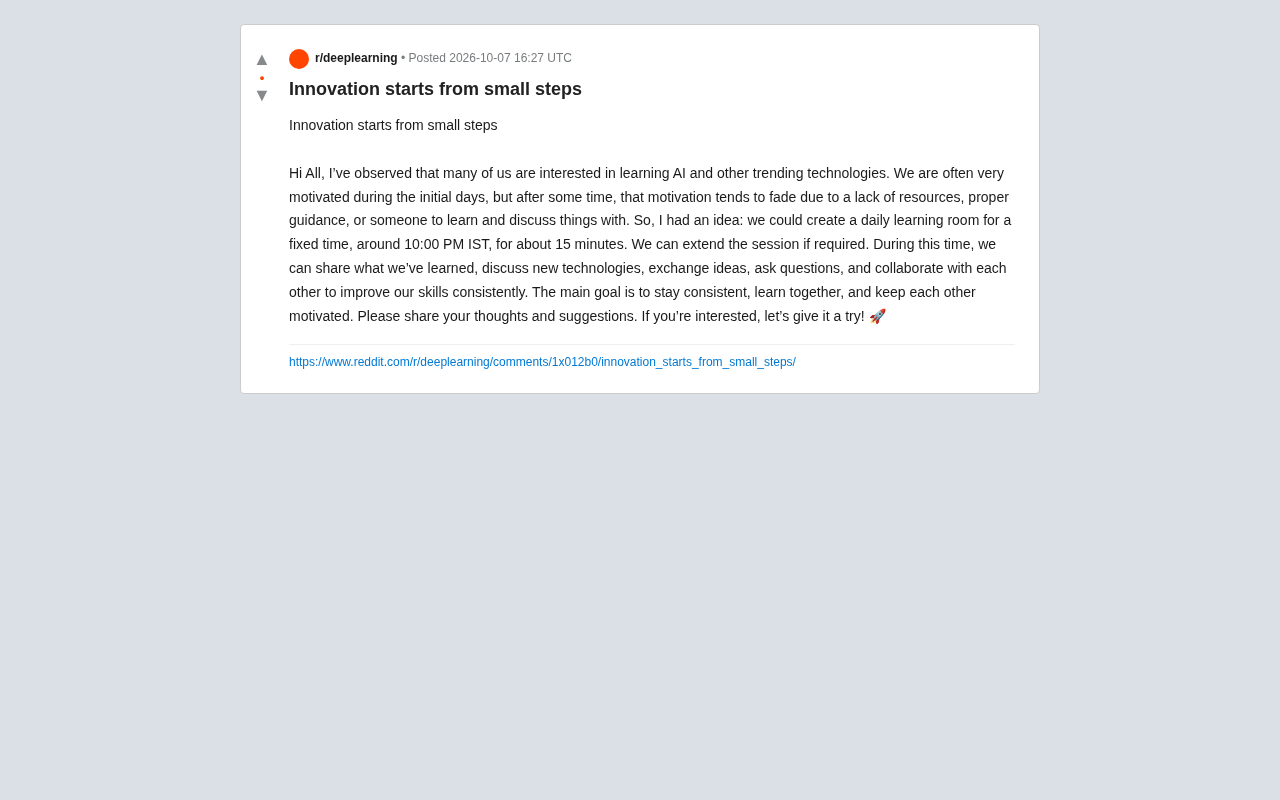
The poster observed that many people are genuinely interested in learning AI and other trending technologies, but that "initial motivation is high, yet after a while, enthusiasm fades due to a lack of resources, proper guidance, or simply having no one to learn and discuss things with." This is a remarkably common phenomenon, and one of the root causes behind low completion rates for online courses and abandoned learning plans.
A Community Study Group: A Simple but Effective Proposal
The core proposal in the post was to set up a "daily learning room": a fixed session at 10:00 PM IST every day, lasting about 15 minutes, with the option to extend when needed. During this time, participants could share what they learned that day, discuss new technologies, exchange ideas, ask questions, and collaborate — all in service of continuously building their skills.
The design of this proposal has a few details worth noting. First and foremost, the time commitment is short — a 15-minute threshold is low enough that it doesn't create additional burden for participants, perfectly in line with the "start small" philosophy. Second, the fixed time builds a regular habit, and habit formation is precisely the key mechanism for countering motivation decay.
The poster made clear that the primary goals are "to maintain consistency, learn together, and motivate one another." In other words, the idea is to use the power of community to solve the problem of individual self-discipline.
Why Going It Alone Is So Hard
From a learning science perspective, the poster's intuition is well-grounded. The biggest enemy of solo learning isn't intelligence or time — it's the sustainability of motivation. Research consistently shows that learning without immediate feedback, social commitment, or accountability mechanisms is difficult to sustain over the long run.
When learning becomes a solitary activity, no one notices if you stop, and no one is there to help when you hit a wall. The AI field moves fast and covers a lot of ground; beginners can easily find themselves stranded when they get stuck, and that sense of frustration rapidly erodes the enthusiasm they started with.
Community-based study directly counters these issues:
- Social commitment: Participating publicly creates a mild sense of accountability, making it harder to quit halfway;
- Real-time discussion: Questions can be addressed on the spot, reducing the frustration of getting stuck;
- Cross-pollination of knowledge: Different participants sharing their own learning journeys quickly broadens everyone's perspective;
- Emotional support: Mutual encouragement provides an extra push during low-motivation periods.
There's an important concept in learning science called the "Accountability Partner" — the idea of forming a mutual monitoring commitment with another person to improve goal completion rates. Psychological research shows that when someone publicly declares their learning plan and sets regular check-in points, their completion rate is significantly higher than with purely personal commitments. Research by American psychologist Gail Matthews found that people who made commitments to others and regularly updated their progress achieved their goals at a rate roughly 33% higher than those who simply kept their goals to themselves. This also explains why learning communities with "check-in" mechanisms tend to sustain user engagement far better than open forums — fixed timing, public records, and immediate feedback together hit the core elements of the behavioral psychology concept known as the "Habit Loop": cue, routine, reward.
The Practical Logic Behind the 15-Minute Format
The smartest aspect of this proposal is the "15 minutes" specification. Many learning plans fail precisely because the goals are set too high — two hours a day, finishing an entire textbook — these grand ambitions collapse easily against a busy schedule.
By contrast, a 15-minute micro-habit has almost no startup friction. Its value isn't in how much you can learn in a single session, but in maintaining an unbroken "streak." Once the routine is established, many people naturally start extending the time they invest — which is exactly what the poster meant by "extend when necessary."
That said, self-organized communities like this face real challenges. Time zones are one issue (a fixed IST time isn't friendly to participants in other regions), sustaining the organizer's ongoing commitment is another, and keeping the room active as novelty wears off is the biggest long-term test. Many similar study groups ultimately go through the same "enthusiasm decay curve" as individual learners.
The concept of "Micro Habits" was systematically articulated by behavior change researcher Stephen Guise, whose core insight is to shrink goals down to a size too small to refuse, thereby bypassing the brain's natural resistance to high-difficulty tasks. A daily 15-minute learning room is a direct expression of this logic. There's also a related cognitive science phenomenon called the "Zeigarnik Effect": people remember and ruminate on unfinished tasks more vividly than completed ones. Short group study sessions leverage this effect — when a 15-minute discussion ends, participants often leave with questions still unanswered, and that sense of incompleteness actually motivates them to keep exploring before the next session, creating a positive learning cycle.
What This Means for AI Learners
Regardless of whether this particular proposal succeeds, the ideas it conveys are valuable for any technical learner. In an era where AI technology evolves at a relentless pace, continuous learning is no longer optional — it's a baseline requirement for practitioners. And more often than not, what matters isn't finding the "best course" or the "most comprehensive resources" — it's finding an approach that lets you actually keep going.
Whether that means joining a community study room like this one, finding a learning partner, participating in open source communities, or building your own micro-habits, the underlying logic is the same: lower the barrier, stay consistent, and use external forces to counter motivation decay. As the post title says, innovation starts from small steps — and in the realm of technical learning, consistent small steps often carry you further than the occasional giant leap.
Related articles

Free Unlimited Claude Code Solution: Agnes AI + CC Switch Setup Guide
No paid subscription needed — pair the free AI platform Agnes AI with the open-source tool CC Switch to provide a backend for Claude Code, enabling unlimited free calls to text, image, and video models. This guide covers the full setup, test results, and usage boundaries.

A Complete Zero-Cost Guide to Getting Started with Claude Code for Beginners in China
A beginner's guide to Claude Code for users in China: two installation methods (command line and IDE plugin), full configuration steps for replacing the official API with the free domestic LongCat model, and a hands-on demo of building a small tool with natural language, plus tips.

When the NSA Gets Involved: The AI Supply Chain Crisis Behind Open-Source CVEs and API Key Hijacking
Multiple open-source projects disclosed severe CVEs in one day, PHP flaws alarmed the FBI, and Railway and OpenCode were breached with API keys stolen. This article breaks down the vulnerability window, AI-accelerated exploitation, and the AI supply chain crisis behind the API key black market, with a developer defense checklist.