Why LangChain Is Essential for LLM Applications: A Guide to Core Concepts

How LangChain bridges the gap between calling LLM APIs and building production-ready applications.
The article explains LangChain's value from an engineering standpoint: while raw LLM API calls work for simple tasks, they quickly become unmanageable for multi-step workflows, private data access, and multi-tool orchestration. LangChain offers five core modules — Prompt Templates, Chains, Memory, RAG, and Agent+Tools — making LLM capabilities reusable, extensible, and maintainable. RAG reduces hallucinations by grounding responses in retrieved knowledge, while Agents use the ReAct architecture to dynamically reason and act. Real deployments exist in e-commerce, insurance, and finance. The key takeaway: raw API calls suffice for experimentation, but productizing LLMs requires a framework.
If you already know how to call OpenAI, DeepSeek, or Qwen APIs and can get a model response with just a few lines of code, you might wonder: why bother learning LangChain? This article examines LangChain from an engineering and production perspective — covering its core purpose, key modules, and real-world enterprise use cases — to help you understand the critical gap between "calling an API" and "building a product."
Why Raw API Calls Can't Support Enterprise-Grade Projects
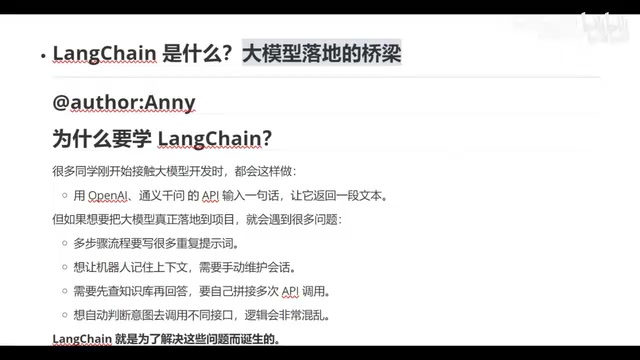
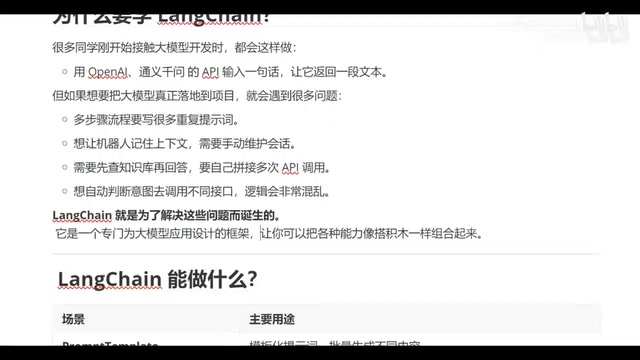
Most developers start by calling LLM APIs directly, and for simple use cases, that works fine. But as requirements grow more complex and workflows multiply, the cracks start to show: conditional logic scattered everywhere, prompts stitched together ad hoc, manual result-passing between multiple API calls — and before long, the codebase becomes an unmaintainable mess.
The course instructor uses a vivid analogy to explain where LangChain fits in: a large language model is like a brilliantly knowledgeable expert — great at history, coding, writing proposals — but it's a "bare brain." It has no idea how your company operates, can't remember what you discussed last time, and can't access your internal documents or databases.
LangChain acts as the "connector" that links this expert to your private enterprise data and business workflows. It transforms LLMs from isolated tech demos into tools that can actually be deployed in real-world applications. The instructor emphasizes this point repeatedly: LLMs must be grounded in real use cases, or they remain nothing more than a floating technology.
What LangChain Actually Does: Five Core Modules
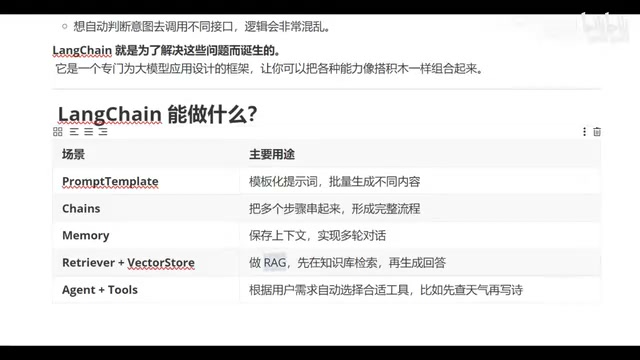
LangChain's core philosophy is combining capabilities like building blocks. The instructor breaks down the most commonly used modules, each addressing a specific category of real-world needs.
Prompt Templates
Turn prompts into reusable templates. If you need to batch-generate introductions, emails, or product ads, you only change the variable parts of the template — the rest of the prompt stays the same — making it easy to produce content at scale across different scenarios.
Chains
Link multiple steps into a complete workflow. For example: a user inputs some text, the model first classifies the sentiment as positive or negative, then generates a comforting response based on that sentiment. With raw API calls, you'd write multiple requests and manually pass results between them. With Chains, you can wire "sentiment classification + response generation" together in a single pipeline.
Memory
Persist context to enable multi-turn conversations. If a user says "We talked about my insurance policy last time — can you look up the claims process?" a model without Memory will have no idea what they're referring to. With Memory, it can recall previous exchanges and continue the conversation naturally.
Retrieval + Vector Store
Search a knowledge base first, then generate answers based on the retrieved results — this is what's commonly known as RAG (Retrieval-Augmented Generation). The instructor highlights that RAG's core value is mitigating the hallucination problem in LLMs: while models are highly capable, their knowledge is limited and they can fabricate information; RAG helps ground responses in real, verifiable content.
It's worth briefly explaining how vector storage works. Before text is stored in a knowledge base, it's first converted into high-dimensional numerical vectors by an embedding model — semantically similar content ends up closer together in vector space. When a user asks a question, the query is likewise converted into a vector, and the system retrieves the nearest passages from the database to use as context, which are then bundled into the prompt sent to the LLM. This process typically relies on vector databases like FAISS, Chroma, or Pinecone. Unlike traditional keyword search, vector retrieval captures semantic meaning rather than literal word matches — for instance, "how do I get reimbursed" and "claims process" may share no common words but can still be identified as similar questions and matched to the same document.
Agent + Tools
Automatically determine which tool to call based on user intent. Take this example: "Check the weather in Beijing and describe it in a poetic way." An Agent identifies two intents — checking the weather and expressing it poetically — then calls the weather API to retrieve data before generating a lyrical description.
Without an Agent, you'd have to hard-code extensive conditional logic and bake the entire processing flow into your prompt, making it difficult to scale. The instructor mentions that Agents are built on a key architecture called ReAct, which stands for Reason + Act — the model thinks and acts simultaneously, intelligently deciding which tool to call at each step.
ReAct was introduced in 2022 by Google and Princeton University as a prompting strategy. Its core idea is to have the model output a "Thought" at each step before deciding which "Action" to take; the result of that action feeds back into the next round of reasoning, cycling until the task is complete. This "think–act–observe" loop lets the model decompose complex tasks and dynamically adjust its strategy, rather than having all the logic hard-coded in a single prompt. LangChain's AgentExecutor is built on exactly this mechanism: in each loop iteration, the model decides which tool to invoke (such as a search engine, calculator, or database query), evaluates the result, and then decides whether to call another tool or deliver a final answer.
Real Enterprise Use Cases
For those wondering whether any companies actually use these frameworks in production, the instructor offers several real-world industry examples:
- Cross-border e-commerce: Using LangChain to build multilingual FAQs — retrieving from multilingual product documentation first, then having the LLM generate responses;
- Insurance companies: Retrieving policy clauses and generating plain-language explanations users can understand — especially useful for industries with heavy technical terminology like finance, legal, and automotive;
- Financial services: Scraping market data and morning meeting content to generate analytical reports and client-facing investment recommendations.
What these scenarios share is the need for private data access, multi-step workflows, and multi-tool orchestration. The instructor's recommendation for choosing a framework: when you're dealing with complex scenarios involving multiple tools and multi-step processes, LangChain is a strong first choice.
Raw API vs. Framework: The Gap in Reusability and Scalability
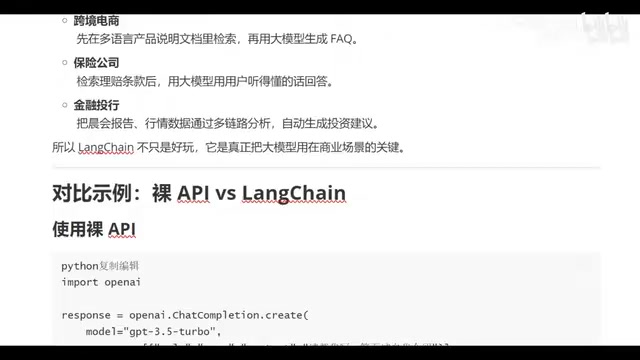
The instructor compares both approaches. Writing a "job interview self-introduction" generator with raw API calls (using Python and gpt-3.5-turbo) isn't difficult — but the moment you want to add an analysis step before generation or translate the output into English afterward, you're back to writing multiple calls and manually wiring results together, and the code quickly becomes unwieldy.
With LangChain, changing the requirement is as simple as updating the topic variable in your template. Adding steps means chaining new components together. The instructor's conclusion: LangChain's most important contribution is making LLM capabilities reusable, extensible, and organized — like giving a large language model a flexible operating system.
The word "organized" has a more concrete engineering meaning: testability and observability. In a raw API approach, prompt assembly, call logic, and business rules often sit tangled in the same block of code — when something breaks, it's hard to pinpoint where. LangChain abstracts each step into an independent component, so developers can unit-test individual Chains or Tools in isolation, and use companion tooling like LangSmith to trace inputs, outputs, latency, and token usage at every step. For enterprise projects that require continuous iteration, this observability advantage over raw API code often has a greater long-term impact on maintenance costs than any single feature.
Summary
The core lesson here isn't about writing code — it's about forming a clear judgment: if your goal is to experiment or get quick answers, raw API calls are perfectly fine. But if you want to productize and operationalize LLM capabilities for real business use, a framework is almost unavoidable.
The course will continue with hands-on projects built from scratch — setting up the environment, building a RAG document Q&A system, and a writing assistant. The instructor also poses a reflective question: if you were to build something with LangChain, what problem in your work or daily life would you most want to solve? This is actually the most important thing to think through before learning any framework — start with a real problem you want to solve, and the framework will make sense.
Related articles

JobRunner MCP Server: AI Agents Can Now Fix Failed Java Jobs
JobRunner launches an open-source MCP server enabling AI agents to view cluster status, diagnose failures, and recover Java jobs—incident response from any cloud coding environment or existing agent.

MLAI Digital Launches 9 Security Agents: MCP Server Safeguards the Full Lifecycle of Agentic AI
MLAI Digital launches Security MCP Server with nine built-in specialized security agents covering vulnerability discovery, attack simulation, prompt injection detection, API and infrastructure assessment, and accelerated remediation—embedding security validation across the full Agentic AI lifecycle from development to production.

Running Isaac Lab on H100 GPUs: Exploring Better Approaches
Exploring optimization methods for running Isaac Lab on NVIDIA H100 GPUs, including MIG configuration, mixed precision, TensorRT acceleration, and community experience to improve robotics simulation and reinforcement learning efficiency.