Why Not Cut the 25-Paper Submission Cap to 2-3?

As AI makes papers cheap to produce, CVPR's 25-paper author cap is criticized for rewarding wide-net casting and worsening review burdens—should it drop to 2-3?
A Reddit discussion questions CVPR 2027's 25-paper-per-author submission cap in the AI era. The poster argues the quota lets researchers hedge against review randomness by batch-submitting questionable papers, and that counting per author rather than per first author lets teams exceed limits. The article examines a counterfactual of limiting first-author submissions to 2-3, which would raise per-paper quality, ease review burdens, and shrink arbitrage—while noting reform faces institutional inertia and competing interests.
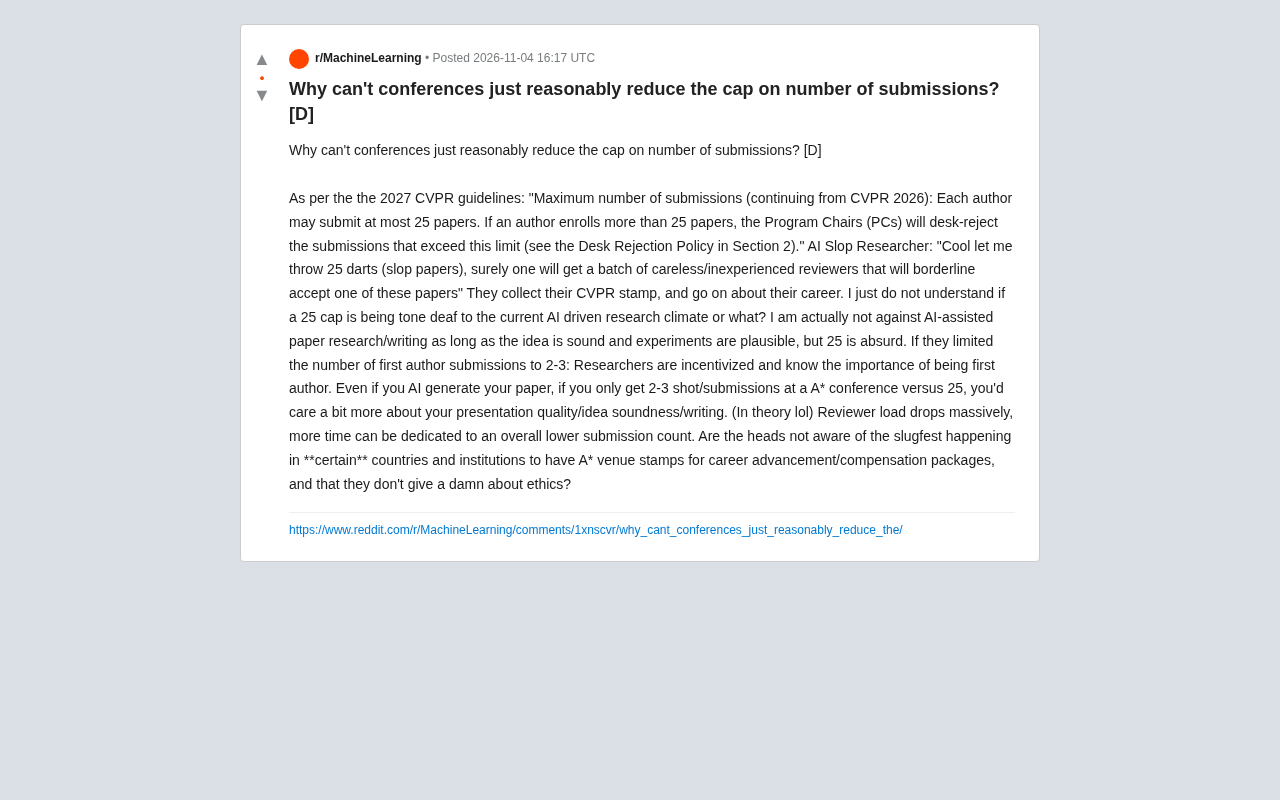
The Absurd Reality of a 25-Paper Submission Cap
In the machine learning community on Reddit, a researcher raised a pointed question: since AI-assisted writing has made paper production easier than ever, why can't top conferences lower the submission cap from 25 to a more reasonable number?
According to the CVPR 2027 call for papers (continuing the CVPR 2026 policy), each author may submit up to 25 papers. Submissions exceeding the limit will be desk-rejected by the program chairs. The poster paints a troubling scenario: a researcher chasing "AI slop papers" can fling out 25 questionable manuscripts like darts, betting that sooner or later a careless or inexperienced reviewer will let one slip through. Once they secure a CVPR acceptance badge, they can keep advancing their career.
This description isn't pure sarcasm. It touches on a structural contradiction the academic publishing system faces in the AI era: when the cost of generating papers approaches zero while the rewards of acceptance remain significant, the submission cap itself becomes a lever that needs re-examination.
CVPR (IEEE/CVF Conference on Computer Vision and Pattern Recognition) is a top conference in computer vision, known alongside ICCV and ECCV as the "Big Three," and is listed as a Class A conference in the China Computer Federation (CCF) recommendation list. CVPR submissions have surged in recent years, surpassing 10,000 in 2024, with an acceptance rate of around 20%. The conference uses double-blind review, typically assigning 3 reviewers per paper, most of whom are active researchers in the field participating voluntarily. The submission cap policy is set by the Program Chairs to balance submission freedom with review resources. A "desk-reject" means a manuscript is rejected directly by the program chairs without entering peer review, usually for violations of formatting, ethics, or submission count limits.
Why the Submission Cap Fails
The poster's core challenge is: is the 25-paper cap tone-deaf to the current AI-driven research environment?
From an institutional design perspective, the original intent of a submission cap was to prevent a tiny minority from abusing the submission channel and hogging review resources. But the number 25 may have been sufficiently permissive before AI-assisted writing became widespread—yet today it can become a kind of "legal fence" that allows individuals or teams to release manuscripts in near-industrial fashion while pushing the review system's capacity to its limit.
More troublesome is the incentive structure. The poster points out that in certain countries and institutions, A* conference acceptances are directly tied to career advancement and compensation, and some people don't care about the boundaries of academic ethics. When the payoff of "getting the badge" far exceeds the reward for "doing solid work," batch submission becomes a rational strategy. The 25-paper quota isn't a ceiling—it's treated as a starting line.
Here's an easily overlooked detail: the submission cap is calculated per "author." If a collaborative team has multiple co-authors, the total submission count can easily exceed 25. The poster doesn't elaborate on this point but hints at the granularity problem—limiting by author rather than by first author may drastically weaken the effect.
A* conference refers to conferences rated at the highest level in a particular academic evaluation system. In the China Computer Federation (CCF) recommendation list, Class A is the highest level; internationally, Australia's ERA ranking and Microsoft Academic ranking also use A* to denote top conferences. Some universities and research institutions treat A* conference acceptances as hard requirements or important bonus points for doctoral graduation, tenure evaluation, talent recruitment, and performance rewards, creating an incentive structure that worships "paper badges." This evaluation approach makes the acceptance record itself a scarce resource rather than the paper's actual scholarly contribution, thus spawning submission strategies that bet on quantity for probability.
What Would Happen If the Cap Dropped to 2-3
The poster proposes a direct counterfactual: what if top conferences only allowed 2-3 first-author submissions?
First, researchers would be forced to value the weight of first authorship. With only two or three shots, every submission's topic quality, experimental design, and writing presentation would receive more serious attention. The poster admits this inference is somewhat idealistic (he adds a "theoretically haha" footnote), but the logic holds: scarcity raises the decision cost of each submission.
Second, the review burden would drop significantly. A reduced total submission volume means each paper can be allocated more review time and attention, and review quality is expected to improve. This forms a closed loop with the poster's criticism that "careless reviewers let slop papers through"—reducing submission volume isn't just about saving effort; it directly improves the quality of the review signal.
Third, the arbitrage space for batch submissions would be compressed. When a person can only submit 2-3 papers, the strategy of hedging against review randomness with quantity no longer works. The poster emphasizes that he is not opposed to AI-assisted research and writing itself, provided the ideas hold up and the experiments are credible. The problem isn't the tool—it's that the 25-paper quota effectively rewards "casting a wide net" rather than "digging deep."
First author in an academic paper usually refers to the researcher who contributed the most, undertaking the main experimental design, implementation, and writing. In academic evaluation, first authorship often carries more weight than co-author status, especially in promotion and graduation assessments. The current CVPR 25-paper cap is calculated per "author," meaning every listed author (including middle authors) has a 25-paper quota, and collaborative teams can greatly exceed the total limit through multiple authorship. If changed to limit first-author submissions to 2-3, it would directly constrain an individual's ability to batch-submit as first author, but co-authors could still circumvent the limit by participating in others' papers, so policy design must also consider authorship rules and contribution statement mechanisms.
Institutional Inertia and Multi-Party Games
The poster finally throws the question to conference organizers: are they aware of the fierce competition for A* badges in certain regions and institutions, and the indifference to ethics among some of those involved?
The difficulty of this question lies in the fact that adjusting the submission cap involves multiple interests. Conference organizers want to maintain submission scale and influence, institutions need acceptance numbers to support rankings, and individuals need badges to advance their careers. Lowering the cap is logically clear but faces heavy resistance in the game of interests. The poster doesn't offer a solution—his contribution is laying out the contradiction: when AI makes paper production cheap, should the conference system continue using permissive submission quotas to pretend everything is as before?
There's no simple answer to this question, but it deserves serious consideration from every submitter and reviewer.
One-line Summary
In the AI era, cheap paper production has led critics to say CVPR's 25-paper author cap rewards wide-net casting and worsens review burdens—it should drop to 2-3.
Paragraph Summary
The article centers on a Reddit machine learning community discussion: CVPR 2027 continues the cap of 25 submissions per author, and the poster questions whether this quota has become ineffective now that AI-assisted writing makes paper generation nearly costless. The article analyzes how the 25-paper cap lets researchers hedge against review randomness with quantity and batch-release questionable manuscripts to gamble on acceptance odds, and notes that counting per author rather than per first author lets collaborative teams easily exceed limits. The poster proposes a counterfactual of limiting first-author submissions to 2-3, arguing scarcity would improve individual paper quality, reduce review burden, and compress arbitrage space. Finally, the article notes that reform faces multi-party games involving conference scale, institutional rankings, and individual promotions, making institutional inertia hard to break.
Related articles

9 AI Subscription Plans Compared: The Real Cost Per 100M Tokens Revealed
Bilibili creator tests 9 AI subscription plans from Volcano, Alibaba, Tencent, Baidu, Zhipu, Xiaomi, MiniMax and more, converting them all to real cost per 100M tokens, breaking down fixed-quota vs. three-tier coefficient billing and how caching, time-of-day discounts, and window limits affect actual quota.

Vibe Coding for Beginners: Expressing Intent Instead of Handwriting Code
What is Vibe Coding? A 137-episode Bilibili course defines it: the core is expressing intent, not writing code. This article analyzes Vibe Coding's productivity logic, target audience, and entry expectations to help beginners decide if it's worth learning.

LangChain Beginner's Guide: An Agent Development Roadmap from LangGraph to Deep Agents
Clarify the encapsulation relationship among LangChain, LangGraph, and Deep Agents, and master the learning path and selection logic for agent development frameworks—suitable for beginners in large model development.