Why RAG Falls Short for GTM Agents: The Leap from Information Retrieval to Expert Reasoning
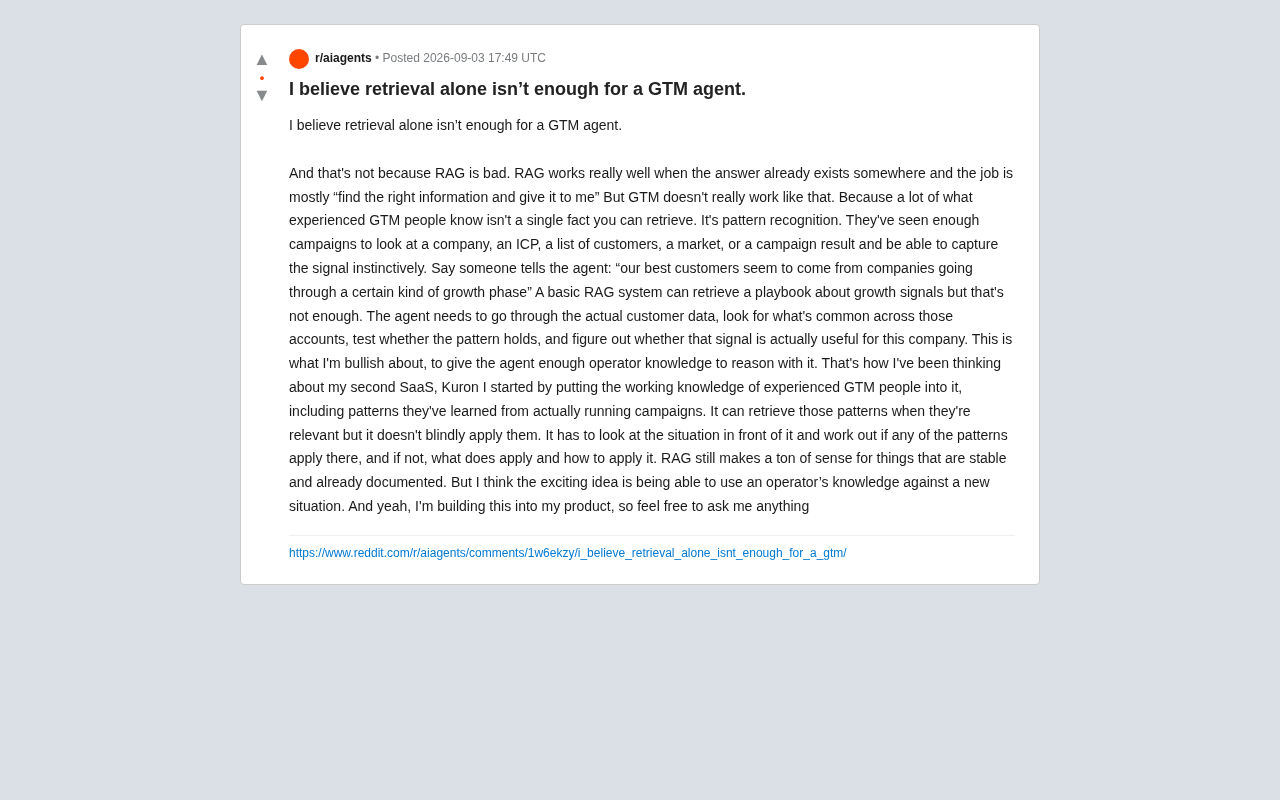
GTM agents need expert reasoning over new contexts, not just retrieval of existing answers.
Sparked by a Reddit post from a GTM agent developer, this article argues that RAG (Retrieval-Augmented Generation) is insufficient for GTM use cases that depend heavily on experiential intuition. Senior GTM practitioners excel at pattern recognition — finding commonalities in customer data, validating hypotheses, and applying experience to novel situations. This tacit knowledge can't simply be stored in a vector database and retrieved. The author's product Kuron takes a more advanced approach: structuring operator know-how into reasoning-ready patterns, then having the agent evaluate their applicability before acting. The article proposes a three-tier agent capability model — retrieval, pattern matching, and contextual reasoning — arguing that GTM requires the highest tier, and calling on the industry to move from information retrieval toward expert reasoning.
Introduction: Retrieval Is Not Intelligence
In the current wave of AI agents, RAG (Retrieval-Augmented Generation) has become almost the default technical foundation. The logic is straightforward: store knowledge in a vector database, retrieve the most relevant snippets when a user asks a question, and hand them off to a large language model to generate an answer. For most scenarios where "the answer already exists somewhere," RAG performs exceptionally well.
But a developer building a GTM (Go-To-Market) agent raised a thought-provoking point on Reddit: RAG alone isn't enough to build a great GTM agent. This isn't because RAG itself is flawed — it's because the very nature of GTM work isn't about "finding information." It's about pattern recognition.

RAG works in three steps: documents are chunked into small segments and converted into high-dimensional vectors via an embedding model, then stored in a vector database; when a user asks a question, it's also vectorized and the system retrieves the most relevant segments using algorithms like cosine similarity; finally, those segments are concatenated into a prompt as context, and a large language model generates the final response. This architecture is highly effective for "knowledge Q&A" scenarios — it mitigates hallucinations and reduces reliance on a model's pretrained parametric knowledge. But RAG's core assumption is that the answer already exists somewhere in the document store and just needs to be found. When an answer requires reasoning, comparison, and validation to be generated, the ceiling of RAG becomes starkly apparent.
The Unique Nature of GTM Knowledge: Intuition, Not Facts
Experiential Knowledge Can't Simply Be Retrieved
The author's central argument is this: the knowledge that seasoned GTM professionals possess is rarely a single "retrievable fact." It's a pattern recognition capability built through years of accumulated experience.
They've seen enough campaigns, accounts, ICPs (Ideal Customer Profiles), and market outcomes that when faced with a new company, a customer list, a market segment, or a set of campaign results, they instinctively pick up on the critical signals. This capability is closer to "intuition" than to "knowledge entries."
Here's an example: when someone tells an agent, "our best customers all seem to come from companies at a particular stage of growth" —
- A basic RAG system will retrieve a marketing playbook about "growth signals";
- But that's nowhere near enough.
This kind of hard-to-articulate experiential knowledge is what cognitive science typically calls "tacit knowledge" (Tacit Knowledge), a term coined by philosopher Michael Polanyi, in contrast to "explicit knowledge" that can be clearly articulated. Tacit knowledge is especially pronounced in GTM: veterans can sense that "this customer is about to churn" or "this market window has already closed," yet they'd struggle to write that judgment down in a document for others — or a system — to directly apply. This is the structural limitation of RAG: vector databases excel at storing and retrieving explicit knowledge, but have no mechanism for tacit knowledge. Translating expert experience into structured patterns that machines can reason over is one of the most central challenges in agent engineering today.
What the Agent Actually Needs to Do
Faced with that scenario, a competent GTM agent should:
- Dig into real customer data, not generic playbooks;
- Find commonalities across those accounts, identifying hidden patterns;
- Verify whether that pattern actually holds, rather than assuming;
- Determine whether that signal is genuinely useful for this particular company.
This is a reasoning process, not a retrieval process. Retrieval gives you a ready-made answer; reasoning applies knowledge to situations it has never encountered before.
Kuron's Approach: Turning Operator Knowledge into Reasoning Capability
The author put this philosophy into practice in Kuron, his second SaaS product. His construction path is instructive:
Step 1: Inject "Operator Knowledge"
He first loads the working knowledge of experienced GTM practitioners into the system — including the pattern libraries distilled from running real marketing campaigns. These aren't abstract theories; they're battle-tested insights from hands-on execution.
Step 2: Retrieve Without Blindly Following
The critical distinction: Kuron retrieves these patterns when relevant, but never applies them blindly.
It must examine the specific situation at hand and evaluate:
- Which existing patterns apply to the current context?
- If none apply, what does?
- How should they be applied?
This mechanism of "first judging applicability, then deciding how to apply" is precisely what differentiates it from ordinary RAG systems. Retrieval provides candidate patterns; reasoning determines the final action.
In AI engineering, this architecture is sometimes called "knowledge graph-augmented reasoning" or, more broadly, a "Neuro-Symbolic AI" approach: expert experience is encoded as structured rules or pattern libraries, which the model dynamically invokes and combines during the reasoning phase rather than returning all at once during retrieval. Compared to pure RAG, this path carries higher engineering complexity — it requires significant upfront effort to structurally organize expert knowledge during the knowledge capture phase — but it yields stronger generalization. The system can judge the applicability boundaries of existing knowledge in novel, unseen contexts, rather than mechanically forcing a fit.
RAG Still Matters — Just Not Everything
It's worth emphasizing that the author doesn't dismiss RAG's value. He explicitly states:
RAG still makes a lot of sense for content that is stable and already documented.
In other words, in scenarios where knowledge boundaries are clear and answers are definitive, RAG remains an efficient and reliable choice. The truly exciting frontier is applying operator knowledge to brand-new contexts — and that's exactly the leap from "information retrieval" to "expert reasoning."
A Deeper Question: The Capability Layers of Agents
This Reddit discussion actually surfaces a problem that's broadly overlooked in AI agent design today: we over-rely on retrieval and underestimate reasoning.
We can roughly break down agent capabilities into three layers:
| Level | Capability | Use Case |
|---|---|---|
| L1 Retrieval | Find existing answers | Document Q&A, knowledge base queries |
| L2 Pattern Matching | Recognize similar contexts and apply known experience | Routine business judgment |
| L3 Contextual Reasoning | Validate and combine knowledge in new contexts | GTM, strategic decisions, complex domains |
For a field like GTM that relies so heavily on experiential intuition, staying at L1 is clearly insufficient. A genuinely valuable GTM agent needs L3 capability — the ability to take a library of expert knowledge, face a never-before-seen market situation, and independently determine which experiences hold, and which need to be adjusted.
Conclusion
At its core, this developer's argument is a reminder to the entire industry: the value of knowledge lies not in being stored, but in being applied appropriately. RAG solves the problem of "knowing." But what a GTM agent truly needs is the ability to "know how to use it."
As more and more products treat "plugging in RAG" as the finish line of AI capability, perhaps we should be asking: how do we make agents reason, validate, and make judgments about new problems the way a seasoned operator would? That's the real watershed between an "information tool" and an "intelligent partner."
Related articles
Claude Code Adds Agent View: A Research Preview for Unified Session Management
Claude Code's new Agent View feature (research preview) consolidates all coding sessions into a unified list, advancing AI tools toward multi-agent orchestration.
Open-Source Python SDK: Measuring AI Agent Reliability with SRE Principles
Agent Reliability is an open-source Python SDK that applies SRE's SLO and error budget concepts to AI Agent evaluation, with PASS/FAIL/UNKNOWN states, CI assertions, and zero forced dependencies.
MiniMax RefMod: A Complete Guide to Training-Free Reusable Identity Workflows
MiniMax RefMod offers training-free reusable identity workflows for image, video, and audio generation. Includes Runpod template and tutorial for quick setup.