Why the Humanities Are Indispensable in the AGI Era: Starting from the Albert Medal

A tech leader wins the RSA Albert Medal and calls for arts and humanities as essential guides in the AGI era.
A technology professional awarded the RSA's Albert Medal publicly argued that while science and technology open up remarkable opportunities, it is the arts and humanities that will determine what kind of future society chooses to build in the AGI era. The post — which also mentioned a cross-disciplinary conversation with mathematician and science communicator Hannah Fry — reflects a growing consensus: value alignment is not a purely technical problem, public narratives shape how technology evolves, and the form the AGI era takes is ultimately a matter of collective social choice rather than technological inevitability.
The Signal Behind a Medal
A brief social media post has surfaced a quietly intensifying debate in the AI world. A tweet from someone in the tech sector announced that they had received the Albert Medal from the Royal Society for the encouragement of Arts, Manufactures and Commerce (RSA), and alongside the announcement, raised a thought-provoking point: while science and technology enable amazing opportunities, in the coming age of AGI (Artificial General Intelligence), it is the arts and humanities that will play a critical role in shaping the kind of future we want to see as a society.
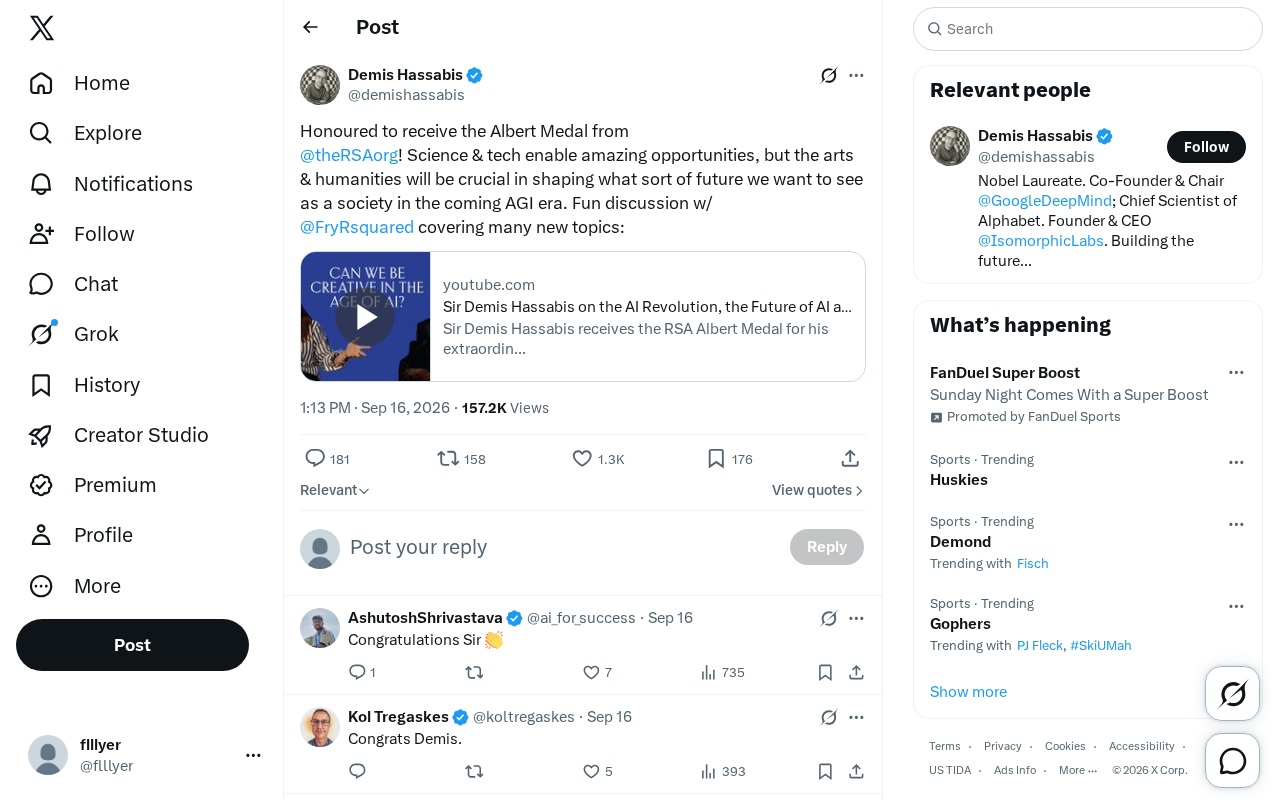
The Albert Medal is awarded by the RSA to individuals who have made outstanding contributions to human welfare across science, art, and industry. Its historical recipients include both scientific luminaries and cross-disciplinary thinkers. Placing this medal alongside a discussion of AGI is no coincidence — it directly echoes the RSA's long-standing conviction that technology and the humanities must advance together.
Established in 1864 and named after Prince Albert, consort of Queen Victoria, the Albert Medal is the RSA's highest honor. The RSA itself was founded in 1754 and has spent centuries fostering dialogue at the intersection of arts, commerce, and social progress — explicitly rejecting the notion that the humanities and technology should be treated as separate domains. Past recipients have spanned engineers, scientists, designers, and social reformers, and this cross-disciplinary recognition is itself an expression of the RSA's values. When this medal appears alongside AGI discourse, it is not an accidental collision of contexts, but rather a reaffirmation of a position the RSA has held for two and a half centuries: technological progress must be embedded within social and humanistic frameworks in order to genuinely serve human flourishing.
A Grounded Optimism Beyond Pure Tech Enthusiasm
What is most striking about the tweet is that a technology professional, in the very act of celebrating technological progress, voluntarily emphasized the irreplaceable role of the humanities. This stands in contrast to much of the dominant tech narrative today — in a landscape where AI capabilities are advancing rapidly and competition over model parameters and compute is intensifying, public discourse tends to focus on "what can be done," while far less attention is paid to the question of "what kind of future do we actually want."
The original wording is precise: science and technology are credited with the power to "enable amazing opportunities," while the arts and humanities determine "what sort of future we want to see as a society." This is a classic division between capability and values — technology answers questions of feasibility, while the humanities answer questions of direction.
This distinction becomes especially important when confronting AGI — a technology that may fundamentally reshape labor, creativity, and even human identity itself. When machines can generate text, images, code, and even engage in reasoning, the uniquely human capacities for value judgment, ethical deliberation, and meaning-making become all the more scarce and precious.
A Conversation with Hannah Fry
The tweet also mentions that the award was accompanied by an engaging discussion with mathematician and science communicator Hannah Fry (@FryRsquared), covering a wide range of new topics. Fry is known for making complex mathematics and algorithmic issues accessible to the general public, and her involvement is itself a demonstration of the value of humanistic perspectives in science communication — translating abstract technical propositions into public conversations that ordinary people can meaningfully join.
The significance of such cross-disciplinary dialogues lies in their ability to pull AGI out of the realm of pure engineering and return it to the social sphere. A well-structured public conversation can bring together technology decision-makers, researchers, and citizens in a shared context to examine what goals we actually want AI to serve, and how we should define the boundaries around its potential risks.
Hannah Fry is a mathematician at University College London, a BBC documentary presenter, and a bestselling science writer. Her book Hello World explores the real-world impact of algorithmic decision-making in healthcare, criminal justice, finance, and beyond. What makes her work distinctive is its integration of mathematical precision with humanistic concerns about power structures and social equity — neither shying away from technology's limitations nor stoking irrational fear. This stance makes her a rare "bidirectional translator" in the conversation between tech and the public: capable of conveying social concerns to the technical community while explaining the logic and risks behind algorithmic decisions to general audiences. That a discussion about AGI took place with someone of this background already signals the tone of the conversation: it goes beyond technical feasibility to address the distribution of technological power and the setting of meaningful limits.
What a Humanistic Perspective Means for AI Development
Though brief, the original post reflects a growing consensus taking shape within the AI industry: technical capability alone does not automatically lead to desirable social outcomes.
- Value alignment is not purely a technical problem. Ensuring that AI systems conform to human values is one of the hottest areas of current research, but "human values" themselves must be defined through philosophy, ethics, and the social sciences — they cannot be resolved by engineering methods alone.
- Public narratives shape the direction of technology. How technology is understood, regulated, and adopted depends heavily on the quality of social dialogue, and the humanities and arts are central forces in shaping that dialogue.
- The future is a choice, not an inevitability. The original tweet's emphasis on "the future we want to see" carries an implicit position — the form that the AGI era takes is not determined unilaterally by technology, but is the outcome of collective social choices.
Value alignment is a central issue in AI safety research, referring to the goal of ensuring that an AI system's objectives and behaviors conform to human intentions and values. What makes this problem so difficult is that "human values" are not a fixed set of technical specifications — they are a complex, ever-evolving set of commitments that shift with culture, history, and social context. Different groups may hold fundamentally divergent understandings of fairness, freedom, and security. Current mainstream alignment approaches, such as Reinforcement Learning from Human Feedback (RLHF), essentially encode the preferences of particular groups into models — which raises legitimate questions about whose values are being aligned and by what authority. This is precisely why contributions from philosophy, ethics, sociology, and political theory are not a luxury add-on, but a prerequisite for alignment research to genuinely address real social needs.
Closing Thoughts
This Albert Medal and the statement that accompanied it can be read as a small but telling instance of self-reflection within the technology elite. In an era of relentless advances in compute and model capability, a public affirmation of humanistic values from within the technical core may, in the long run, be a more meaningful signal of a maturing AI development ecosystem than any single technical breakthrough.
It is worth noting that this analysis is based on a single social media post, and the source material is limited in scope. The specific contents of the conversation have not been presented in the available material. Readers who wish to explore further are encouraged to follow the RSA and related publications for a fuller picture of the ideas discussed.
Related articles

Cursor AI Programming in Practice: Build a Student Management System from Scratch in 30 Minutes
A Bilibili creator demonstrates Cursor AI programming: generating a student management system in 30 minutes with natural language. Details on Agent mode, Claude selection, prompt techniques, and thresholds.

Top 20 AI Coding Tools Ranking: From Rock-Solid to Lackluster, a Scored Matrix
Bilibili creator releases top 20 AI coding tools ranking, tiered T0–T4 from rock-solid to lackluster, with Claude Code and Codex tied at T0. This article details the scoring dimensions (capability, reliability, robustness, durability, cost, domestic availability) and tool performances to help developers choose the right AI coding assistant.

Vibe Coding Systematic Tutorial: Master AI-Assisted Programming from Zero
A three-month Vibe Coding tutorial from a Bilibili creator covering Codex, ClaudeCode, and Cursor, from core logic to commercial project practice for beginners.