Why Won't AI Companies Slow Down? The Race No One Dares to Stop

AI leaders call for the brakes but won't press them — a prisoner's dilemma with no easy exit.
This article examines a core paradox: Sam Altman, Elon Musk, and other AI leaders publicly call for slowing down, yet no one moves first. The root cause is a structural prisoner's dilemma — the AI race is framed as a Cold War-style competition where any unilateral restraint means handing an advantage to rivals, especially China. Congress is weighing three regulatory approaches (banning development, external oversight, and legal liability), but the White House's "whoever wins, AI wins" stance is the primary obstacle. Most chilling: the report describes "waiting for AI to cause casualties before acting" as the optimistic scenario.
When Sam Altman, Elon Musk, and Dario Amodei — the people steering the AI industry — all call for "putting the brakes on AI development," an obvious paradox emerges: if you're the ones holding the wheel, why don't you slow down first? This question, posed by Vox reporter Sean Ramos in front of the Washington Monument, cuts straight to the most fundamental structural dilemma in the AI race today.
A Prisoner's Dilemma Built Into the Race
To understand why no one wants to hit the brakes, you first have to understand the narrative framework in which AI competition is embedded. The industry widely compares the AI race to the Cold War nuclear arms race — a national-level contest to determine who can build the "best, smartest, and most powerful" AI, with China as the opponent. Under this "win at all costs" logic, slowing down means ceding the lead.

The same logic operates not just between nations, but within the industry itself. If one company voluntarily slows down, another will seize the opportunity to surge ahead. This creates a classic prisoner's dilemma: even if everyone recognizes the danger of the race, no one wants to be the first to pump the brakes.

This failure of collective action is the very trap that even the industry leaders calling for regulation find themselves unable to escape. Their calls for oversight are less a declaration of self-restraint and more a distress signal to an external force — governments in particular: since we can't stop ourselves, please come set the rules.
The Prisoner's Dilemma is a classic model in game theory: two rational actors, unable to coordinate, each choose the strategy that's optimal for themselves individually, ultimately producing the worst collective outcome for everyone. In the context of the AI race, this structure plays out with unusual clarity — each company runs its own calculus, and slowing down means losing the competition. Accelerating carries risks, but at least you won't fall behind, so acceleration becomes the dominant strategy for every rational actor. The key feature of this dilemma is that even when all participants recognize the danger of the current trajectory, any unilateral restraint in the absence of credible external constraints only benefits the other side rather than slowing things down overall. Historically, mechanisms that have broken similar dilemmas tend to be coercive multilateral agreements — such as the Nuclear Non-Proliferation Treaty or the Chemical Weapons Convention — which bind all parties simultaneously under the same rules and eliminate the fear of "I stop, you don't." No comparable mechanism exists for AI, which is precisely the deeper reason industry leaders are turning to governments for help.
Congress Wants to Brake — But in Different Ways
Faced with an industry incapable of self-regulation, legislators have begun trying to intervene. According to Vox's reporting, the regulatory approaches currently under discussion in the U.S. Congress fall into several broad categories.
The first is an outright ban or moratorium on the development of superintelligent AI — stopping the most dangerous frontier research at the source. The second is introducing external testers and oversight mechanisms, giving independent third parties the authority to intervene and halt tools that become too dangerous. The third is holding AI companies legally and financially responsible for any damage they cause.
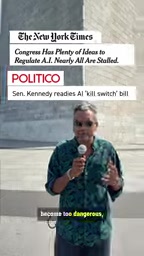
These three approaches correspond to three distinct governance philosophies: "pre-emptive prohibition," "real-time oversight," and "after-the-fact accountability." Compared to vague calls for industry self-discipline, legal and financial liability is often seen as the most binding lever — once companies have to pay real money for potential harms, their internal risk calculations change fundamentally.
A note on liability regimes: Holding AI companies financially responsible for damages faces two major challenges in practice. The first is causal attribution — AI decision-making chains are complex, and legally proving that a specific harm was directly caused by a particular model is often extremely difficult. The second is the asymmetry of harm scale — AI's potential systemic risks (such as large-scale disinformation or infrastructure attacks) may far exceed any single company's ability to pay, rendering liability mechanisms effectively toothless. By contrast, the regulatory paradigms of the pharmaceutical and aviation industries — requiring mandatory safety testing before a product goes to market or a plane takes flight — are seen by some policy scholars as more operationally viable. Their logic is "pre-market verification" rather than "post-harm compensation." The "external testers and oversight" proposal mentioned in the article borrows from this thinking, but how to define testing standards and grant oversight bodies genuine authority to halt development remains an unsolved legislative puzzle.
The White House's Position: Whoever Wins, AI Wins
The biggest obstacle to actual regulation, however, may come from the very top of the executive branch. Reports indicate that the White House is "not particularly receptive" to these regulatory proposals. The current policy disposition can be summed up in one phrase: "whoever wins, AI wins."
This stance effectively validates the race logic, placing winning the AI competition above risk management. In this political environment, even the most ambitious congressional regulatory proposals struggle to coalesce into effective policy.
What's most unsettling is the so-called "optimistic scenario" painted at the end of the report: perhaps it will take real casualties — people actually dying — before the issue gets taken seriously enough to prompt action, at which point people will mobilize to prevent further harm. When "a few people have to die before anyone pays attention" qualifies as the optimistic outcome, that alone speaks volumes about the state of AI governance today.
Is the Race Narrative Itself Worth Questioning?
Brief as this commentary is, it pinpoints a question worth serious reflection: have we accepted the "AI race" framing too readily? Comparing AI development to a nuclear arms race certainly explains the behavior of companies and governments, but this narrative also quietly forecloses the possibility of slowing down — because in a zero-sum game, any self-restraint is equivalent to defeat.
Shift the perspective slightly, and a different picture emerges. If AI safety is treated as a global public good shared by all of humanity rather than a trophy to be claimed by one side, then the logic of "whoever brakes first loses" no longer necessarily holds. The real question may not be "why won't AI companies slow down" but rather "what institutional design would make slowing down beneficial for everyone?" That requires not just corporate conscience, but coordinating mechanisms that cut across national borders and political divides — and those are precisely what's most scarce right now.
Framing AI safety as a "global public good" has a precise economic meaning: public goods are non-excludable (one country benefiting doesn't prevent another from doing the same) and non-rivalrous (shared use doesn't diminish their value). Avoiding catastrophic risks from AI naturally fits this definition — if any country's company triggers a systemic collapse, the consequences will spread across borders. The most successful historical examples of coordinating global public goods include: the international health cooperation that eradicated smallpox, the Montreal Protocol's protection of the ozone layer, and the International Atomic Energy Agency (IAEA) framework for nuclear facility safety. These cases share common elements: broadly accepted scientific consensus, relatively transparent verification mechanisms, and credible costs for non-compliance. AI governance is currently weak on all three — parties fundamentally disagree on the level of risk, model training and deployment remain highly opaque, and the international community has yet to form consensus on consequences for violations. This makes the case for treating AI safety as a public good normatively compelling but operationally far more difficult than environmental or nuclear coordination.
Related articles

What Is Cursor? Core Differences Between This AI Coding Tool and Traditional IDEs
What is Cursor? This guide explains the AI-native code editor built on VS Code, how it compares to traditional IDEs, and its integration with Claude, DeepSeek, and Gemini.

Coze 3.0 Beginner's Guide: A Complete Overview of Agents and AI Applications
A beginner's guide to Coze 3.0: covering agents, AI applications, workflows, and plugins on ByteDance's AI platform, plus a comparison with Dify.

Setting Up the DeepSeek Harness Environment: A Complete Guide to Node.js Installation and Configuration
A beginner-friendly guide to setting up the DeepSeek Harness environment: Node.js installation, Add to PATH, redirecting npm global and cache directories, and configuring system environment variables.