Will MCP Replace API? The Essential Difference Explained in 40 Seconds
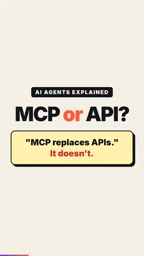
MCP is not a replacement for API but an abstraction layer on top of API designed for AI models.
Citing a 40-second video, the article clears up a popular misconception: MCP won't replace API. API users are human programmers who must read docs and write code, a fragmentation AI handles poorly. MCP servers list and describe their tools, offering self-describing capability and a unified protocol, so models learn once and use everywhere. Crucially, MCP servers still call ordinary APIs underneath — MCP is an AI-facing adaptation layer on top of API, not a replacement.
The relationship between MCP and API is widely misunderstood. A popular claim says "MCP will replace API," but a 40-second video on YouTube delivers a blunt verdict: no. MCP is not a replacement for API — it's an abstraction layer built on top of API, designed specifically for AI applications.
This judgment deserves elaboration, because it directly shapes how developers approach technology choices when building AI applications.
API Is Designed for Programmers
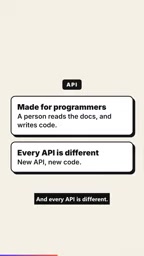
The users of traditional APIs are humans — specifically, programmers. The workflow is straightforward: developers read the documentation, understand the request format, parameter meanings, and response structure, then write code to call it.
Here's an easily overlooked fact: every API has its own design style. REST, GraphQL, gRPC — different vendors have different naming conventions, authentication methods, and error code definitions. Programmers are used to this fragmentation because humans have comprehension and adaptability; reading a few pages of documentation is enough to get started with a new interface. But for AI models, this "every API must be relearned" pattern is extremely inefficient.
MCP Is Designed for AI Applications
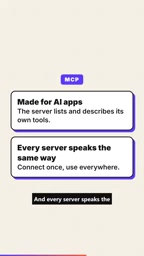
MCP (Model Context Protocol) takes a completely different approach. Its server proactively "lists its own tools and describes them," letting the model decide which tool to call on its own.
The key difference lies in self-describing capability. APIs require humans to read external documentation before use, while MCP servers embed the tool list and descriptions directly into the protocol. Models can discover and select tools directly, without humans writing new integration code for each new interface.
Another important characteristic is protocol uniformity. Regardless of what service is behind it, MCP servers communicate in the same way. For models, this means learn once, use everywhere — a stark contrast to the API world where "every interface is a new world."
MCP (Model Context Protocol) was proposed and open-sourced by Anthropic in late 2024, with the goal of establishing a standardized interface between large language models and external tools and data sources. Its core design uses a client-server architecture: MCP clients run on the AI application side (such as chat assistants, IDE plugins), while MCP servers encapsulate a specific capability (file systems, databases, third-party SaaS, etc.). The two sides exchange messages via JSON-RPC, and the protocol defines several basic primitives — tools (functions callable by the model), resources (contextual data available for reading), and prompts (preset interaction templates). Because these capabilities have their formats defined by the protocol itself, models can automatically discover available tools, understand their parameters, and decide when to call them without relying on human documentation. MCP is therefore often compared to a "USB-C interface for the AI world."
MCP Is a Layer on Top of API, Not a Replacement
This is the most critical point in the entire explanation: most MCP servers are, at bottom, simply calling ordinary APIs.
In other words, MCP hasn't eliminated API — it has built an AI-facing adaptation layer on top of API. API remains the infrastructure; MCP is the middleware that makes it easier for AI models to use that infrastructure.
Once this architectural relationship is clarified, many confusions naturally dissolve:
- Why can't MCP exist independently of API? Because the underlying data and services are still provided by API
- Why do we need MCP when we already have API? Because API's "human-friendly" design isn't friendly to AI, and MCP fills in the "model-friendly" gap
- Will MCP make API disappear? No — just as REST didn't make HTTP disappear, stacking abstraction layers is normal in software engineering
Self-describing is the key concept for understanding MCP's value. Traditional APIs are "black boxes" whose functions, parameters, and response structures are recorded in external documentation, which must be read by humans and then translated into calling code. MCP servers, on the other hand, return a structured tool list through standard methods (such as tools/list) during the handshake phase, with each tool carrying a name, natural language description, and parameter definitions in JSON Schema form. After receiving this list, the model can directly use it as context for reasoning, determining which tool matches the current task and what parameters to fill in. This "capabilities as context" mechanism lets AI applications avoid rewriting integration logic for each new service and avoid manually maintaining synchronization between documentation and code — downgrading tool integration from a "development task" to a "configuration task."
Practical Implications for Developers
Understanding the hierarchical relationship between MCP and API helps developers make clearer technical decisions. If you're building AI applications, MCP solves the problem of "letting models autonomously discover and use tools," while API solves the problem of "how services and data are accessed." The two operate at different levels, each solving different problems.
The video's author mentions at the end that the channel has a complete layer-by-layer breakdown. For developers who want to deeply understand MCP architecture, anchoring the recognition that "MCP is a layer on top of API" will make it much smoother to explore specific implementation details.
The relationship between MCP and API is not competition but collaboration. API is the foundation; MCP is the floor that lets AI stand on it.
From a layered design perspective, stacking abstraction layers is a common pattern in software engineering: HTTP on top of TCP, REST on top of HTTP, and various SDKs on top of REST; each layer doesn't eliminate the one below but encapsulates solutions for the pain points of specific users. MCP follows the same logic — API targets human engineers writing code, optimizing for stability, flexibility, and control; MCP targets AI models making decisions, optimizing for discoverability, uniformity, and automation. When choosing technology, developers can ask two questions first: who ultimately "consumes" this capability? If it's a human writing code to call it, using API directly is more straightforward; if you want the model to autonomously decide when to call it, it's worth wrapping another layer of MCP. The two usually coexist rather than being an either-or choice.
One-line Summary
MCP is not a replacement for API but an abstraction layer built on top of API specifically designed for AI models.
Paragraph Summary
Drawing on the conclusion of a 40-second video, the article clarifies a popular misconception: MCP will not replace API. API users are human programmers who need to read documentation, understand each one's different design style, and then write code to call it — a fragmentation that humans can tolerate but that is extremely inefficient for AI models. MCP, by contrast, has servers proactively list and describe their tools, featuring self-describing capability and a unified communication protocol, so models can learn once and use everywhere, autonomously discovering and selecting tools. Crucially, most MCP servers still call ordinary APIs at bottom, making MCP an AI-facing adaptation layer built on top of API rather than a replacement. Clarifying this hierarchical relationship helps developers make clearer technology choices when building AI applications: API solves how services and data are accessed, while MCP solves how models autonomously discover and use tools.
Related articles

CSS Anchor Positioning: A New UI Positioning Approach Without JavaScript
A deep dive into CSS Anchor Positioning: from anchor-name and position-anchor to the anchor() function, position-area shorthand, position-try-fallbacks, anchor-size, and upcoming anchor queries.

New AI Chart Interaction: Continuous Follow-up Questions and Visualization in Conversation
Explore a new AI interaction method for continuously generating charts in conversation. Use the /visualize command to ask follow-up questions and visualize answers in the same chat window, improving data analysis efficiency.

Cursor Merges Into X Subscription: Paid Plans Share Unified Usage Pool, Grok Model Coding Usage Doubled
Cursor joins The X Subscription with a unified usage pool and doubled Grok coding quota. Third-party models shift to API pricing. Existing users can keep or migrate plans.