WIT: An AI Communication Checker That Helps Global Teams Bridge English Cultural Gaps

WIT checks how your English reads across cultures before you hit send.
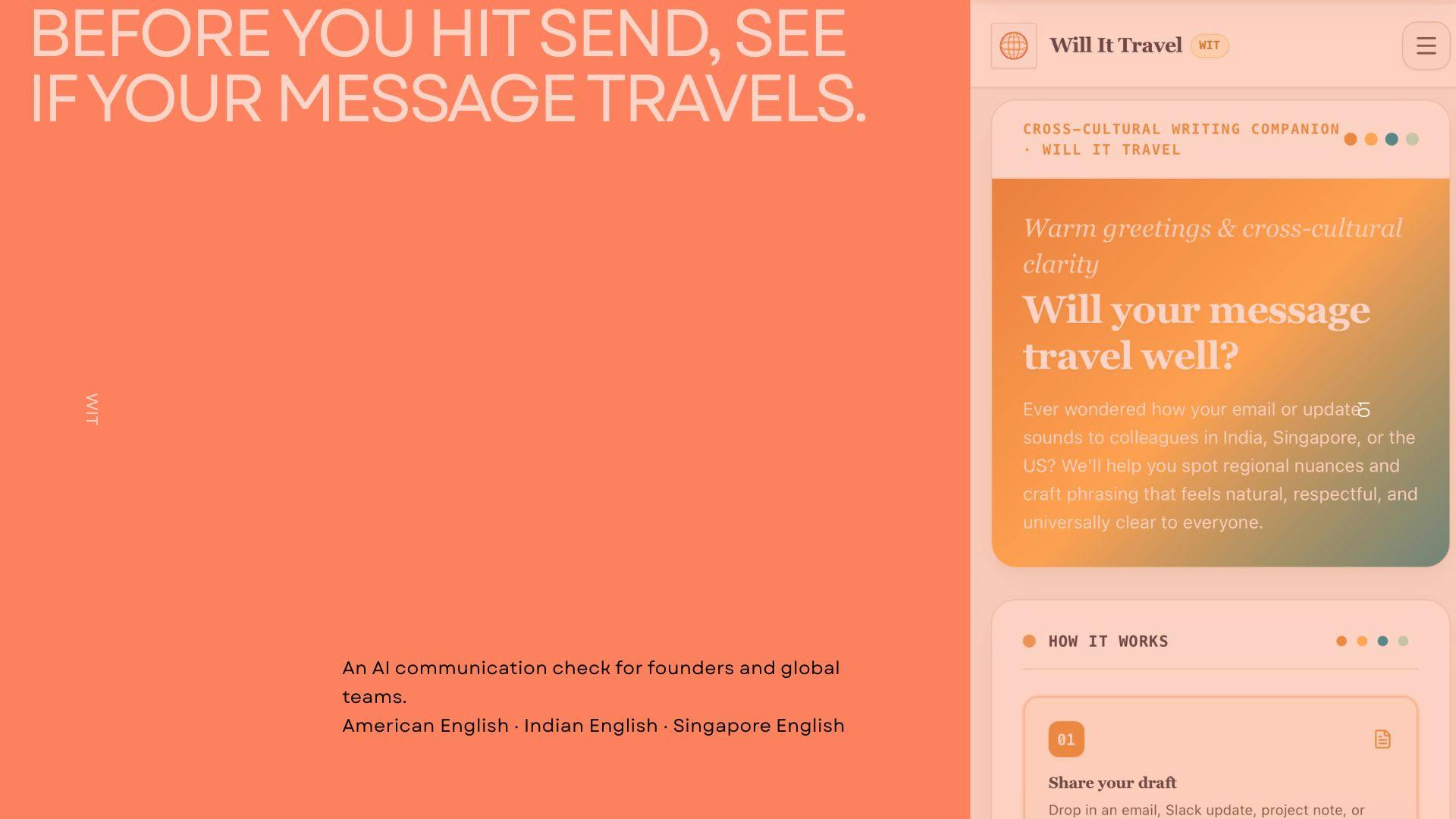
WIT is an AI-powered communication checker launched on Product Hunt that helps founders and global teams bridge cultural gaps in English communication. By analyzing emails, Slack messages, and copy across American, Indian, and Singaporean English contexts, it reveals potential misinterpretations and offers culturally adapted rewrites — all while preserving the author's voice.
When English Is No Longer the Same English
In an era of increasingly frequent global collaboration, we tend to assume that "everyone speaks English, so communication isn't a problem." Reality, however, often tells a different story. An email from an American founder to an Indian team might be misread as arrogant or vague due to differences in phrasing conventions. Product copy targeting Singaporean users might lose its persuasive power because of differing cultural contexts.
WIT, recently launched on Product Hunt, targets exactly this pain point. It's an AI communication checker designed for founders and global teams, and its core value proposition can be summed up in one sentence: Before you hit "send," see whether your message will actually land with the other side. Since launch, the product has earned 70 upvotes, ranking 10th on the daily leaderboard.
The Core Problem WIT Solves: The Invisible Gap in Global English
WIT's design philosophy is built on a commonly overlooked fact: English is not monolithic — it has diverged into multiple "Global Englishes" variants. American English, Indian English, and Singaporean English differ significantly in word choice preferences, tonal conventions, politeness levels, and degrees of directness.
The same sentence that sounds professional and sharp in one English context might be read as cold or even rude in another. These misunderstandings typically don't trigger any language error alerts, which means traditional grammar checkers (like Grammarly) are completely blind to them — they focus on "Is it correct?" while WIT focuses on "Is it appropriate?"
WIT's Core Features: Paste, Diagnose, Optimize
WIT's workflow is remarkably straightforward. Users simply paste in an email, a Slack message, or a piece of product copy, and the tool performs a cross-cultural communication analysis across three dimensions:
- Cross-context presentation: Shows how the content might be interpreted differently by American, Indian, and Singaporean English audiences;
- Explanation of causes: Explains why these differences in understanding arise, helping users grasp the underlying cultural and linguistic logic;
- Rewrite suggestions: Provides a clearer alternative phrasing while emphasizing "without losing your voice."
That last point deserves special attention. A common flaw of many AI writing tools is that they "format" all text into a uniform, robotic tone. WIT explicitly promises to preserve the author's personal style while optimizing communication effectiveness — and this is the key differentiator that sets it apart from similar tools.
Who Should Use WIT: Built for Real Cross-Cultural Collaboration Scenarios
WIT is categorized under productivity, customer communication, and language, with a very clear target user profile: founders and distributed global teams.
For a startup, founders often need to communicate simultaneously with investors, employees, partners, and customers from different countries. A poorly worded email can, at best, cause information distortion, and at worst, damage business relationships. WIT intervenes at the critical moment "before sending," exposing potential cross-cultural communication risks in advance — delivering genuine practical value in international business scenarios.
Overall, WIT is best suited as a supplementary reference tool for:
- Entrepreneurs who frequently engage in cross-border written communication;
- Marketing and product teams writing copy for multi-regional markets;
- Remote collaborators looking to sharpen their cross-cultural communication sensitivity.
From Error Correction to Cross-Cultural Adaptation: An Evolutionary Leap for AI Language Tools
From a product positioning standpoint, WIT represents an evolution in thinking for AI language tools. The first generation solved spelling and grammar issues. The second generation (various AI rewriting assistants) addressed tone and fluency. The direction WIT represents goes a step further into cross-cultural pragmatic adaptation — it's not concerned with the text itself, but with the reaction the text triggers in the minds of specific audiences.
This "receiver-centered" analytical perspective is remarkably forward-thinking in an age where global collaboration has become the norm.
A Clear-Eyed Look at WIT's Limitations
Limited English Variant Coverage
Currently, WIT only supports three English variants: American, Indian, and Singaporean. But the map of Global Englishes extends far beyond these — British English, Australian English, Nigerian English, Philippine English, and others all have their own distinct characteristics. Three variants is a reasonable starting point for an early-stage product, but the ability to expand coverage in the future will be a critical test for truly serving global teams.
AI Judgment of Cultural Differences Is Extremely Challenging
Cultural pragmatic differences in language are an incredibly nuanced domain — even human experts struggle to provide definitive answers. AI judgments in this area can easily fall into stereotypes — for example, simply assuming "Indian English is more formal" or "Singaporean English is more direct" — leading to overgeneralized suggestions. The actual value of such tools depends heavily on the granularity and accuracy of their analysis, which needs to be continuously validated in real-world usage scenarios.
It should not be treated as an absolute authority, but rather as a smart assistant that "reminds you to consider the other person's perspective."
Conclusion: The Value of Thinking One Step Ahead Before Hitting Send
WIT's emergence reflects how AI applications are continuously penetrating from general capabilities into niche scenarios. It doesn't try to solve grand problems — instead, it focuses on the specific and very real pain point of cross-cultural English communication. In an era where collaboration is increasingly global and the cost of miscommunication keeps rising, the product philosophy of "thinking one step ahead before sending" carries inherent value. Whether WIT can continue to refine its accuracy and coverage will ultimately determine its long-term worth.
Related articles

Cursor AI Programming in Practice: Build a Student Management System from Scratch in 30 Minutes
A Bilibili creator demonstrates Cursor AI programming: generating a student management system in 30 minutes with natural language. Details on Agent mode, Claude selection, prompt techniques, and thresholds.

Top 20 AI Coding Tools Ranking: From Rock-Solid to Lackluster, a Scored Matrix
Bilibili creator releases top 20 AI coding tools ranking, tiered T0–T4 from rock-solid to lackluster, with Claude Code and Codex tied at T0. This article details the scoring dimensions (capability, reliability, robustness, durability, cost, domestic availability) and tool performances to help developers choose the right AI coding assistant.

Vibe Coding Systematic Tutorial: Master AI-Assisted Programming from Zero
A three-month Vibe Coding tutorial from a Bilibili creator covering Codex, ClaudeCode, and Cursor, from core logic to commercial project practice for beginners.