Workday Data Connect Joins Unity Catalog: Unified Governance for HR and Financial Data

Workday HR and financial data joins Databricks Unity Catalog via zero-copy federation for unified analytics and governance.
Databricks has announced Workday Data Connect federation entering Unity Catalog Beta, allowing enterprises to access Workday HR and financial data in a zero-copy, read-only manner without physically moving data into Databricks. Unity Catalog serves as the unified governance hub, providing access control, data lineage tracking, and audit logs to ensure sensitive payroll, performance, and financial data remains compliant when brought into analytics workflows. Once integrated, enterprises can combine Workday data with other business data for workforce analytics, financial planning, and natural language exploration via Genie. The feature is currently in Beta, and organizations using both Workday and Databricks should evaluate its integration value early.
A Major Step Toward Merging Workday Data with Enterprise Data
Databricks has announced that Workday Data Connect federation is now in Beta for Unity Catalog. This capability allows enterprises to unify HR and financial data from Workday with other enterprise data across Databricks — all managed under a single governance framework.
For organizations that rely heavily on Workday to manage employees, payroll, organizational structures, and financial planning, this marks the breaking down of a long-standing data silo. In the past, HR and financial data was often locked inside Workday, and joining it with sales, operations, or product data typically required cumbersome export, copy, and ETL processes. Now, that data can flow directly into a unified analytics and AI platform.
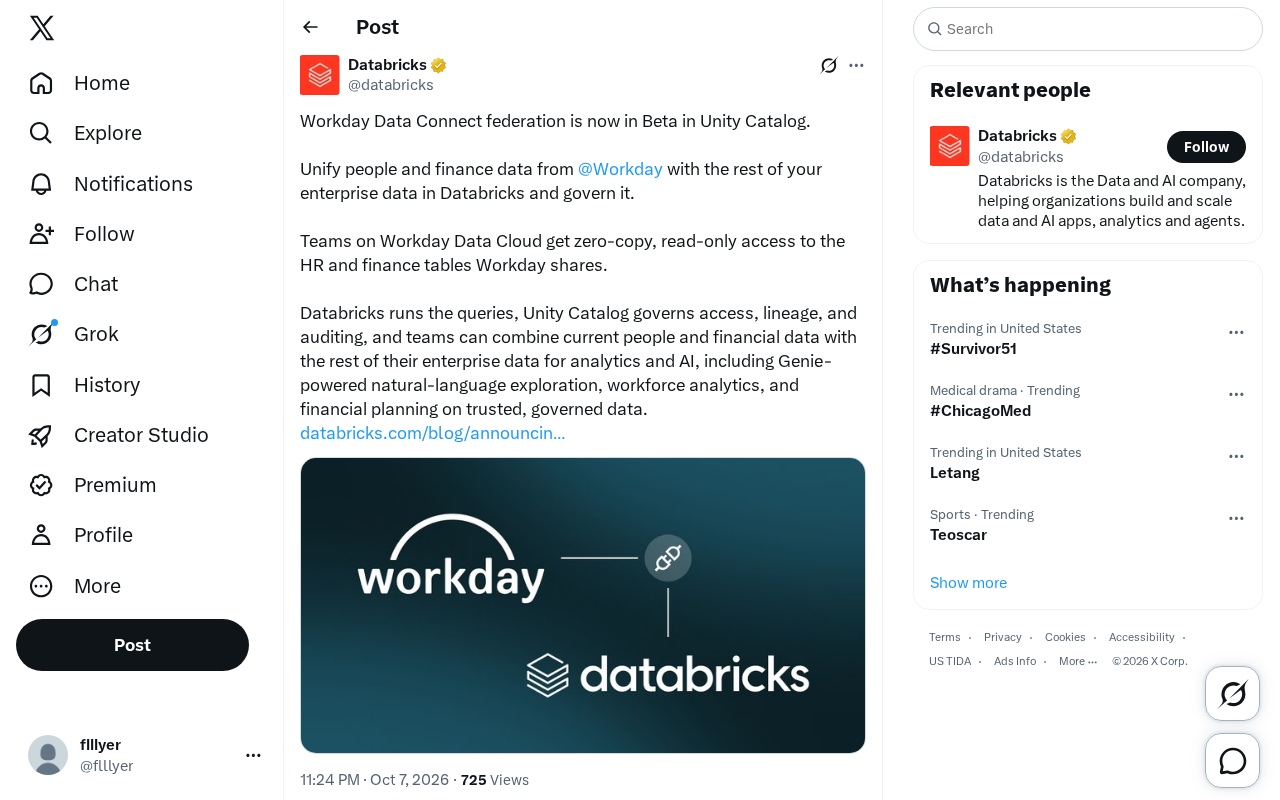
Zero-Copy Read-Only Access: Use the Data Without Moving It
The core technical highlight of this integration is zero-copy, read-only access. Teams using Workday Data Cloud can directly read HR and financial data tables shared by Workday — without physically copying the data into Databricks.
This architecture delivers several practical benefits:
- Eliminate data redundancy: No more copying data back and forth across systems, reducing storage costs and the risk of sync errors.
- Ensure data freshness: Teams access current headcount and financial data from Workday, not a stale snapshot from a previous export.
- Clear permission boundaries: Read-only access means the analytics layer cannot write back to the source system, protecting the integrity of the data at its origin.
According to the official description, queries are executed by Databricks, while table sharing and access are controlled on the Workday side — creating a clean separation of responsibilities.
The underlying logic of zero-copy technology is to let consumers access the data provider's storage location directly via a data sharing protocol, rather than transferring a copy between two systems. Here, Workday Data Connect exposes tables externally using an open protocol similar to Delta Sharing, and the Databricks engine retrieves the required data in real time at query execution via federated queries. This is fundamentally different from traditional ETL pipelines, which must extract data to intermediate storage, transform it, and then load it to the target system — a chain that typically introduces hours or even days of latency and produces a separate copy for each additional downstream system. In the zero-copy model, data "ownership" always remains with Workday, while Databricks only gains "read access." This is why read-only access can architecturally protect source system data integrity — permission boundaries are set by the data provider at the sharing layer, rather than relying on consumers to self-regulate.
Unity Catalog as the Governance Hub
Throughout this solution, Unity Catalog plays the role of a unified governance layer, handling three critical responsibilities: access control, data lineage, and auditing.
For highly sensitive data like HR and financials, governance capabilities are often more important than analytics capabilities themselves. Information such as compensation, performance reviews, and financial plans can have serious consequences if accessed improperly or leaked. Unity Catalog's centralized permission management ensures that only authorized users and applications can access the relevant data tables. Through lineage tracking, organizations can clearly understand which data sources contributed to an analytical result and what processing it went through. And through audit logs, all access activity is recorded and traceable.
This mechanism allows enterprises to break down data silos without compromising compliance — which is precisely the top concern for many regulated industries.
Unity Catalog is the unified metadata and governance layer Databricks introduced in 2021. It uses a three-level namespace (catalog → schema → table) to manage data assets across workspaces and clouds. Compared to the earlier model where each Databricks workspace maintained its own Hive Metastore, Unity Catalog centralizes the permission model, lineage graph, and audit logs at the account level, enabling unified tracking of access behavior across different teams and regions for the same dataset. The data lineage feature automatically captures column-level data flows — meaning which fields from which source tables, processed through which notebooks or SQL statements, contributed to a specific metric in a report. This is especially critical for HR and financial data: when auditors or compliance teams need to trace the calculation of a specific compensation record, the lineage graph provides a complete audit trail without requiring anyone to manually search through code repositories.
From Unified Data to AI-Powered Analytics
Data unification and governance are just the foundation — the real value is unlocked at the application layer. After integration, enterprise teams can combine current headcount and financial data with other enterprise data for analytics and AI use cases, including:
- Workforce analytics: Combine with business data to gain deeper insight into headcount allocation, talent mobility, and organizational effectiveness.
- Financial planning: Conduct budgeting and forecasting on top of trusted, governed data.
- Genie-powered natural language exploration: Leverage Databricks' Genie capability to let users query and explore this data using natural language, lowering the barrier to data analysis.
Notably, the official messaging repeatedly emphasizes "trusted, governed data." As AI applications become increasingly widespread, the reliability of models and analytical outputs depends directly on the quality and trustworthiness of the underlying data. Building governance into the data pipeline is a prerequisite for making AI results truly actionable in decision-making.
Genie is Databricks' natural language data interaction interface, which uses a large language model (LLM) to translate user questions into SQL queries, supported by the semantic layer in Unity Catalog to understand table names, field meanings, and business metric definitions. Unlike generic Text-to-SQL tools, Genie relies on semantic models that data administrators configure in advance in Unity Catalog — including field annotations, business term mappings, and trusted query examples — to improve the accuracy of generated SQL. Once Workday data is connected to Unity Catalog, HR and finance-related data tables can also be incorporated into Genie's semantic layer configuration. This enables non-technical users to get analytical results directly from questions like "What is the correlation between average performance scores and revenue by department last quarter?" — without waiting for a data team to manually write a report.
What This Means for Enterprise Data Strategy
This deep integration between Workday and Databricks reflects a clear trend in enterprise data platforms: breaking down data silos without sacrificing governance.
Workday holds an organization's most critical data about people and money, while Databricks is increasingly serving as the unified data and AI platform for more and more enterprises. By connecting them through federation and zero-copy mechanisms, organizations can retain the specialized strengths of each system while achieving seamless data integration at the analytics and AI layer.
It's worth noting that this feature is still in Beta, meaning capabilities and stability continue to be refined. Organizations interested in adopting it should monitor progress toward general availability and assess the integration value against their own Workday usage.
Summary
The entry of Workday Data Connect federation into the Unity Catalog Beta delivers core value by unifying HR and financial data via zero-copy, read-only access and enabling centralized governance through Unity Catalog. It allows enterprises to combine Workday data with the rest of their enterprise data in a trusted, controlled environment — serving use cases like workforce analytics, financial planning, and natural language data exploration. For organizations that use both Workday and Databricks, this is a data integration path worth evaluating.
Related articles

Gaussian Process Bandit Optimization: Exploration Strategies and Inference Regret Guarantees
Cumulative regret guarantees in Bayesian optimization fail to reflect final recommendation quality. This article examines a new study that provides inference regret guarantees for Gaussian process bandit optimization through exploration query strategies and fill distance analysis, validated on hyperparameter optimization and control tasks.

The Most Detailed Codex Guide on Bilibili: From Installation to Real-World Practice
The most detailed Codex guide on Bilibili: from app store installation to daily work mode configuration, with a real coffee shop project demonstrating file organization, data extraction, dashboard creation, and other practical tasks. Learn to use Plan Mode and desktop pets to leverage Codex efficiently.

Appearance Compensation in Volume Rendering: Why RGB Accuracy Cannot Guarantee Density Correctness
Volume rendering research reveals that volumetric data perfectly reproducing external RGB views may still contain density errors: appearance compensation can double central density and keep external rays unchanged even when L2 error exceeds 14.52%. Density recovery depends on appearance capacity, spatial resolution, and measurement design.