Workflow SDK 5 Released: 25x Lower Latency to Speed Up Agent Loops
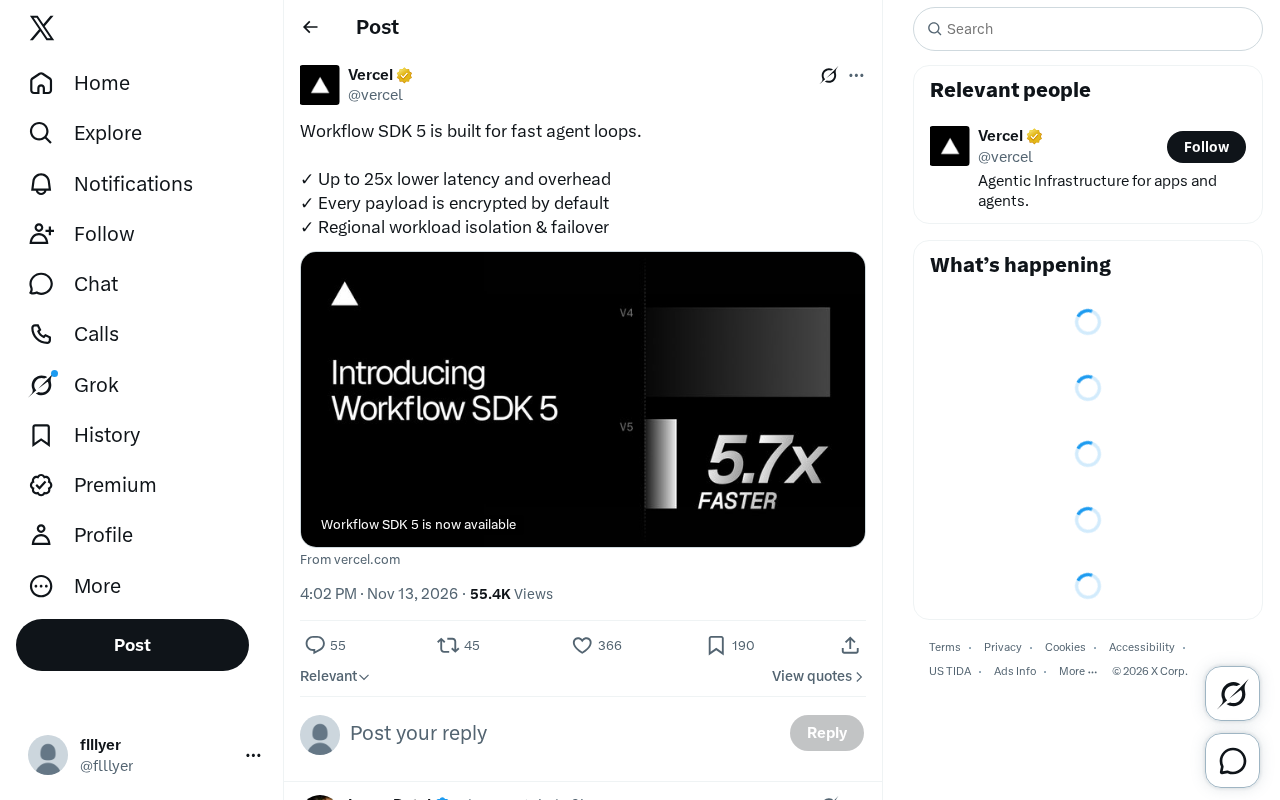
Workflow SDK 5 claims 25x orchestration latency reduction, with default encryption and regional disaster recovery.
Workflow SDK 5 targets orchestration layer performance and production readiness for Agent applications with three core upgrades: officially claimed latency and overhead reductions of up to 25x for high-frequency short Agent loops; all payloads encrypted by default, making security a baseline behavior; and region-level workload isolation and failover for high-availability cross-region deployments. The article affirms the clear direction while cautioning that 25x is an official upper-limit claim without disclosed benchmarks, and that this version is worth benchmarking but not making architectural decisions from promotional figures.
Introduction
Agent application performance bottlenecks often lie not in the model itself, but in the orchestration layer. If the "glue logic" of tool calls, state passing, and error retries isn't fast enough, even the strongest model will be held back. The release of Workflow SDK 5 targets exactly this pain point: it officially claims latency and overhead reductions of up to 25x, encrypts all payloads by default, and provides region-level workload isolation and failover.
Three Core Upgrades
Latency and Overhead Reduced by Up to 25x
Agent loops are characterized by high-frequency, short round-trip calls. Every tool call, every state check, accumulates orchestration overhead. Workflow SDK 5 claims to compress this latency and overhead by up to 25x, meaning steps that were previously forced to serialize or add caching due to orchestration overhead can now approach real-time responsiveness.
Officials have not disclosed the specific benchmarks or workloads under which this 25x figure was measured. From an engineering perspective, dramatic overhead reduction typically comes from reducing serialization layers, optimizing scheduling paths, or reusing execution contexts. For developers, what's more noteworthy is: once orchestration cost is no longer the dominant factor, the design space for Agent loops expands significantly, allowing for more aggressive multi-turn tool calls and self-correction.
Agent Loop refers to the closed-loop process where an agent repeatedly executes "reason—select tool—call tool—observe result—reason again" until the task is complete or a termination condition is triggered. Unlike single-turn Q&A, a complex task may involve dozens of tool round-trips, each containing parameter serialization, state passing, result parsing, and scheduling decisions. This is precisely why orchestration layer overhead gets amplified: while single-call overhead is small, multiplied by the number of loop iterations, it can exceed the time consumed by model inference itself. Common approaches to reducing orchestration overhead include reducing serialization/deserialization layers, reusing execution contexts to avoid repeated initialization, and pushing scheduling logic closer to the execution engine. Understanding this is key to judging that figures like "25x" are far more sensitive to high-frequency short-call workloads than to low-frequency long-call workloads.
Every Payload Encrypted by Default
Workflow SDK 5 makes "every payload encrypted by default" an out-of-the-box feature. Agent systems frequently carry sensitive data during tool calls and state passing—user input, internal API responses, credential contexts. Default encryption means security is no longer an option requiring extra configuration, but a baseline behavior of the SDK.
This design orientation deserves recognition: secure by default effectively reduces data exposure caused by configuration oversights. However, encryption inevitably introduces additional computational overhead, and it's currently unclear whether the claimed low latency was measured with encryption enabled.
Payload in this context refers to data structures such as tool call requests and responses, state snapshots, and event messages that are transmitted over networks or persisted in storage. Agent system payloads often mix raw user input, retrieved private document fragments, downstream API results, and credential context references—the impact of a leak can be significant. Secure by Default is a design principle: the system is in a secure state without any additional configuration, rather than leaving security to users to enable voluntarily. The opposite is "opt-in security," which in practice is often skipped due to configuration omissions or time pressure. However, it's worth noting that default encryption typically involves key management and rotation mechanisms; if key lifecycle management is inadequate, encryption itself can become a new operational risk.
Region-Level Workload Isolation and Failover
The third feature is region-level workload isolation and failover. For Agent services deployed across regions, this means that when a single region has issues, workloads can be isolated and transferred rather than causing a complete outage. The combination of isolation and failover points to high-availability requirements for production environments—as Agents move from demos to online services, this layer is unavoidable.
Failover refers to the system automatically switching workloads to a backup region to continue running when a region or node becomes unavailable, minimizing downtime. Workload isolation emphasizes separating execution environments across different regions or tenants to prevent cascading failures from single points of failure or resource contention. For Agent services, the challenge lies in state: if the intermediate state of a multi-step loop exists only in the failed region, it needs to be rebuilt or recovered from persistent storage after switching—otherwise failover is merely formal completion while the task itself has already failed. Therefore, whether region-level isolation truly works depends on whether state is designed to be migratable across regions, which is the engineering detail to probe when evaluating such high-availability capabilities.
Implications for Agent Developers
Performance optimization of Agent loops has long been constrained by two factors: orchestration overhead and state management. The three features of Workflow SDK 5 correspond to the dimensions of speed, security, and reliability respectively—the direction is clear.
But caution is warranted: 25x is the officially claimed upper limit, and actual gains depend on specific workloads; whether enabling encryption and isolation affects latency performance also requires empirical verification. For teams building multi-step Agent workflows, this version is worth watching and benchmarking, but architectural decisions should not be made directly based on promotional figures.
Summary
Workflow SDK 5 concentrates its selling points on the three most fragile aspects of Agent loops: latency, security, and disaster recovery. All three features point to production readiness rather than toy-level demos. As model capabilities increasingly converge, the engineering quality of the orchestration layer is becoming a differentiator. What's worth watching going forward is community benchmark data and the actual impact of default encryption on throughput.
One-line Summary
Workflow SDK 5 claims 25x orchestration latency reduction, with default encryption and regional disaster recovery.
Paragraph Summary
Workflow SDK 5 addresses performance and production-readiness issues in the orchestration layer of Agent applications with three core upgrades: officially claimed latency and overhead reductions of up to 25x for high-frequency short Agent loop round-trips; all payloads encrypted by default, making security a baseline SDK behavior rather than an optional configuration; and region-level workload isolation and failover to meet high-availability needs for cross-region deployments. The article affirms the clear direction while noting that 25x is an official upper-limit claim without disclosed benchmark or workload details, and whether encryption affects latency remains unstated. The conclusion: this version is worth watching and benchmarking, but architectural decisions should not be made directly from promotional figures.
Related articles

Beagle Brigade: From Fruit to GHB — Guarding the Border
How does the Beagle Brigade guard U.S. borders? Based on To Catch A Smuggler, this article shows detector dogs finding fruit and meat, and agencies tracking GHB and cocaine smuggling.

The Secret to High-Yield Tomatoes: How Consistent Watering Makes Container Tomatoes Outperform Ground-Planted Ones
A YouTube growing log shows container tomatoes far outyield ground-planted ones. The grower credits consistent, adequate water—not fertilizer—for the longer fruiting period and higher yield.

Reverse Role-Play: When You Become an LLM's Subagent in a Game
A reverse role-play game appears on Hacker News where players act as an LLM's subagent. This article analyzes its game mechanics, the philosophical implications amid the AI agent boom, and how indie developers use lightweight interaction to explore human-machine power relations.