WorkflowArena: A Benchmark for Multi-Agent Workflow Orchestration Capabilities

WorkflowArena quantifies LLMs' autonomous workflow orchestration via 145 long-horizon tasks, revealing divergent delegation strategies and orchestration quality's independent impact on performance.
WorkflowArena is a new benchmark for LLMs' autonomous workflow orchestration, featuring 145 long-horizon tasks across 8 professional domains, evaluated by hidden validators that assess final deliverables while recording all delegation behavior, covering both results and process. Experiments on nine models show no single configuration is optimal across all domains; Claude delegates less often with larger worker groups, while GPT delegates more frequently with smaller units. Crucially, with a fixed executor, workflows written by Claude Opus 5.5 significantly boost weaker executors, proving orchestration quality is itself a measurable performance determinant. The benchmark advances multi-agent evaluation from results-oriented to process- and structure-oriented.
Multi-agent systems are becoming the dominant deployment form for large models, yet models' ability to autonomously orchestrate workflows has long lacked systematic evaluation. The recently proposed WorkflowArena benchmark fills this gap: through 145 long-horizon tasks, it is the first to quantify "workflow orchestration" as an independent capability and reveals significant differences in delegation strategies across models.
Why Workflow Orchestration Needs Its Own Benchmark
Today's LLM agents are no longer confined to single-turn dialogue or single-step reasoning. With various agent harnesses, models can dynamically create worker agents and write executable workflows to coordinate them. This means the authority to design system structure is shifting from developers to the models themselves—models decide at runtime whether to delegate, how to delegate, and how to organize multiple agents to work together.
This organizational quality constitutes an independent capability in its own right. However, existing benchmarks either measure only end-to-end task completion or evaluate coordination under pre-specified collaboration structures, and neither can answer the question: "How good is a workflow that the model designs autonomously?" WorkflowArena formalizes this capability as workflow orchestration and builds a dedicated evaluation framework around it.
Agent harness refers to the runtime framework wrapped around a base LLM that translates the model's text outputs into executable actions, such as tool calls, file reads and writes, subprocess creation, and multi-agent communication. It typically provides a task loop, context management, permission control, and error retry mechanisms, enabling the model to dynamically generate and schedule worker agents at runtime. It is precisely because the harness hands the model the ability to "create sub-agents and write and execute workflows" that the authority to design system structure shifts from developers to the model itself; and it is precisely because different harnesses have different abstraction levels and default policies that the same model may exhibit vastly different delegation behavior under different harnesses—one reason evaluation needs to isolate orchestration capability separately.
Benchmark Design: Long-Horizon Tasks and Hidden Validators
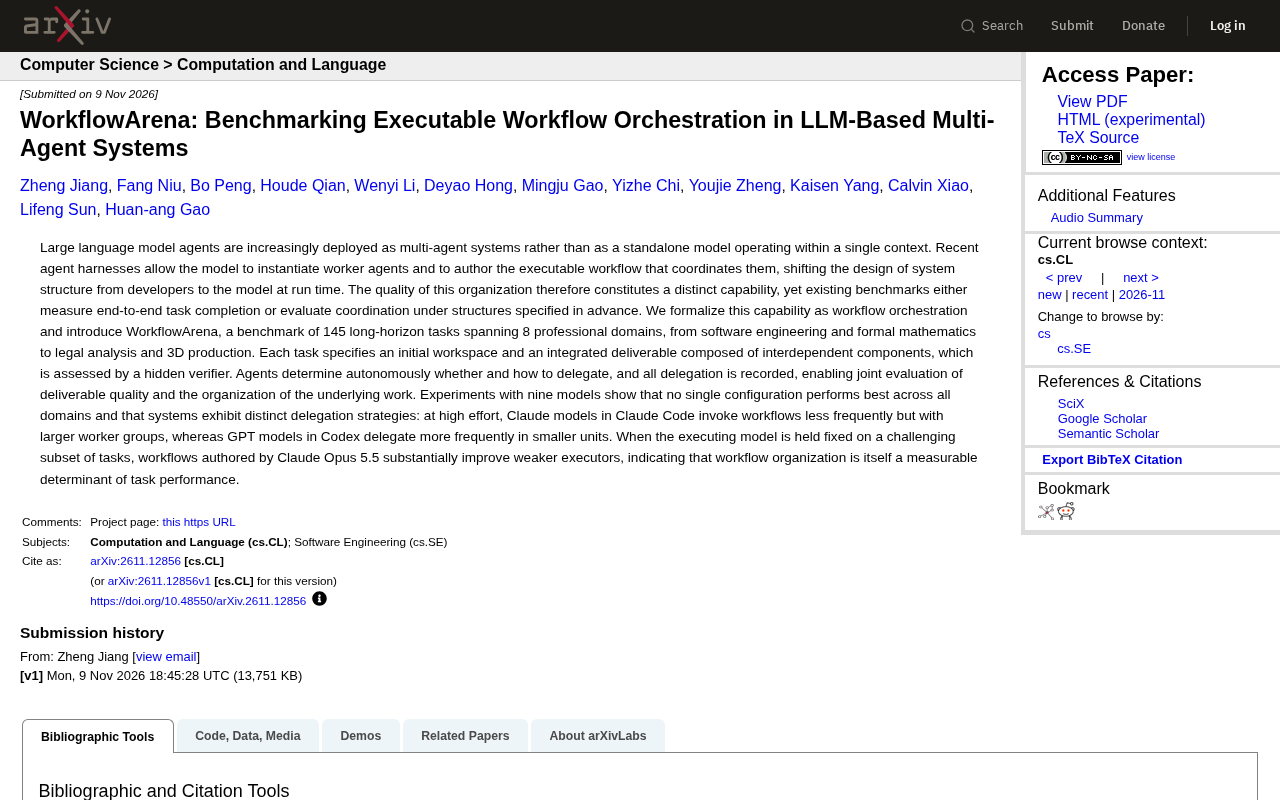
WorkflowArena contains 145 long-horizon tasks spanning 8 professional domains, from software engineering and formal mathematics to legal analysis and 3D production. Each task provides an initial workspace and a comprehensive deliverable composed of interdependent components, ultimately evaluated by a hidden validator.
The key design point: agents autonomously decide whether and how to delegate, and all delegation behavior is recorded. This enables the benchmark to evaluate both deliverable quality and the way the underlying work is organized—looking not only at results but also at process. This dual evaluation perspective is an important step toward understanding the capability boundaries of multi-agent systems.
Long-horizon tasks refer to tasks that cannot be completed in a single turn or a few interactions and require the model to plan, execute, check, and revise over an extended time span. Such tasks typically contain multiple interdependent sub-goals, intermediate artifacts must be saved and reused, and errors accumulate and amplify along the dependency chain. WorkflowArena constructs this long-horizon structure with "initial workspace + multi-component comprehensive deliverable": the model must decide on its own the order of task decomposition, when to introduce workers for parallel processing, and how to integrate the outputs of each sub-unit. The hidden validator makes an overall judgment on the final deliverable after the task ends, preventing the model from overfitting to visible tests and thus more faithfully reflecting the combined quality of orchestration and execution.
Nine-Model Experiment: No Universal Configuration, Delegation Strategies Diverge Markedly
The research team conducted experiments on nine models and found two noteworthy conclusions.
First, no single configuration performs best across all domains. Different models have their own strengths and weaknesses in different professional domains, which means that selecting a multi-agent system requires matching the specific task scenario rather than pursuing a universal optimum.
Second, the systems exhibit markedly different delegation strategies. In high-effort mode, the Claude model in Claude Code invokes workflows less frequently but uses larger worker groups each time, whereas the GPT model in Codex delegates more frequently but with smaller units. This strategic difference reflects different models' preferences for task decomposition and organization, and also signals to developers that model choice substantially changes the system's collaboration structure.
Delegation strategy here refers to the choices a model makes when orchestrating a workflow regarding "whether to create workers, how many to create, and how fine-grained a subtask each worker handles." It can be understood as a continuum: at one end are a few large-grained workers, suited to situations where subtasks are highly coupled and global context is needed; at the other end are many small-grained workers, suited to situations where tasks can be cleanly partitioned and parallel gains are obvious. Each strategy has its costs—large worker groups reduce coordination overhead but a single point of failure has a large blast radius, while small worker groups increase parallelism but raise communication and integration costs. The difference between Claude and GPT in high-effort mode is precisely this trade-off manifested at the model level, and it also shows that delegation granularity itself changes the system's collaboration topology and fault-tolerance characteristics.
Workflow Organization Itself Is a Performance Determinant
A more illuminating finding comes from experiments with a fixed executor model. On a subset of challenging tasks, when the executor model is held constant, workflows written by Claude Opus 5.5 significantly improved the performance of weaker executors.
This result shows that workflow organization itself is a measurable determinant of task performance—good orchestration can compensate for insufficient execution capability. For practitioners of multi-agent systems, this means optimization should not be limited to choosing a stronger executor model but should also focus on who designs the workflow and how. Orchestration quality matters as much as model capability.
Fixed-executor experiments are a controlled-variable design: the same (usually weaker) executor runs the same tasks under different orchestration schemes, thereby separating "execution capability" from "orchestration quality." If the executor is unchanged but results change significantly, the difference can only be attributed to the workflow structure itself. This type of experiment draws on classic multi-agent and program synthesis research—treating orchestration as an independently optimizable "program" of which the executor is merely the runtime. Its practical implication is that the orchestration layer can be trained, retrieved, or reused as an independent module—for example, distilling high-quality workflows into templates and then applying them to weaker executor models, thereby improving overall performance at lower cost.
Implications for Multi-Agent System Development
The introduction of WorkflowArena marks an extension of multi-agent evaluation from "results-oriented" to "process- and structure-oriented." Its value lies at three levels: for researchers, it provides a reproducible measure of orchestration capability; for developers, it reveals the coupling between model selection and delegation strategy; and for model vendors, it points to the possibility of orchestration quality as an independent optimization dimension.
As agent harnesses give models more and more authority over system design, how to evaluate and improve this "organizational capability" will become a key issue as multi-agent systems mature. WorkflowArena has taken a systematic step forward.
One-line Summary
WorkflowArena is the first to quantify LLMs' ability to autonomously orchestrate workflows through 145 long-horizon tasks, revealing divergent delegation strategies and the independent effect of orchestration quality on performance.
Paragraph Summary
WorkflowArena is a new benchmark targeting LLMs' autonomous workflow orchestration capability. It contains 145 long-horizon tasks across 8 professional domains, with hidden validators assessing final deliverables while recording all of the model's delegation behavior, thus covering both results and process. Experiments on nine models show: no single configuration is optimal across all domains; Claude models tend to delegate less often but with larger worker groups, while GPT models delegate more frequently with smaller units. More importantly, with a fixed executor model, workflows written by Claude Opus 5.5 significantly improve the performance of weaker executors, proving that orchestration quality is itself a measurable performance determinant. The benchmark advances multi-agent evaluation from results-oriented to process- and structure-oriented.
Related articles

Gemini 4 Neon's Comeback: How Google's 'American Doubao' Shipped Five Models in Two Weeks
Google shipped five models in two weeks. Gemini 4 Neon ranks third globally and first on the coding agent leaderboard, at half the cost of Opus 5.5. A Bilibili creator breaks down the three-layer comeback story: regulatory relief, sparse MoE architecture, and in-house TPUs—plus Carbon promo savings tips and AntiGravity quota rules.

What Is Hermes Agent? An Always-On AI Agent That Grows With You
Hermes Agent is an always-on AI agent running on a VPS, reachable via WhatsApp, Telegram, and Discord. It manages lists, calendars, and scheduled tasks and grows with use.

Building AI Animated Videos with Claude Code: A Hands-On Local Toolchain Guide
A hands-on demo of using Claude Code with local open-source tools like Kokoro and Remotion to generate AI videos with narration, animation, and music in minutes. Workflow, efficiency gains, and limitations analyzed.