World's First Enhanced Geothermal Plant Built in 23 Months — Fervo Is Rewriting the Pace of Clean Energy

Fervo Energy built the world's first EGS plant in 23 months, validating a replicable path to scaling geothermal power.
Fervo Energy has completed the world's first Enhanced Geothermal System (EGS) power plant in just 23 months, breaking from the multi-year timelines typical of traditional energy infrastructure. EGS uses hydraulic fracturing to create artificial flow channels in hot dry rock, freeing geothermal energy from dependence on natural hot springs and theoretically opening up most of the globe to development. Unlike wind and solar, geothermal delivers stable, around-the-clock baseload power — a major strategic asset as AI and data center demand drives electricity consumption higher. Fervo says future projects will connect to the grid even faster, suggesting the first plant's engineering lessons are already becoming a reusable learning curve. Key uncertainties remain, including actual generation capacity, long-term reliability, and induced seismicity risks.
A Geothermal Plant Built in 23 Months
A noteworthy milestone has emerged in the clean energy sector: Fervo Energy has announced that its first Enhanced Geothermal System (EGS) power plant went from groundbreaking to completion in just 23 months. For an industry where energy infrastructure projects routinely take years to build, that timeline alone is news.
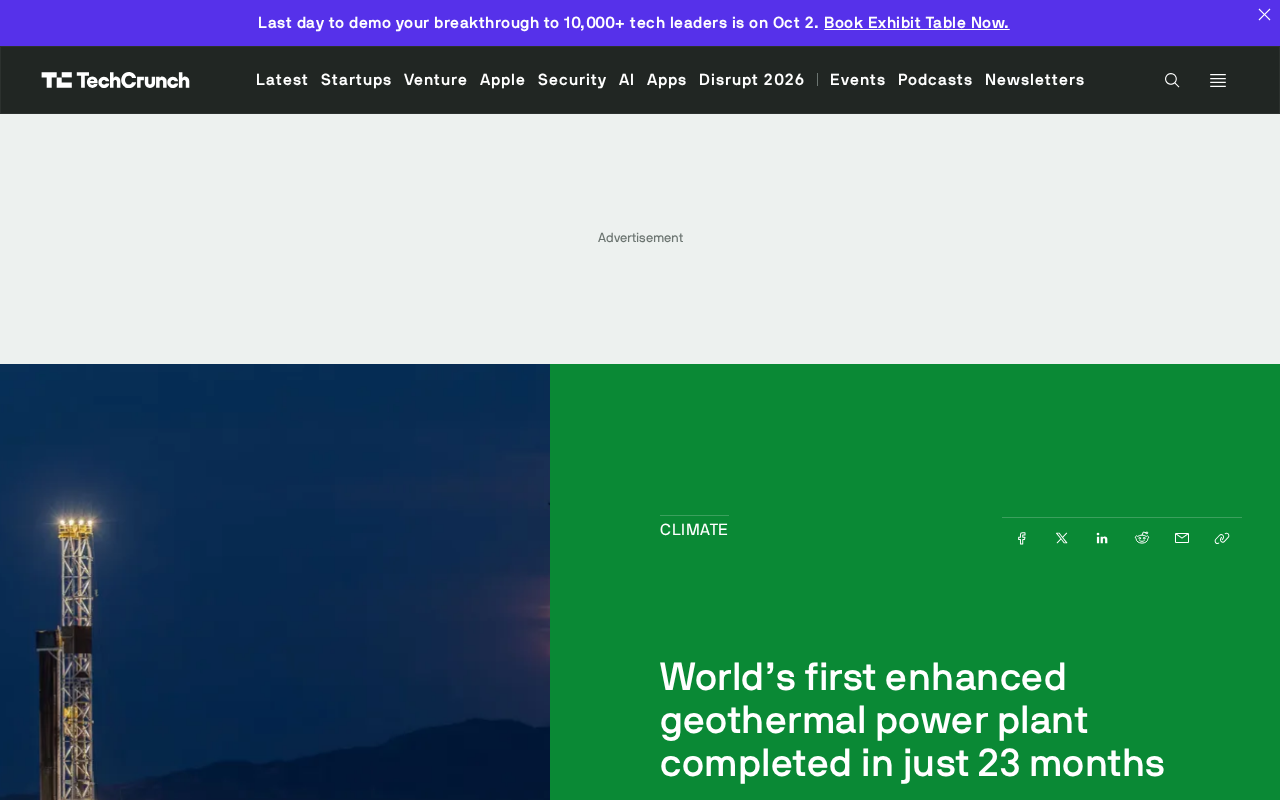
More significantly, Fervo says subsequent phases of the project will be able to connect to the grid even faster. This means the first plant isn't just an isolated achievement — it validates a construction process that can be replicated and accelerated. The largest costs and risks in energy projects often stem from prolonged development timelines, so compressing that timeline is directly tied to whether geothermal energy can move from demonstration to scale.
Why Enhanced Geothermal Matters
From Natural Hot Springs to Engineered Reservoirs
Conventional geothermal power generation is highly dependent on specific geological conditions — it requires naturally occurring hot water and permeable rock formations, which severely limits viable development sites. The core idea behind Enhanced Geothermal Systems is to use engineering methods to artificially fracture hot dry rock deep underground, inject water to heat it, and then pump it back to the surface to generate electricity.
This approach borrows mature drilling and hydraulic fracturing techniques from the oil and gas industry, and in theory can expand viable geothermal development from a handful of volcanically active zones to a much broader range of locations. In other words, EGS aims to transform geothermal energy from a resource that depends on nature's hand to one that can be deliberately planned and deployed as a stable power source.
Hydraulic fracturing has been used in the oil and gas industry for decades. The principle involves injecting fluid underground at high pressure to create tiny fractures in rock formations, increasing permeability. When EGS applies this technique to geothermal energy, the target shifts from sedimentary rock to harder dry rock such as granite, typically at depths of 3 to 10 kilometers and temperatures exceeding 150 to 300°C. Engineers must drill at least two wells — one injection well and one production well — then use fracturing to transform the rock between them into an artificial heat exchanger. Unlike oil and gas fracturing, where the goal is to extract fluid, EGS aims to create a stable circulation pathway. This demands far more precise control over the fracture network — which is why EGS has faced long-standing technical challenges, and only recently achieved breakthroughs by leveraging advanced directional drilling and real-time monitoring technologies from the oil and gas sector.
Stability Is Its Core Value
Unlike intermittent renewables such as wind and solar, geothermal provides around-the-clock baseload power that isn't affected by weather. As power grids grow increasingly reliant on variable renewable sources, a clean and stable power supply takes on special strategic significance — it can serve as the dependable backstop that wind and solar cannot.
The Industrial Logic Behind the Speed
The 23-month construction timeline is striking precisely because it directly addresses one of the most difficult challenges in deploying clean energy: speed. Electricity demand is growing rapidly, driven particularly by high-consumption industries like data centers and AI computing, and grids are increasingly hungry for new clean baseload capacity.
Fervo's emphasis on faster grid connection for subsequent projects signals that the engineering experience, drilling data, and process optimizations accumulated from the first plant are being converted into reusable capabilities. The value of energy technology often lies not in any single project, but in the learning curve — each plant built makes the next one cheaper and faster. If that curve holds, EGS has the potential to gradually approach or even surpass some conventional power generation methods in terms of cost and timeline.
Questions That Still Need Answers
Publicly available information remains relatively limited, and several key dimensions still require further validation: the plant's actual generation capacity and scale, long-term operational stability, and environmental concerns such as microseismic activity induced by hydraulic fracturing. While the fracturing technology used in EGS is mature, its safety and sustainability under varying geological conditions still need to be tested over time.
Furthermore, whether the promise of "faster grid connection" can be delivered depends on multiple factors — supply chains, permitting approvals, and financing — not technology alone. The real test lies in whether subsequent projects can translate this demonstration success into scalable, economically sustainable commercial operations.
Induced seismicity is one of the main social controversies surrounding EGS projects. High-pressure water injection alters the stress state of underground rock, potentially triggering fault slippage that was already near a critical threshold, producing perceptible or even damaging earthquakes. In 2006, an EGS demonstration project in Basel, Switzerland was permanently shut down after triggering a magnitude 3.4 earthquake — the most prominent setback in the field's history. Since then, the industry has widely adopted the Traffic Light Protocol, which involves real-time monitoring of underground seismic activity and immediate reduction of injection pressure or cessation of operations once predefined thresholds are exceeded. Fervo's project is located in Nevada, where geological conditions are relatively stable. But as EGS expands into more regions, managing induced seismicity risk across varying fault structures will become a critical variable for regulatory approval and public acceptance.
Conclusion
Fervo's plant marks a pivotal step in enhanced geothermal energy's transition from laboratory and pilot stages toward full-scale engineering. The 23-month construction timeline and the expectation of even faster grid connection have brought geothermal — long underestimated as a clean energy source — back into the spotlight. Amid the dual pressures of global energy transition and surging demand from AI computing, a stable, clean, and deployably predictable power source clearly holds considerable promise. The question worth watching now is whether it can extend the success of "the first plant" into a routine reality for every plant that follows.
Related articles

The Other Side of the Agricultural Revolution: How Disease Helped Farmers Defeat Hunter-Gatherers
Historian Kyle Harper explains how agricultural societies defeated hunter-gatherers: not only through population growth from superior energy extraction per unit of land, but also through pathogens bred by settled life that caused extra mortality during expansion—a dual replacement mechanism.

Why Is AI-Generated Language So Hard to Understand?
Why is AI-generated language fluent yet hard to understand? Based on a Hacker News discussion, this article analyzes the cognitive load of AI text from three angles—imbalanced semantic density, lack of common ground, and side effects of alignment training—and offers practical advice for getting along with AI language.

Progressive Disclosure Makes Agents 2.3x Faster: A New Approach to Context Engineering
A Hacker News discussion proposes using progressive disclosure to optimize AI agent context, achieving a 2.3x speedup. This article analyzes the three performance costs of context bloat and introduces practical approaches such as layered tool catalogs, on-demand retrieval, and history compression, along with implementation considerations.