WoW Dataset: A Full-Lifecycle LLM Training Corpus Driven by Educational Knowledge Graphs
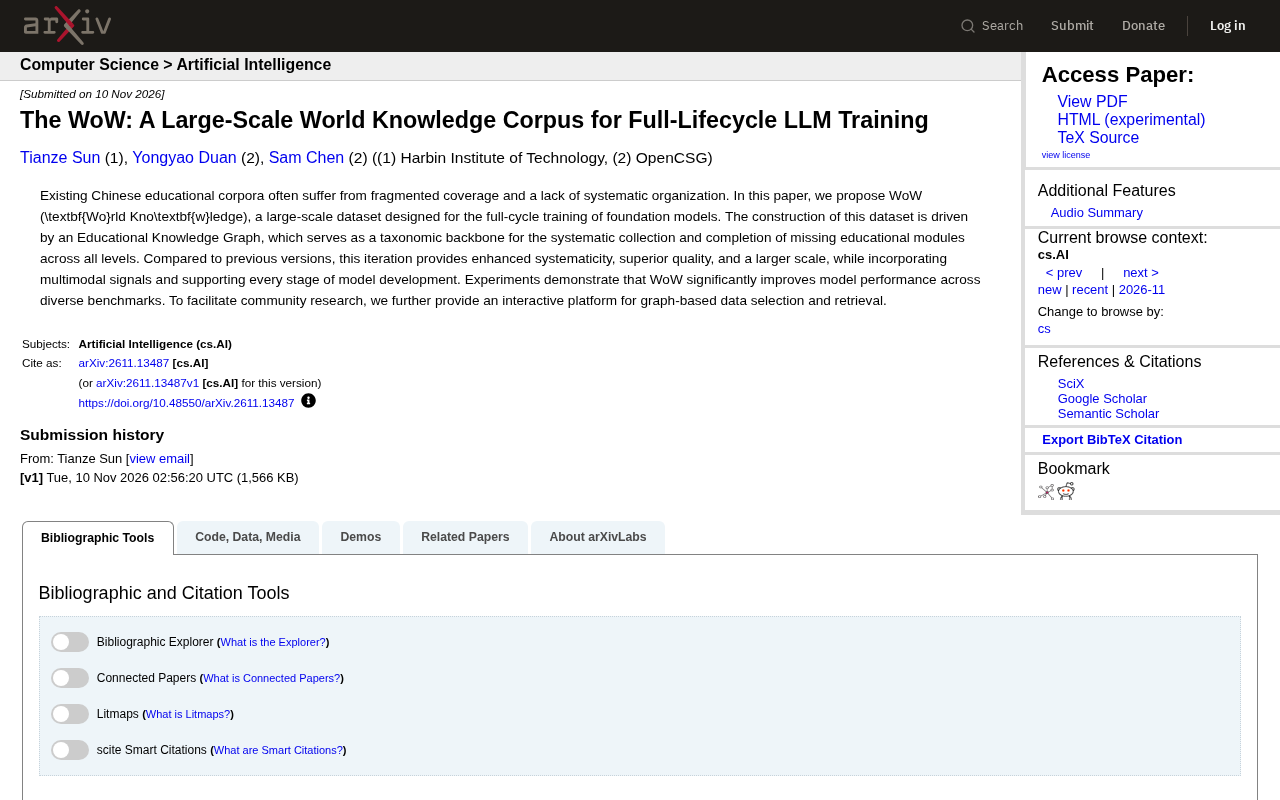
WoW builds structured Chinese educational corpora with educational knowledge graphs as the skeleton, addressing fragmentation and improving model performance.
To address the fragmentation and lack of systematic organization in Chinese educational corpora, the paper proposes the WoW dataset, which uses educational knowledge graphs as a classification skeleton to systematically collect and complete missing educational modules across all grade levels. Compared with previous versions, WoW improves in systematization, quality, and scale, and introduces multimodal signals to support all stages of model development. Experiments show that WoW significantly improves model performance on diverse benchmarks. The authors also provide an interactive platform that supports graph-based data selection and retrieval for community research. WoW represents an attempt to move Chinese educational corpora from "stacking quantity" toward "structuring," offering new ideas for Chinese LLM training corpus construction.
The Dilemma of Chinese Educational Corpora and WoW's Approach to Breaking Through
Existing Chinese educational corpora have long suffered from fragmented coverage and a lack of systematic organization, which directly constrains the performance of foundation models on knowledge-intensive tasks. A paper from rss proposes the WoW (World Knowledge) dataset, attempting to address this pain point at its root. Unlike the common "crawl-clean-stack" approach to corpus construction, WoW's core idea is to use educational knowledge graphs as a classification skeleton, systematically collecting and completing missing educational modules across all grade levels.
This design makes the dataset no longer a collection of scattered texts, but a structured, traceable knowledge system. The paper points out that the dataset is designed for the full-lifecycle training of foundation models, covering the complete requirements from pre-training to subsequent stages.
Educational knowledge graphs are structured knowledge bases for the education domain, typically using subjects, grade levels, knowledge points, and their prerequisite relationships as nodes and edges to form a hierarchical knowledge network. Unlike general knowledge graphs (such as Wikidata), educational knowledge graphs emphasize pedagogical logic and cognitive order—for example, in mathematics, the concept of "fractions" typically precedes "fractional equations." In corpus construction, such graphs can serve as a taxonomic skeleton to ensure that corpora are organized in an orderly manner by subject and grade level; at the same time, they can serve as gap-detection tools, identifying missing modules by comparing graph nodes with existing corpus coverage. WoW leverages this characteristic to transform corpus collection from a "crawl-clean-stack" process into a systematic "graph-driven, gap-completion" workflow.
How Knowledge Graphs Serve as the "Skeleton" of Corpora
From Classification Skeleton to Module Completion
WoW's construction is driven by educational knowledge graphs. The graph plays a dual role here: first, as a taxonomic backbone, delineating clear subject and grade-level boundaries for the corpus; second, as a gap-detection tool, identifying modules at each educational level that are not yet covered by existing corpora and completing them in a targeted manner. This "build the skeleton first, then fill in the flesh" approach stands in sharp contrast to simply expanding corpus size.
Multimodal signals refer to data in different modalities such as images, audio, and video, beyond plain text. In educational scenarios, multimodal signals may include charts, formula images, teaching video clips, and voice explanations. Introducing multimodal signals means that corpora are no longer limited to text but can cover richer forms of knowledge expression—for example, geometric figures assisting in understanding spatial relationships, or experiment videos demonstrating operational steps. For foundation models, multimodal corpora help train cross-modal understanding and generation capabilities, aligning with the trend of models evolving from text-only to multimodal. WoW explicitly supports multimodal signals, indicating that its design already considers the potential demand for multimodal data in full-lifecycle model training.
Triple Enhancement in Systematization, Quality, and Scale
The paper explicitly compares this iteration with previous versions, emphasizing enhancements in three dimensions: greater systematization, better quality, and larger scale. At the same time, the new version introduces multimodal signals, no longer limited to plain text, and explicitly supports every stage of model development. This means that WoW is positioned not as an evaluation set for a single task, but as corpus infrastructure spanning the entire training pipeline.
Experimental Performance and Community Support
The paper's experimental results show that WoW significantly improves model performance on diverse benchmarks. Although the abstract does not disclose the specific benchmark names or the magnitude of improvement, the phrase "significant improvement" combined with multi-benchmark validation indicates that its benefits are not limited to a single scenario.
To facilitate community research, the authors also provide an interactive platform that supports graph-based data selection and retrieval. The value of this accompanying tool lies in the fact that researchers can locate the required corpus by knowledge graph nodes, rather than blindly filtering through massive amounts of text. For teams that need targeted training and evaluation for specific subjects or grade levels, this graph-based retrieval capability is more practically meaningful than corpus size alone.
Interactive platform here refers to an online tool that allows researchers to perform data selection and retrieval based on educational knowledge graphs. Its core function is to associate corpora with graph nodes, enabling users to quickly locate and filter corresponding corpora by clicking on subject, grade-level, or knowledge-point nodes, without manually searching through massive amounts of text. This design improves the efficiency and precision of corpus usage, and is particularly suitable for teams that need targeted training or evaluation for specific instructional modules. The platform may also support data preview, download, and statistics functions, thereby lowering the barrier to community use and promoting corpus sharing and collaborative research.
Implications for Chinese LLM Training Corpus Construction
WoW's approach reveals an easily overlooked issue: the "quantity" and "structure" of corpora are not equivalent. Fragmented corpora, even if massive in scale, are hard-pressed to support models in forming systematic knowledge representations; whereas corpora with knowledge graphs as their skeleton can convey clearer knowledge organization logic during training.
The graph-driven construction approach also provides a foundation for corpus interpretability and maintainability—when corpora correspond one-to-one with graph nodes, both gaps and redundancies become locatable and repairable. The addition of multimodal signals aligns with the trend of foundation models evolving toward multimodality.
Of course, the paper's abstract does not elaborate on the details of graph construction, the specific types of multimodal signals, or the actual usability of the platform—these remain to be disclosed in the full text. But in terms of direction, WoW represents a meaningful attempt to move Chinese educational corpora from "stacking quantity" toward "structuring."
One-line Summary
WoW builds structured Chinese educational corpora with educational knowledge graphs as the skeleton, addressing fragmentation and improving model performance.
Paragraph Summary
To address the fragmentation and lack of systematic organization in Chinese educational corpora, the paper proposes the WoW dataset, which uses educational knowledge graphs as a classification skeleton to systematically collect and complete missing educational modules across all grade levels. Compared with previous versions, WoW improves in systematization, quality, and scale, and introduces multimodal signals to support all stages of model development. Experiments show that WoW significantly improves model performance on diverse benchmarks. The authors also provide an interactive platform that supports graph-based data selection and retrieval for community research. WoW represents an attempt to move Chinese educational corpora from "stacking quantity" toward "structuring," offering new ideas for Chinese LLM training corpus construction.
Related articles

How Do Cursor, Devin, TRAE, and Copilot Compare on Price? Calculate Your Credits Before You Compare Monthly Fees
Side-by-side comparison of individual and team pricing for Cursor, Devin Desktop, TRAE, and Copilot, breaking down credit rules, third-party model inclusion, overage billing, and practical methods for measuring usage before paying, setting spending caps, and choosing the right tool.
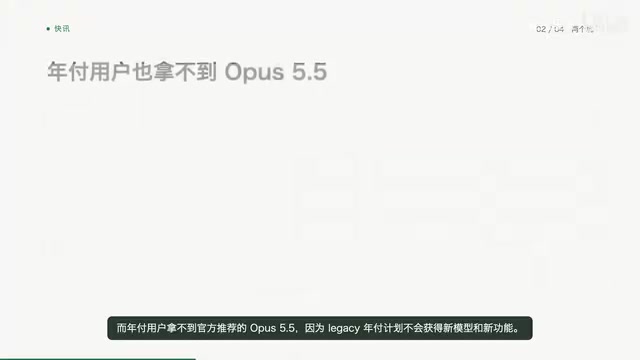
Copilot Retires Three Models: Pro Users Left With Only One Alternative
GitHub Copilot retires Claude Opus 4.8, Claude Opus 5, and GPT-5.6 Tera on Nov 16 across Chat, code completion, and Agent mode. Pro users have only GPT-6 Luna left; Legacy annual plans miss Opus 5.5; admins must enable replacements manually.
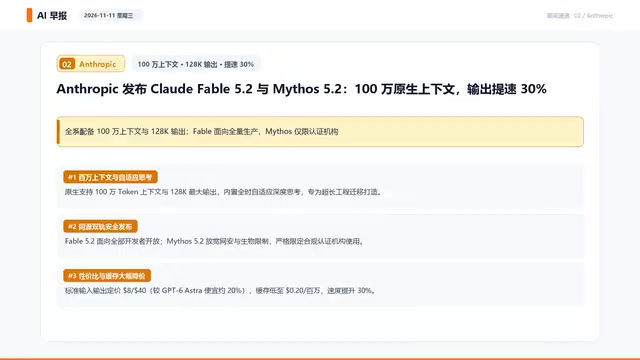
Gemini 4 Carbon Arrives: The LLM Race Enters the Era of Million-Token Context and Trillion-Parameter Open Source
Google launches Gemini 4 Carbon and multi-agent tool Swarm; Anthropic debuts million-context Fable 5.2 and Mythos 5.2; OpenAI releases security-focused GPT-6 Cyber; Mistral and Kimi open-source trillion-parameter models — the LLM race accelerates across the board.