X1 Review: AI-Powered iPhone App Generator That Takes You From Idea to App Store

X1 is an AI iOS app builder that guides non-coders from idea to App Store publication step by step.
X1 is an AI-powered iOS app builder that topped Product Hunt, positioning itself as 'Lovable for iPhone apps.' Instead of one-shot generation, it uses step-by-step guided collaboration, real-device iPhone preview, and full App Store submission management to help non-technical users build and publish native iOS apps. Key challenges include passing Apple's strict review guidelines and handling complex app maintenance.
In the current wave of AI-assisted programming (Vibe Coding) sweeping across software development, a product called X1 has topped the Product Hunt charts with 223 upvotes and 42 comments. Its positioning is remarkably straightforward — dubbed "Lovable for iPhone apps," it aims to let ordinary people go from an idea all the way to App Store publication without writing a single line of code.
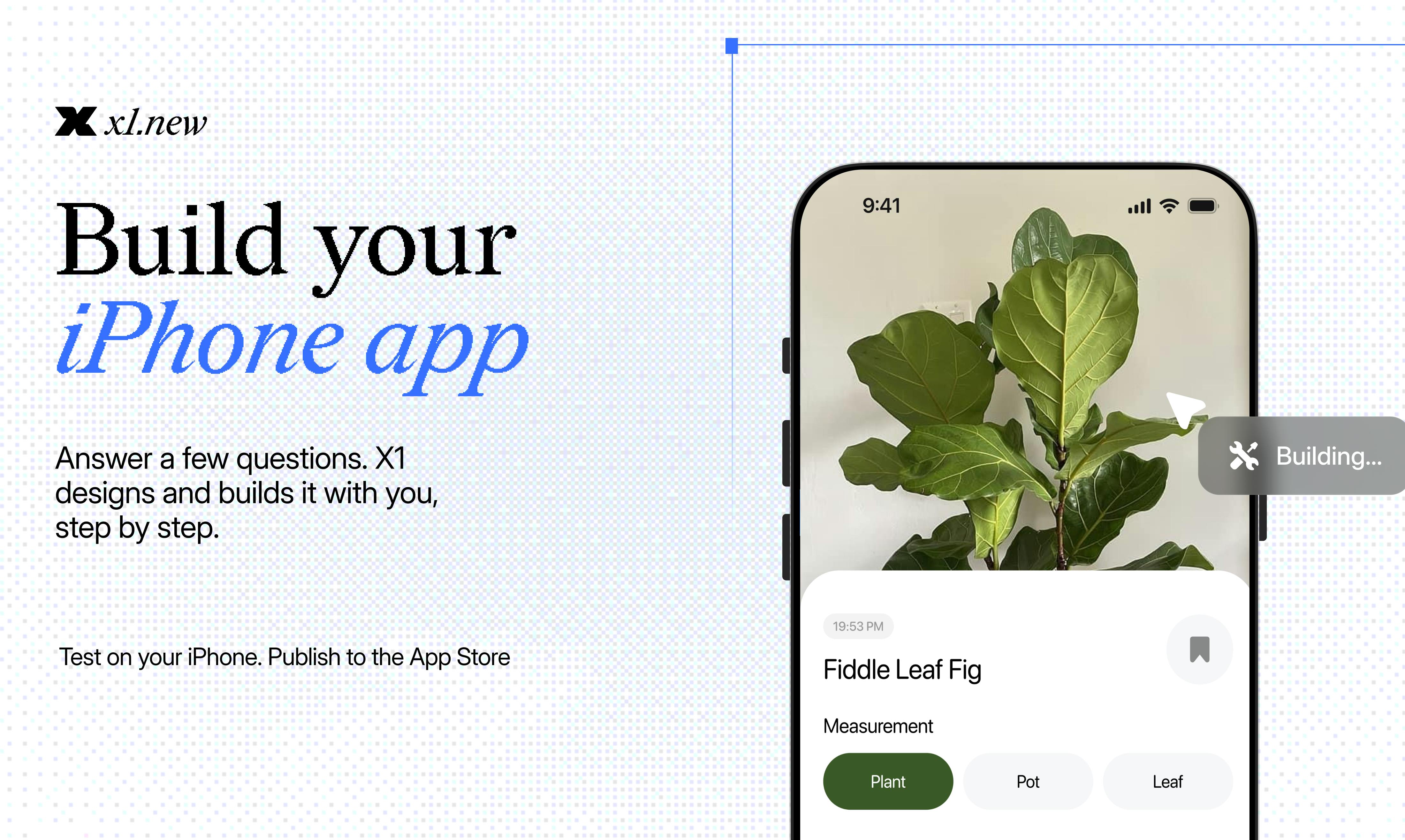
What X1 Is: An AI-Powered iOS App Builder
At its core, X1 is an AI-powered iOS app builder. The pain point it targets is crystal clear: for the vast majority of people who have product ideas but lack development skills, there's an enormous technical chasm between "having an idea" and "publishing on the App Store." iOS development involves Swift/SwiftUI, Xcode configuration, developer accounts, signing certificates, review guidelines, and the App Store submission process — each step alone is enough to deter non-technical creators.
To understand the depth of this chasm, consider the complexity of the iOS native app development tech stack. Swift is the modern programming language Apple introduced in 2014, while SwiftUI is the declarative UI framework released in 2019 — together they form the mainstream technology choice for current iOS development. Xcode is Apple's official integrated development environment (IDE), which is massive in size and runs exclusively on macOS. Code Signing is Apple's security mechanism for verifying the legitimacy of an app's source, requiring developers to pay $99 annually to join the Apple Developer Program. These technical barriers stacked together make the entry cost for iOS development far higher than web development — where all you need is a browser and a text editor to get started.
X1 attempts to use AI to connect this entire chain, achieving end-to-end delivery "from idea to App Store." At the intersection of No-Code and Vibe Coding, it has found a landing spot that's specific enough and compelling enough to stand out.
Vibe Coding: A New Programming Paradigm
Vibe Coding is a concept proposed by OpenAI co-founder Andrej Karpathy in early 2025, referring to developers describing desired functionality to AI in natural language, with the AI then handling the actual code writing. Unlike traditional programming, Vibe Coding emphasizes "expressing intent" rather than "writing logic" — the developer acts more like a product manager or director, while the AI is the executor. The popularity of this concept reflects the rapid advancement of large language models' code generation capabilities and has spawned an explosion of AI programming tools like Cursor, Windsurf, Lovable, and Bolt. X1 is a representative product from this wave targeting the mobile space.
Why the Lovable Comparison
Lovable is the star product in the AI website-building space, known for "generating complete web applications from natural language descriptions." By adopting the tagline "Lovable for iPhone apps," X1 is sending a clear signal to the market: replicating the "conversational app generation" experience that Lovable validated on the web, bringing it to the more closed and higher-barrier native iPhone app ecosystem.
Lovable (formerly GPT Engineer) is one of the most representative products in the AI web-building space from 2024-2025, developed by a Swedish team. Users simply describe their desired web application in natural language, and Lovable automatically generates a complete full-stack application including frontend interface, backend logic, and database connections, with one-click deployment support. It has achieved #1 on Product Hunt's daily chart multiple times, raised over ten million dollars in funding, and is considered the benchmark case for the fusion of No-Code and AI Code Generation. Lovable's success proved the viability of "conversational app generation" on the web, but native mobile applications have lacked an equivalent solution due to ecosystem closedness and review mechanisms — this is precisely the market gap X1 is trying to fill.
X1's Core Feature: Step-by-Step Guided App Generation
The most noteworthy aspect of X1's design isn't "AI can generate apps" — that's no longer novel today — but rather the generation path it has chosen.
Avoiding the "One-Click Generation" Trap
The official description specifically emphasizes: X1 does not attempt to generate an entire app from one prompt. This is an important product judgment. Experience has long shown that asking a large model to "generate a complete app from a single sentence" often produces results that are structurally chaotic, difficult to modify, and impossible to actually ship. X1 takes the opposite approach, using a step-by-step guided method:
- Focused questioning: The AI asks targeted questions about your idea, progressively clarifying requirements
- Screen-by-screen design: It designs each interface for your review and editing
- Phased construction: The app isn't generated all at once but built module by module, phase by phase
This human-in-the-loop collaborative model ensures users retain control at every step and significantly reduces the risk of AI producing uncontrollable results in one shot.
Human-in-the-loop is an important paradigm in AI system design, referring to the preservation of human decision nodes within AI automated workflows, allowing humans to review, correct, and confirm at critical steps. This concept originates from cybernetics and human-computer interaction research and is particularly important in AI-generated content (AIGC) — purely automated generation often leads to error accumulation (so-called "hallucination cascading"), where small errors in early steps get amplified in subsequent steps, ultimately making the whole output unusable. Introducing human checkpoints maintains efficiency while ensuring quality, forming an iterative cycle of "generate-review-correct-continue." X1's choice of this path indicates the team has a clear understanding of AI's current capability boundaries.
Real-Device Preview: Build and Test as You Go
Another practical highlight: during the building process, users can directly preview and test the app on their own iPhone. This is especially critical for iOS development — there's often a gap between the real-device experience and design mockups. Touch interactions, navigation smoothness, and actual screen presentation all need to be verified on the device. X1 brings this step forward into the building process, rather than waiting until the end to discover problems.
In the traditional iOS development workflow, real-device testing itself is a cumbersome step: developers need to configure devices in Xcode, install Provisioning Profiles, connect devices via USB or wireless, and compile and install — the entire process is extremely unfriendly to beginners. X1 simplifies this experience into instant preview during the building process, essentially reducing the latency of the "perception-feedback" loop — a key factor in improving satisfaction in user experience design.
Bridging the Last Mile: App Store Submission Management
If interface generation is something many AI tools are already doing, X1's true differentiator lies in its attempt to solve the "last mile" — App Store publication.
For indie developers and no-code creators, the submission process itself is a significant hurdle: you need to prepare app screenshots, write store descriptions, configure metadata, and pass Apple's strict review. X1 helps users complete these tasks, including:
- Preparing the App Store listing
- Generating app screenshots
- Handling the submission process
If these capabilities are truly as mature as described, then X1 offers not just a "generator" but a complete productization pipeline. This is also a key reason it reached #1 in its category on Product Hunt — it delivers a promise of a complete closed loop, not a half-finished product.
It's worth noting that Product Hunt is one of the world's most influential new product launch platforms, founded in 2013, where the community votes daily to select the most noteworthy new products. In tech startup circles, Product Hunt first-day ranking is considered an important indicator of product-market appeal. Achieving #1 on the daily chart brings not only a large number of early users and media attention but also serves as strong evidence of product-market fit for investors. X1's 223 votes represent a relatively high level on the platform, indicating it has generated significant attention in the developer and entrepreneur community.
X1's Potential Challenges and Use Cases
As a new product, X1's ambitious vision comes with several real-world issues worth watching.
Can Generated Quality Pass Apple's Review
Apple's App Store review is notoriously strict, particularly with a clear tendency to reject apps that are functionally homogeneous, template-based, or lacking substantive content (such as Guideline 4.3). How AI-generated apps avoid being classified as "low-quality reskinned apps" will directly determine whether X1 can deliver on its "publication" promise.
Specifically, App Store Review Guidelines Section 4.3 specifically targets "Spam," explicitly stating that apps with duplicate functionality, template-generated apps, and apps lacking unique value are not accepted. In recent years, as No-Code tools and AI generation tools have proliferated, a flood of low-quality apps has entered the App Store, and Apple's review team has significantly increased rejection rates for such applications. The review team checks whether apps have sufficient original functionality, whether they're simply WebView wrappers, whether the UI is overly template-like, and more. This means that if AI-generated apps cannot demonstrate sufficient differentiation and functional depth, they face a high risk of rejection. How X1 balances standardized generation processes with personalized output is the key technical challenge for its ability to consistently deliver on its promises.
Maintainability and Deep Customization Capabilities
While step-by-step guidance improves controllability, the maintainability of AI-generated code, subsequent iteration capabilities, and support for complex business logic remain longstanding issues for No-Code tools. How complex an application X1 can support still awaits validation through more real-world cases.
This problem is universal across the entire No-Code/Low-Code industry. Early users are often attracted by the rapid prototyping experience, but when a product enters its growth phase and needs complex features added (such as payment integration, push notifications, data synchronization, background task processing, etc.), the tool's limitations become apparent. Additionally, when users want to migrate away from the platform (i.e., "export code for self-maintenance"), the quality and readability of AI-generated code will directly determine migration costs.
Who Should Use X1
X1's value is most direct for entrepreneurs, designers, and content creators who "have ideas but lack technical skills." For teams with existing development capabilities, its appeal lies more in "accelerating prototype validation" rather than "replacing professional development."
Conclusion: A Pragmatic Exploration in the Vibe Coding Era
X1 represents a very specific and pragmatic direction under the Vibe Coding trend: rather than pursuing flashy "build an app with one sentence" demos, it embeds AI capabilities solidly into the entire 0-to-1 process of iOS app development through step-by-step collaboration, real-device verification, and submission management. Built by three makers — Tushar Chopra, Muhammad Inamullah, and Manil Lakabi — it has already gained initial market validation on Product Hunt.
Whether it can truly cross the App Store review threshold and turn "everyone can build iPhone apps" from a slogan into reality will be the most worthwhile story to follow. From a broader perspective, X1's emergence also reflects the industry trend of AI programming tools migrating from "assisting professional developers" to "empowering non-technical users" — as AI handles increasingly more technical details, "programming" itself is being redefined as a form of creative expression rather than a technical skill.
Key Takeaways
Related articles

Cursor AI Programming in Practice: Build a Student Management System from Scratch in 30 Minutes
A Bilibili creator demonstrates Cursor AI programming: generating a student management system in 30 minutes with natural language. Details on Agent mode, Claude selection, prompt techniques, and thresholds.

Top 20 AI Coding Tools Ranking: From Rock-Solid to Lackluster, a Scored Matrix
Bilibili creator releases top 20 AI coding tools ranking, tiered T0–T4 from rock-solid to lackluster, with Claude Code and Codex tied at T0. This article details the scoring dimensions (capability, reliability, robustness, durability, cost, domestic availability) and tool performances to help developers choose the right AI coding assistant.

Vibe Coding Systematic Tutorial: Master AI-Assisted Programming from Zero
A three-month Vibe Coding tutorial from a Bilibili creator covering Codex, ClaudeCode, and Cursor, from core logic to commercial project practice for beginners.