x402 Protocol Explained: The Truth About AI Agent Autonomous Payments and the Overlooked Pitfalls
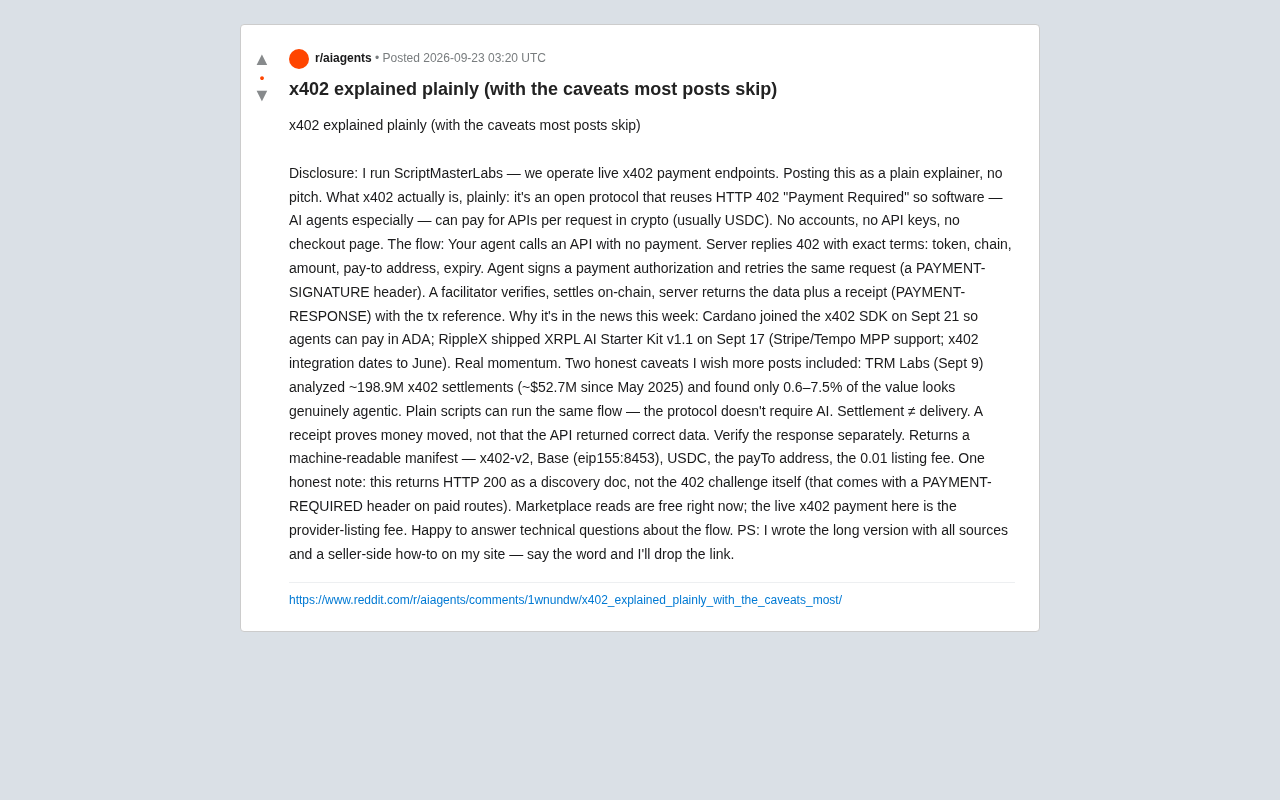
x402 revives HTTP 402 for keyless AI Agent crypto payments, but real AI-driven volume is tiny and settlement doesn't guarantee correct data delivery.
x402 is an open protocol that reactivates the HTTP 402 "Payment Required" status code, enabling AI Agents to pay per request with stablecoins like USDC through a four-step request-response loop — no accounts or API keys needed. Cardano and RippleX have recently joined the ecosystem, signaling genuine multi-chain traction. However, two pitfalls demand attention: TRM Labs analysis of ~198.9M settlements found only 0.6–7.5% of value was truly AI-driven, with most likely coming from ordinary scripts; and on-chain receipts only prove funds moved, not that the API returned correct data — response correctness must be validated separately at the application layer.
What Exactly Is x402
x402 is an open protocol that repurposes the long-dormant HTTP 402 status code — "Payment Required" — which had been sitting unused since the early days of the web. Its goal is straightforward: allow software, especially AI Agents, to pay per request when calling APIs, settling directly in cryptocurrency (typically USDC). No accounts, no API keys, no traditional checkout pages required.
For an AI Agent ecosystem that's becoming increasingly autonomous, this is a genuinely imaginative solution. Traditional API calls require a human to pre-register, link a payment method, and manage credentials. x402 embeds payment capability directly into the HTTP interaction itself, enabling machines to autonomously complete the full loop of "discover service → pay → receive data."
The history of HTTP 402 is interesting in its own right. Defined in the HTTP/1.0 specification back in 1991, it was originally envisioned for access control over paid digital content — but because the early internet lacked viable micropayment infrastructure, the status code was never formally adopted and remained "reserved but unused" for over three decades. Now, the maturity of blockchain and stablecoins has finally provided a workable settlement layer beneath it. Stablecoins like USDC enable programmable, permissionless value transfer on-chain, making automated machine-to-machine settlement technically feasible. The x402 protocol takes its name directly from this status code; its core insight is that HTTP already defines the semantics of "payment required" — what was missing was a standardized mechanism for payment negotiation and settlement.
A Full Breakdown of the Payment Flow
The logic behind x402 isn't complicated. It breaks down into four steps:
- Initiate the request: Your Agent calls an API without any payment information.
- Receive a 402 response: The server returns HTTP 402, along with explicit transaction terms — token type, chain, amount, recipient address (
pay-to), and expiration. - Sign and retry: The Agent signs a payment authorization and resends the same request via the
PAYMENT-SIGNATUREheader. - Verify and settle: A "facilitator" validates and completes the on-chain settlement; the server then returns the data along with a receipt (
PAYMENT-RESPONSE) containing a transaction reference.
The elegance here is that the entire payment negotiation is stuffed inside the standard HTTP request-response cycle — no out-of-band interactions, and the whole thing can run fully automated.
The "facilitator" is a key architectural component of x402 worth explaining on its own. A facilitator isn't a centralized clearing institution — it's a service node responsible for validating the payment signature submitted by the Agent and broadcasting the transaction to the blockchain. It addresses a core trust problem: API providers don't need to run their own blockchain nodes, nor do they have to wait for on-chain confirmations before returning data. The facilitator provides instant proof of payment and takes on the responsibility of subsequent on-chain settlement. The degree of decentralization varies across different chains and implementations. Custodial facilitators offered by institutions like Coinbase lower the barrier to entry but introduce certain trust assumptions; developers need to weigh facilitator reliability against their own risk tolerance.
Why It's Been All Over the News Lately
According to the original poster (the team behind ScriptMasterLabs, who have actually deployed x402 payment endpoints), the recent surge in attention comes from several ecosystem developments:
- Cardano joined the x402 SDK on September 21, enabling Agents to pay with ADA.
- RippleX released XRPL AI Starter Kit v1.1 on September 17, with support for Stripe/Tempo MPP — though its x402 integration actually dates back to June.
Multiple chains and payment solutions onboarding in quick succession suggests that x402 has built genuine momentum in the Agent payments space, rather than just riding a wave of conceptual hype.
Two Critical Pitfalls Most Articles Skip Over
What makes this breakdown valuable is its honesty about two problems that marketing copy tends to gloss over.
Pitfall #1: The Share of "Agent Payments" May Be Wildly Overstated
In a September 9 analysis, TRM Labs examined roughly 198.9 million x402 settlements (totaling approximately $52.7 million since May 2025) and found that only 0.6% to 7.5% of that value appeared to be genuinely AI Agent-driven.
The reason is simple: the protocol itself doesn't require the caller to be an AI. Any ordinary script can run through the same flow. In other words, "x402 transaction volume" does not equal "AI Agent economy scale" — a large portion of those settlements may simply be automation scripts, or even artificial volume. Conflating protocol adoption with a thriving autonomous AI economy is a common misreading.
Pitfall #2: Settlement ≠ Delivery
The second point is more technical but equally important: an on-chain receipt only proves that money moved — it does not prove that the API returned correct data. The PAYMENT-RESPONSE receipt attests to the flow of funds, not the quality of service.
This means developers integrating x402 can't naively assume that "paid = got the right result." Response correctness must be verified separately. For Agent systems relying on x402 for autonomous payment, this is a trust gap that must be addressed at the architecture level — otherwise an Agent could repeatedly pay for garbage data without ever noticing.
This problem is known in economics as the "Delivery versus Payment" (DvP) problem, a core challenge that traditional finance has long struggled to solve. Conventional solutions typically rely on escrow accounts or central securities depositories (CSDs) to ensure asset transfers and fund settlements complete atomically. In the x402 context, because "data" can't be natively locked on-chain and atomically exchanged the way financial assets can, DvP is technically very difficult to fully eliminate. One mitigation approach is introducing reputation systems or staking mechanisms — service providers stake assets and are penalized if their responses are verified to be incorrect. Another approach is incorporating verifiable computation (such as zero-knowledge proofs) at the protocol layer to attest to the provenance and integrity of data. Both are early-stage explorations; in production x402 environments today, developers are largely left to validate response content themselves at the application layer.
One Practical Technical Detail
The original poster also clarified an implementation detail that's easy to misunderstand. Their marketplace interface returns a machine-readable manifest (x402-v2, Base chain eip155:8453, USDC, payTo address, 0.01 listing fee).
But here's the key: this discovery document returns HTTP 200, not a 402 challenge. The actual 402 challenge is issued via a PAYMENT-REQUIRED header on the paid route. Reading the current marketplace is free — the x402 payment is triggered at the "service provider listing fee" step. This distinction matters a lot for developers building seller-side services; conflating the discovery layer with the payment layer is an easy mistake to make.
Takeaway: A Grounded View of x402
x402 is an elegantly designed protocol that is gaining real ecosystem support, offering AI Agents a standardized path to autonomous payment. But two honest caveats are worth keeping in mind: the AI-driven share of current transaction data is far lower than promotional narratives suggest, and on-chain settlement does not guarantee the correctness of data delivery.
For developers, x402 is worth experimenting with and tracking — but in production environments, response validation is non-negotiable, and "adoption" metrics deserve healthy skepticism. The genuine Agent economy is still in its infancy, and there's a significant gap between protocol maturity and the heat of the surrounding narrative.
Related articles

Free Unlimited Claude Code Solution: Agnes AI + CC Switch Setup Guide
No paid subscription needed — pair the free AI platform Agnes AI with the open-source tool CC Switch to provide a backend for Claude Code, enabling unlimited free calls to text, image, and video models. This guide covers the full setup, test results, and usage boundaries.

A Complete Zero-Cost Guide to Getting Started with Claude Code for Beginners in China
A beginner's guide to Claude Code for users in China: two installation methods (command line and IDE plugin), full configuration steps for replacing the official API with the free domestic LongCat model, and a hands-on demo of building a small tool with natural language, plus tips.

When the NSA Gets Involved: The AI Supply Chain Crisis Behind Open-Source CVEs and API Key Hijacking
Multiple open-source projects disclosed severe CVEs in one day, PHP flaws alarmed the FBI, and Railway and OpenCode were breached with API keys stolen. This article breaks down the vulnerability window, AI-accelerated exploitation, and the AI supply chain crisis behind the API key black market, with a developer defense checklist.