xAI Launches Grok Bot Office Agent, Gemini Surpasses 1 Billion Monthly Active Users

xAI launches Grok Bot agent, Gemini hits 1B MAU, and Microsoft's Maya 200 chip undercuts NVIDIA by 40%.
Major AI developments include xAI's Grok Bot, an office agent that independently logs into tools and executes tasks; Google's Gemini reaching 1 billion MAU as its fastest-growing product; Microsoft's Maya 200 chip reportedly 30-40% cheaper than NVIDIA; Claude Opus 5 Max reclaiming top benchmark positions; and Mistral planning to host China's GLM model, signaling open-source ecosystem globalization.
This article summarizes AI industry developments from August 12, 2026. Please note that some items (such as the Terminal Bench 3.0 rankings and Mistral hosting Chinese models) have not yet been officially confirmed. Readers are advised to exercise judgment based on original sources.
xAI Launches Grok Bot: An AI Teammate That Can Log Into Your Tools
xAI officially announced today that its office assistant agent Grok Bot is rolling out in early beta to the public. Unlike traditional chat-based assistants, Grok Bot is positioned as an "AI teammate" with independent execution capabilities—it has its own computing environment, can log into users' various tools, perform operations like a real person, and deliver completed work.
This marks a critical step in AI applications evolving from "conversational assistance" to "task delegation." Previously, we were accustomed to asking AI questions, getting answers, and then executing tasks ourselves; Grok Bot's approach lets AI directly take over workflows—users simply set objectives, and the agent handles login, operations, and delivery entirely on its own.
Background on the Agent Paradigm: This "task delegation" paradigm stems from the ongoing evolution of the Agent concept in AI. Traditional large language model interactions follow a "human asks, AI answers" conversational model, requiring users to translate suggestions into actions themselves. The Agent paradigm introduces a complete "perceive-plan-execute" closed loop: agents can observe environmental states, formulate multi-step plans, invoke external tools to complete operations, and dynamically adjust strategies based on execution results. The key breakthrough in this architecture lies in the maturation of "Tool Use" and "environment interaction" capabilities—since 2024, OpenAI's Function Calling, Anthropic's Computer Use, and Google's Gemini Agent framework have successively launched, giving AI the foundational ability to operate browsers, terminals, APIs, and other external systems. Grok Bot's design of "having its own computer" essentially provides the agent with an isolated sandbox environment, ensuring both security and the ability to persistently run long-duration tasks.
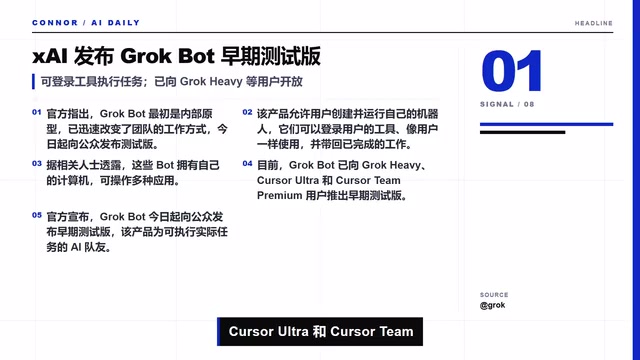
Currently, Grok Bot has adopted a measured distribution strategy, initially available only to Grok Heavy, Cursor Ultra, and Cursor Team Premium users. The choice to deeply integrate with developer tools like Cursor reveals xAI's intent to first validate agent reliability in programming and engineering scenarios—after all, code environment outcomes are the easiest to objectively evaluate.
From Tool to "Colleague"
Notably, Grok Bot's design of "having its own computer" means the agent no longer depends on the user's local session but instead has a continuously running independent workspace. This architecture makes long tasks and asynchronous collaboration possible: you can assign a task and walk away while the AI continues working in the background. This is precisely the core competitive direction in the current agent landscape.
Gemini Surpasses 1 Billion Monthly Active Users: Google's Fastest-Growing Product
Google officially announced that Gemini's monthly active users have reached 1 billion, making it the 14th Google product to cross this threshold and the fastest-growing product in the company's history. Google DeepMind CEO Demis Hassabis immediately posted congratulations.
About Google's 1 Billion MAU Club: The 13 Google products that previously crossed this threshold include Search, Gmail, YouTube, Chrome, Google Maps, Google Play, Google Drive, Google Photos, and others. These products share the common characteristic of being deeply embedded in the Android ecosystem and Google Account system, forming a powerful cross-distribution network. Android has over 3 billion active devices globally, and any app pre-installed or deeply integrated into the system has a natural advantage for achieving scale.
For Google, Gemini's scaling validates its catch-up capability in the consumer AI market. From follower to commanding 1 billion MAU, Gemini leveraged the natural distribution advantages of the Android ecosystem, Search entry points, and the Workspace office suite for rapid penetration. Gemini's growth path exploited Google's "infrastructure-level distribution" mechanism: it was integrated into Search's AI Overview feature, Android's system assistant entry point, and Workspace's document and email editing flows. This capability represents a structural moat that pure startups cannot replicate, which also explains why OpenAI and Anthropic have recently been accelerating independent distribution for their consumer-facing applications. This figure once again demonstrates that during the AI application adoption phase, distribution channels are often as important as model capabilities.
Microsoft Maya 200 Chip: 30% to 40% Lower Cost Than NVIDIA
According to an exclusive report from The Information, Microsoft claims its self-developed Maya 200 chip has operating costs 30% to 40% lower than the most advanced NVIDIA chips when running certain OpenAI and Microsoft models. However, this has not yet been officially confirmed by Microsoft.
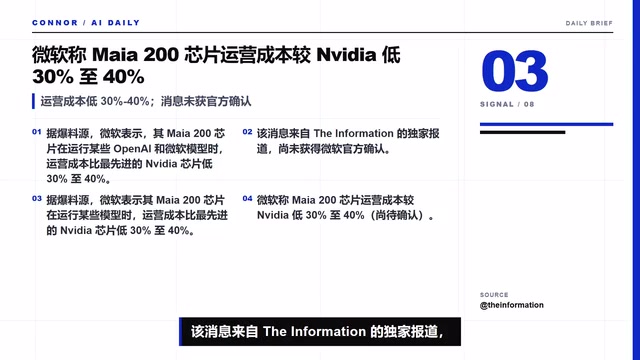
Industry Background—Custom Chips and the "De-NVIDIA" Wave: NVIDIA has long held over 80% market share in AI training and inference chips, with its GPUs (particularly the H100/H200/B200 series) serving as the de facto standard for large model training. However, NVIDIA chips' high prices (approximately $25,000-$40,000 per H100) and supply constraints have prompted hyperscale cloud providers to launch custom chip programs. Google's TPU series has iterated to the sixth generation (Trillium), Amazon's Trainium/Inferentia focuses on separating training and inference, and Microsoft's Maya series has expanded from Cobalt ARM CPUs into AI accelerators. The core economic logic of custom chips is: when inference requests reach billions per day, even saving a few cents per inference can translate to billions of dollars in annual savings.
If the data holds true, this would be another significant milestone in hyperscalers' "de-NVIDIA" efforts. As inference demand grows explosively, chip costs directly determine AI service gross margins. The continued investment in custom AI chips by giants like Microsoft, Google, and Amazon is fundamentally motivated by reducing dependence on a single supplier and compressing long-term costs. A 30% to 40% cost advantage, if consistently reproducible in production environments, could reshape data center procurement patterns and profoundly impact Microsoft Azure's AI service pricing strategy.
Benchmark Shifts: Claude Opus 5 Max Reclaims the Top Spot
In model capability evaluation, several benchmark updates are noteworthy today:
- According to an analyst account leak, Terminal Bench 3.0 benchmark results were released, with Claude Opus 5 Max scoring 43.5% to surpass GPT-5.6-Sol's 34.6%, reclaiming the top position among state-of-the-art models (the original data had some discrepancies; the relative ranking is used here).
- Evaluation firm Artificial Analysis launched a new agent benchmark called AA-Analyst Agent, focused on real-world quantitative analysis of spreadsheets and documents. Opus 5 leads with 54%, followed by GPT-5.5 and Fable 5.
Background on Evaluation System Evolution: AI model evaluation has gone through several phases. Early benchmarks like MMLU and HellaSwag primarily measured language understanding and knowledge; subsequently, SWE-bench introduced real code repair tasks, and GPQA tested graduate-level reasoning. Now Terminal Bench and AA-Analyst Agent represent a third-generation evaluation philosophy: directly measuring models' task completion abilities in real tool environments. Terminal Bench requires models to execute complex system administration and development tasks in a Linux terminal, while AA-Analyst Agent simulates real data analysis workflows—opening spreadsheets, understanding data structures, performing calculations, and generating reports. Scores dropping from the high ranges of traditional benchmarks to the 40-50% range precisely indicates that these tasks still provide sufficient discriminating power for current models.
It's worth noting that Terminal Bench results currently come from unofficial channels and await verification. However, both benchmarks point to a common trend: evaluation is shifting from pure language ability to real-world task execution capability, particularly in quantifiable office and engineering scenarios like terminal operations and spreadsheet analysis—closely aligned with the development direction of agent products like Grok Bot.
Mistral Plans to Host China's GLM Model: Open-Source Ecosystem Crosses Geopolitical Boundaries
According to leaks, European AI company Mistral has announced that its platform will begin supporting third-party open-source models, with China's GLM 5.2 being the first selected—hosted directly by Mistral rather than simple API relay. This information has likewise not been officially confirmed.
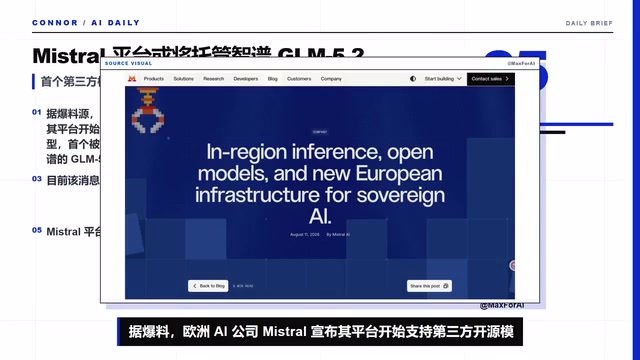
Background on Mistral and GLM: Mistral AI was founded in 2023 by former researchers from Meta and Google DeepMind, headquartered in Paris, and is Europe's most representative AI foundation model company. Its strategic positioning emphasizes open source, European data sovereignty, and multilingual capabilities. It has received multiple rounds of funding including from Microsoft, with a valuation exceeding $6 billion. The GLM series models are developed by Zhipu AI, affiliated with China's Tsinghua University, using a general language model architecture that excels in bilingual Chinese-English tasks. Mistral's choice to "host" rather than merely provide API forwarding means model weights are deployed directly on Mistral's European infrastructure—this both reduces cross-border latency and makes it possible for data to remain in Europe, which is particularly important for European enterprise users subject to GDPR constraints.
This development carries significant symbolic meaning. Mistral, as Europe's open-source AI representative, choosing to host China's GLM series models reflects how the open-source ecosystem is forming collaborative networks that transcend geopolitical boundaries. For developers, multi-model, multi-source hosting platforms mean more flexible selection options; for Chinese open-source models, gaining entry into a European mainstream platform's hosting lineup signals international recognition of technical capabilities. This move also reflects the "platformization" trend in the open-source AI ecosystem: model providers and hosting platforms are separating, with developers accessing the world's best models through unified interfaces.
Underlying Technical Optimizations and Video Generation Advances
At the infrastructure layer, independent semiconductor research firm SemiAnalysis published a technical analysis stating that a decoding optimization technique (KLRT) can improve decode interactivity by 1.9x while maintaining the same per-token cost on a single NVIDIA Blackwell GPU.
Technical Background on Decoding Optimization: The inference process for large language models is divided into two phases: prefill (processing input prompt tokens) and decode (generating output token by token). The decode phase is the primary source of user-perceived latency because each token's generation depends on attention computation over all preceding tokens, resulting in GPU utilization far below training-phase levels. Decoding optimization techniques like KLRT improve generation speed through methods such as reducing KV cache memory access overhead, optimizing attention computation parallelism, or introducing speculative decoding. "1.9x interactivity improvement" means significantly reduced time-to-first-token and inter-token latency in conversational scenarios—critical for latency-sensitive applications like real-time dialogue and code completion.
These inference-layer optimizations often offer better cost-effectiveness than hardware upgrades and are key to improving user experience, especially response speed. Achieving nearly 2x speed improvement without changing hardware delivers economic benefits far exceeding the purchase of new GPUs.
In video generation, LTX 2.5 was officially released, positioned as a "world model built for the world," with improved pixel fidelity, support for multi-shot scenes with cross-shot coherence, and a pre-trained base version.
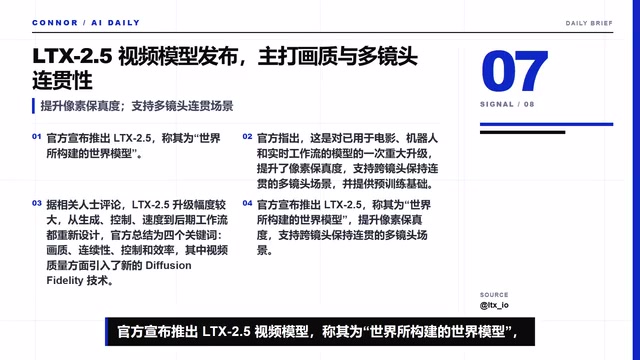
Technical Challenges of Multi-Shot Coherence: As AI video generation extends from single frames to continuous video, core technical challenges include temporal consistency (the same object doesn't deform across consecutive frames), physical plausibility (motion follows Newtonian mechanics), and narrative coherence (character/scene consistency across shots). Multi-shot coherence is among the most difficult problems: when the viewpoint switches from front to side, or jumps from indoor to outdoor, the model must maintain consistency in character clothing, facial features, environmental lighting, and other attributes. Traditional methods rely on character reference image embedding or LoRA fine-tuning to "anchor" identity information, but still tend to drift during complex scene transitions. LTX 2.5's emphasis on the "world model" concept suggests it may employ implicit 3D scene representation or persistent scene state encoding, enabling the model to "recall" world states established in previous shots when generating new ones.
Multi-shot coherence has long been a pain point in AI video generation—how to maintain character and scene consistency when switching viewpoints directly determines whether generated content can be used for real narrative creation. LTX 2.5's emphasis on this capability shows that the competitive focus of video models is shifting from single-shot image quality toward long-narrative coherence.
Conclusion
Looking at today's developments holistically, the AI industry is advancing simultaneously along three main threads: agentification (Grok Bot, AA-Analyst Agent), infrastructure cost reduction (Maya 200 chip, KLRT decoding optimization), and ecosystem openness (Mistral hosting open-source models). Most noteworthy is that AI is moving from "able to answer" to "able to execute"—both product forms and evaluation standards are converging toward real-world task capability.
As a reminder, several items in this article have not been officially confirmed. Readers are advised to rely on official announcements as the authoritative source.
Related articles

Apple HomeView Hands-On Review: Is the $300 Smart Home Hub Worth It?
Apple HomeView hands-on: a $300 smart home hub with facial recognition for quick account switching, but no App Store or voice recognition. Is the wall-mounted version worth it? Should you buy the first generation?

Meta Muse Wonder Launch: What It Means for Meta's Return to the Frontier AI Race
Meta releases Muse Wonder and WonderFull, benchmarks reach the frontier, community feedback is polarized. An in-depth look at Meta's return to the frontier AI race, its personal agent strategy, and Zuckerberg's different path.

Apple Home Smart Home Lineup Leaked: LG and Schneider Team Up, UWB Door Lock on Board
Apple Home ecosystem gains new LG and Schneider devices: UWB smart lock with proximity unlock, 2.5K dual-camera doorbell, privacy indoor camera, and AirPods-like seamless pairing.