xhigh Reasoning Doubles Cost but Struggles to Improve Pass Rate: SlopCodeBench Results

SlopCodeBench shows xhigh reasoning costs 2-4x medium but yields no reliable checkpoint pass-rate gains.
SlopCodeBench's October evaluation compared the same model at medium and xhigh reasoning effort, finding that xhigh consumes 2 to 4 times the resources but shows no statistically reliable checkpoint pass-rate improvement—some tasks even scored slightly lower. The analysis attributes this to a mismatch between breadth-oriented checkpoint evaluation and xhigh's tendency toward long chains on single problems, causing diminishing or negative marginal returns. The authors recommend defaulting to medium, tiering reasoning effort by task type, and optimizing prompt structure rather than blindly increasing reasoning length.
Introduction: Higher Reasoning Investment Doesn't Necessarily Yield Higher Pass Rates
A common intuition when using AI coding assistants is that letting the model "think longer" will produce better code. But the latest SlopCodeBench results throw cold water on this intuition. According to the benchmark's October test report, raising reasoning effort from medium to xhigh increased costs by 2 to 4 times, while the number of checkpoints passed showed no reliable improvement.
This finding has direct implications for developers who rely on AI coding tools day to day: blindly chasing the highest reasoning tier may mean paying for the "thinking process" rather than for "correct results."
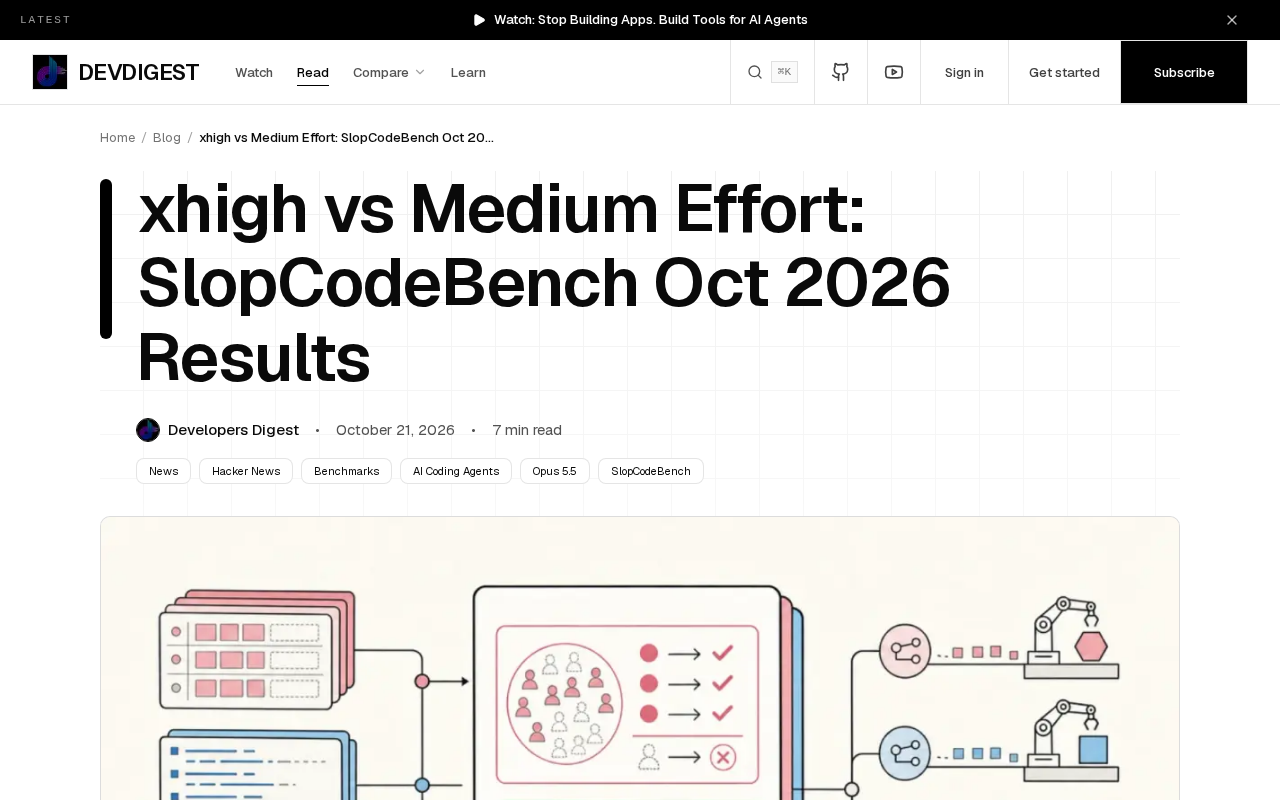
Evaluation Setup and Core Data
SlopCodeBench is a benchmark for code generation tasks that uses a "checkpoint" mechanism to assess whether model outputs satisfy a series of functional and quality requirements. This October run compared the same model's performance at two reasoning effort levels: medium and xhigh.
The key conclusions can be summarized in two points:
- Cost dimension: xhigh reasoning consumes 2 to 4 times the resources of medium, with the exact multiplier depending on task complexity and context length.
- Effectiveness dimension: xhigh showed no statistically reliable improvement in checkpoint pass rates. On some tasks the two were on par, and on a few tasks xhigh was even slightly lower.
This means the relationship between "more reasoning tokens" and "higher code correctness" is not linear—especially in checkpoint-style itemized evaluation, where additional reasoning investment is easily wasted on the model second-guessing itself or on inconsequential details.
Reasoning effort is an adjustable parameter offered by some large model APIs, with common tiers including low, medium, high, and xhigh. It essentially controls how many internal reasoning tokens (chain-of-thought length) the model generates before producing its final answer. Higher tiers allow more intermediate steps, self-checks, and backtracking, with billed tokens increasing accordingly. Note that this parameter does not change the model weights—it only changes the allocation of computational budget during inference, so its benefits depend heavily on task structure: for math or complex algorithm problems requiring multi-step derivation, longer reasoning chains are often effective; but for coding tasks where acceptance criteria are based on functional point coverage, overly long reasoning chains tend to produce redundant verification and irrelevant elaboration, with marginal returns decaying rapidly.
Why xhigh Didn't Deliver Better Results
Checkpoint Evaluation Amplifies the Cost of "Overthinking"
SlopCodeBench's checkpoint design breaks tasks down into multiple verifiable nodes. At the medium tier, the model often quickly hits the main checkpoints; at the xhigh tier, the model tends to develop longer reasoning chains on a single problem, which may actually deviate from the task's core acceptance conditions. This "depth-first" reasoning pattern is mismatched with the "breadth-coverage" scoring logic of checkpoints.
The checkpoint mechanism is an evaluation approach that breaks coding tasks into several independently verifiable functional points or quality requirements, with each checkpoint corresponding to an explicit assertion (e.g., a function returns a specific value, a boundary condition is handled). Unlike holistic human scoring, checkpoint evaluation is binary and cumulative—the model scores as long as it satisfies the assertion, regardless of whether the implementation path is elegant or the reasoning is deep. This design naturally favors "breadth coverage": quickly identifying and satisfying as many checkpoints as possible is more worthwhile than digging deep into a single difficult point. So when the model at the xhigh tier invests a large share of its reasoning budget into repeatedly refining one sub-problem, other checkpoints may be missed entirely, causing overall pass rates to drop rather than rise.
The Cost Structure Reveals Diminishing Marginal Returns
Reasoning costs grow with thinking length, but the checkpoint pass rate improvement curve flattens out after medium. The report explicitly states that the extra cost of xhigh does not correspond to reliable pass-rate gains—a classic case of diminishing marginal returns, and in some scenarios even negative returns.
Diminishing marginal returns in reasoning effort adjustment manifests as: as reasoning tokens increase, the magnitude of pass rate improvement gradually narrows until it approaches zero. There are three main reasons: first, most coding tasks concentrate their difficulty in a few key decisions, which the medium tier already covers; second, longer reasoning chains introduce more intermediate assumptions, and the model may overturn originally correct judgments during self-correction; third, checkpoint evaluation gives the same score for "correct once" and "correct after repeated confirmation," so extra reasoning cannot translate into extra points. When the added reasoning cost exceeds the expected pass-rate gain it brings, marginal returns become negative—which is the likely explanation for xhigh's slightly lower performance on some tasks in the report.
Practical Recommendations for Developers
Based on this data, here are several actionable recommendations.
Use the medium tier by default. For most everyday coding tasks, medium strikes a better balance between cost and effectiveness. Unless the task itself requires long-chain reasoning (such as complex algorithm design or multi-file refactoring), there's no need to raise reasoning effort.
Configure reasoning effort in layers by task type. Reserve high reasoning tiers for scenarios that genuinely require deep thinking, rather than enabling them globally by default. This avoids wasting several times the cost on simple tasks.
Focus on checkpoint coverage rather than reasoning length. If your team's acceptance criteria are itemized checkpoint-style, optimizing prompt structure and clarifying acceptance conditions is more effective than simply raising reasoning effort.
Limitations and Follow-up Observations
One caveat: these results come from a single benchmark's October run, with certain limitations in sample scope and task types. The relationship between reasoning effort and code quality may vary by model version and task domain. Worth watching going forward: whether this conclusion holds up across different benchmarks, and whether model vendors will optimize reasoning allocation strategies to address the "overthinking" problem.
For teams building AI coding workflows, the value of this data lies in providing a calibration point: while pursuing stronger model capabilities, cost efficiency is also a variable that cannot be ignored in engineering decisions.
One-line Summary
SlopCodeBench tests show xhigh reasoning costs 2-4x medium but yields no reliable checkpoint pass-rate improvement.
Paragraph Summary
SlopCodeBench's October evaluation compared the same model's code generation performance at medium and xhigh reasoning effort. It found that xhigh consumes 2 to 4 times the resources of medium but shows no statistically reliable improvement in checkpoint pass rates, with some tasks even slightly lower. The article analyzes that checkpoint-style evaluation emphasizes breadth coverage, while xhigh tends to develop long reasoning chains on single problems—a mismatch that leads to diminishing or even negative marginal returns. Based on this, the authors recommend developers default to the medium tier, configure reasoning effort in layers by task type, and prioritize optimizing prompt structure and acceptance conditions rather than blindly increasing reasoning length. They also note that the conclusion comes from a single benchmark run and needs validation for robustness across more tasks and model versions.
Related articles

Frontend to AI Agent Development: A Frontline Architect Explains Career Paths and Opportunities
A frontline AI architect explains the industry changes and practical paths for frontend developers transitioning to AI Agent development: why pure frontend jobs are disappearing, why Agent + full-stack has become mainstream in hiring, and three transformation routes—Agent development engineer, FDE, and remote contracting—along with corresponding learning strategies.

How to Choose an AI Agent Development Course: Five Pitfall-Avoidance Guidelines
A mechanical-engineering career changer's two-year pitfall-tested checklist for screening AI Agent development courses: complete delivery pipeline, resume-worthy projects, real development perspective, update frequency, and coaching feedback—with concrete judgment methods and pitfall-avoidance tips.

Coze AI Agent Building for Beginners: A Zero-Code AI Agent Development Guide
Coze, ByteDance's one-stop AI application development platform, supports zero-code drag-and-drop AI agent building. This article outlines Coze's core concepts, three advantages, differences between the domestic and international versions, and the distinction between agents and apps, helping beginners quickly get started with AI Agent development.