Xiaomi Open-Sources MiMo V2.6: Claims Top Spot Among Domestic Open-Source Models

Xiaomi open-sources MiMo V2.6 Pro, claiming the #1 open-source model spot at ~1% the cost of flagship rivals.
Xiaomi quietly released the MiMo V2.6 LLM series, with the Pro version reportedly scoring 46.32 on a composite intelligence index and claiming the top global rank among open-source models. Its standout feature is extreme price-performance: on an intelligence-adjusted cost basis, it's priced at roughly 1% of international flagship models, with total training costs around $3.3M USD. Xiaomi also launched a Codex-like MiMo desktop app and opened the model for free on the Open Code platform for one week. Note: all data comes from a single Bilibili creator and awaits third-party verification.
Xiaomi Quietly Drops MiMo V2.6 — Pro Version Claims Global #1 in Open-Source Rankings
Another moment of breathtaking model iteration speed. According to a Bilibili content creator, Xiaomi quietly released the MiMo V2.6 series of large language models late at night, with the Pro version reportedly claiming the top spot among open-source models globally. For a company long associated with its hardware ecosystem, this push into the large model arena is drawing significant attention.
Based on the creator's data, MiMo V2.6 Pro achieved a composite intelligence index score of 46.32. In direct comparison with other open-source models, this score puts it in a position to compete head-to-head with international flagship models. The creator used a rather provocative phrase — a "kill line" — suggesting that models deemed "slow and overpriced" have been left in the dust on the price-performance dimension.
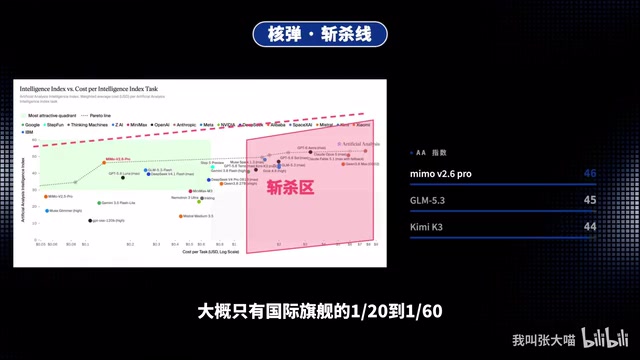
It's worth noting that these benchmark figures come from a single content creator's testing and reporting, and have not yet been cross-validated by third-party authoritative leaderboards. Readers should exercise independent judgment when referencing these numbers.
Price Is the Biggest Weapon
The most impactful aspect of MiMo V2.6 isn't just the score — it's the price-to-performance ratio. According to the creator's analysis, on an intelligence-adjusted cost basis, MiMo V2.6 is priced at roughly 1% of international flagship models, and is even compared favorably against DeepSeekAd V4.1 Flash in terms of overall cost.
If this holds up, it could significantly disrupt the pricing landscape for domestic large models. Historically, enterprises choosing a model often had to trade off between "high capability" and "low cost." A combination of ultra-low pricing and a high intelligence index could, in theory, make near-flagship-level models accessible to a much broader range of small teams and individual developers.

According to the creator, training costs came in at approximately $3.3 million USD (roughly 22 million RMB). For a top-tier large model, this isn't a particularly large investment — if it truly delivers a top ranking on open-source leaderboards, the R&D efficiency here is genuinely worth paying attention to.
What is "Intelligence-Adjusted Cost"? Intelligence-Adjusted Cost is a pricing comparison method that has gained traction in the LLM evaluation community. The core logic is to divide a model's API call price by its score on a given capability benchmark, yielding a "cost per unit of intelligence." The advantage is that it levels the playing field when comparing models with different capability levels — a model that scores twice as high on benchmarks isn't necessarily more expensive once you adjust for performance. That said, this metric is heavily dependent on the benchmark's representativeness. If a benchmark suffers from leaderboard gaming or test-set leakage, the adjusted results will be skewed accordingly, making it important to evaluate across multiple independent benchmarks.
MiMo Desktop App Launches Simultaneously, Positioning Against Codex
Beyond the model itself, Xiaomi also launched a MiMo desktop application alongside the release. The creator compared it to tools like Codex — an AI coding and productivity assistant. This signals that MiMo isn't intended to be a purely API-facing model, but rather aims to form a complete usage loop through companion tooling.
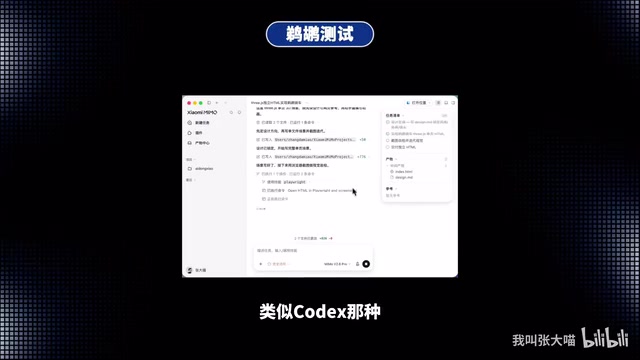
The creator revealed an interesting detail: the video itself was produced using MiMo V2.6 Pro together with the MiMo desktop app. Using the product to create the content that promotes the product is, in one sense, a demonstration of the tool's practical utility — but it also carries an obvious promotional angle, and independent user verification will be needed to assess real-world performance.
What is Codex? Codex is OpenAI's AI coding agent product that can autonomously execute multi-step tasks in the cloud — including writing, debugging, and testing code — based on natural language instructions from the user. It returns results after completing the full development workflow in a sandboxed environment. The key distinction from standard code completion tools (like GitHub Copilot) is its "agent" nature: it actively plans steps, calls tools, and handles errors, rather than passively waiting to be triggered by a cursor. By comparing the MiMo desktop app to Codex, Xiaomi is emphasizing its multi-step autonomous execution capabilities, positioning it as more than just a conversational Q&A window.
Free for One Week — Worth Giving It a Try
For developers eager to test the waters, there's a practical piece of good news. According to the creator, the Open Code platform has announced that MiMo V2.6 will be freely available for one week. This offers a low-barrier window for users who want to experience the model's capabilities firsthand.

All told, MiMo V2.6's highlights come down to three things: open-source, high intelligence index, and extreme price-performance ratio. If these metrics hold up across a wider range of real-world use cases, Xiaomi's presence in the large model space will become significantly more prominent. That said, data from a single source isn't sufficient to draw final conclusions — readers interested in the model are encouraged to try it during the free period and put it through its paces with their own actual tasks.
A Final Word
Competition in the domestic large model space has reached a fever pitch. From DeepSeek to dense iteration cycles across multiple vendors, the quality and price-performance ratio of models available to users is improving at a rapid clip. If MiMo V2.6 truly lives up to the creator's claim of being "one of the best models under 10 million RMB in training cost," it represents not just progress for Xiaomi alone, but a snapshot of the growing maturity of the entire domestic open-source AI ecosystem. As for actual performance — as always, check the data, but let hands-on testing be the final judge.
Related articles

GPT-Next Leak, Gemini 4 Argon Imminent: AI News Roundup
GPT-Next leak suggests extreme efficiency; OpenAI's 28-day shipping pledge boosts speed 50%; Gemini 4 Argon nears release; Anthropic subscription value report sparks debate.

GPT-Next Leaked, Gemini 4 Argon Speeds Up, Fable 5.5 May Launch Today
OpenAI's GPT-Next model leaks, expected to be extremely low-cost and possibly part of the 28-day release plan; Gemini 4 Argon internal testing accelerates, NanoBanana 2.1 is live; Semi Analysis tests show Claude Max's equivalent API value is about 5 times that of ChatGPT Pro; Fable 5.5 may launch today.

Gemini 4 Argon Launches Globally: Key Highlights from the AI Daily Brief
Google opens Gemini 4 Argon globally across Pro and Ultra subscriptions and the API, and demonstrates robot control. This article rounds up open-source models, Agent infrastructure, cost transparency, and safety governance updates.