Xiaomi XiaoAI 10.1-inch Smart Control Panel: Is the AI LLM Integration Worth It?
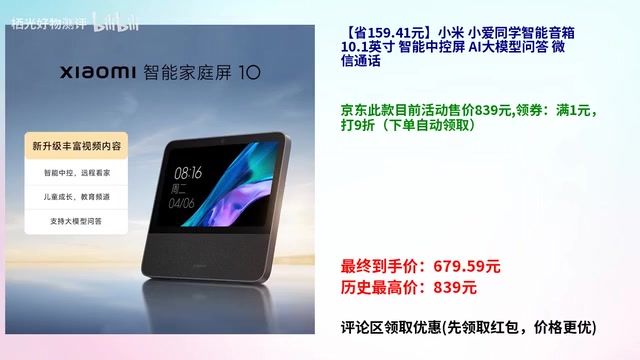
In-depth review of Xiaomi's XiaoAI 10.1-inch smart control panel with AI LLM, Mi IoT, and WeChat calling.
Xiaomi's XiaoAI 10.1-inch smart control panel integrates AI LLM Q&A, WeChat calling, and whole-home Mi IoT control. This review breaks down its AI upgrade from keyword matching to semantic reasoning, the underlying tech (Transformer, KV Cache, Matter, Thread), pricing with national subsidies (~679 yuan), and who should buy it.
A Smart Control Panel Powered by an AI Large Language Model
Large Language Models (LLMs) are rapidly moving from the cloud to consumer-grade hardware, and smart home devices are riding this wave with a new round of capability upgrades. Behind this trend lies the maturation of model compression techniques in recent years, combined with a dramatic drop in cloud inference costs—together pushing LLMs out of data centers and into the living room.
Model compression covers three main technical approaches: Quantization compresses model weights from 32-bit floating point down to 8-bit or even 4-bit integers, reducing model size by over 75%; Pruning removes neural connections that contribute little to the output; and Knowledge Distillation lets a small model "learn" the output distribution of a large model, drastically cutting the parameter count while retaining most of its capabilities. Combined, these techniques allow models that once required tens of GB of GPU memory to run on resource-constrained edge devices or low-cost cloud nodes, enabling consumer products to enjoy LLM capabilities at an affordable hardware cost.
Meanwhile, the falling cost of cloud-side inference has been equally crucial. Data-center-grade GPUs like NVIDIA's A100/H100 offer hundreds of times the Transformer inference power of consumer hardware, and the maturation of inference frameworks like vLLM and TensorRT-LLM—which dramatically boost throughput through techniques like batching and KV Cache—has caused the per-inference cost of models with tens of billions of parameters to fall by an order of magnitude over the past three years.
The Transformer Architecture: The Common Foundation of Modern Large Models: All the large-model capabilities described above trace back to the Transformer architecture proposed by Google in 2017 (in the paper Attention Is All You Need). The Transformer completely replaced the previously dominant RNN/LSTM sequence models. Its core innovation is the Self-Attention mechanism: for each token in the input sequence, the model simultaneously computes relevance weights with all other tokens, capturing semantic dependencies at any distance—for example, understanding which noun at the start of a sentence a pronoun like "it" actually refers to. This globally parallel computation makes Transformers far more training-efficient on GPUs than sequentially processed RNNs, and provides the engineering feasibility for training models with hundreds of billions of parameters. Precisely because Transformer parameter counts can scale almost limitlessly, large language models like GPT and LLaMA later emerged—and this is also the prerequisite that gives compression techniques like quantization and pruning their meaning: only when there are ultra-large models to compress does the need and value of "slimming them down" into consumer devices arise.
The Underlying Principles of KV Cache and Inference Acceleration: During Transformer inference, generating each new token requires recomputing the Key-Value attention matrices for all historical tokens, with computational complexity growing quadratically with context length. KV Cache technology caches the already-computed K and V matrices in GPU memory, so subsequent token generation only needs to read from the cache rather than recompute, boosting inference speed several-fold. Building on this, vLLM introduced the PagedAttention mechanism—borrowing the paging concept from operating system virtual memory to divide the KV Cache into fixed-size memory pages allocated dynamically, avoiding the memory fragmentation of traditional static allocation. This raises GPU memory utilization from under 40% to over 90%, boosting inference throughput by 2 to 4 times on the same hardware. It is precisely these system-level optimizations that together form the technical foundation for the rapid decline in cloud inference costs.
It is this dual-drive of "edge-side compression + cloud-side efficiency gains" that constitutes the core economic premise allowing consumer products to "borrow" large-model capabilities.
Xiaomi's XiaoAI Smart Speaker (10.1-inch Smart Control Panel edition) is a prime example of this trend—it is no longer just a voice assistant that understands simple commands, but a home hub integrating AI LLM Q&A, WeChat calling, and smart home control.
According to a digital reviewer on Bilibili, this product is originally priced at 839 yuan. After stacking e-commerce platform coupons with the national subsidy, the actual price can be as low as 679.59 yuan—a savings of around 159 yuan. For a 10.1-inch screen-equipped control device, this price is quite competitive.
AI LLM Integration: A Leap in Smart Speaker Capability
From Keyword Matching to Semantic Understanding
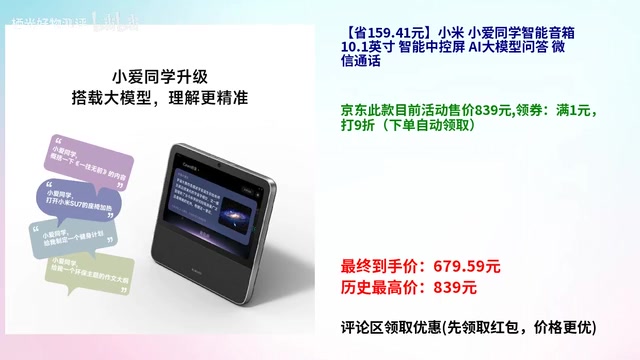
The most core upgrade of this device is its integration with an AI large language model. To understand the significance of this upgrade, we first need to understand the fundamental difference between the two generations of technology.
Traditional smart speakers (like the early XiaoAI or Amazon Alexa) generally adopt an "intent recognition + slot filling" NLU (Natural Language Understanding) architecture: the system predefines a limited set of intent categories (such as playing music or setting an alarm), determines user intent through keyword matching or a small classification model, and then extracts key parameters to execute the operation. This approach is fast and low-latency, but is helpless with questions outside the predefined scope, often responding "I don't quite understand" when faced with complex questions.
LLM-based solutions instead adopt an end-to-end autoregressive generation approach, capable of understanding context, maintaining multi-turn conversation memory, and generating open-ended answers—essentially an upgrade from "table lookup" to "reasoning." During pretraining, autoregressive language models learn the statistical patterns of language from massive amounts of text, and at inference time generate output word by word through "next-token prediction," naturally supporting open-domain Q&A.
More importantly, researchers have found that when a model's parameter count exceeds a certain threshold (around 10 billion), the model's performance on tasks like logical reasoning and multi-step planning exhibits a nonlinear leap in "Emergent Abilities"—a phenomenon systematically described by the Google Brain team in the 2022 paper Emergent Abilities of Large Language Models: below the critical parameter count, task performance is near zero, then suddenly jumps once the threshold is crossed. This discontinuous qualitative shift cannot be predicted by linear extrapolation from small models, and is the fundamental reason large models can handle complex compound problems. When a user asks a compound question like "If it rains tomorrow, should I cancel my outdoor plans? And also analyze the weather trend for the past week for me," the difference becomes especially apparent.
It's worth noting that, limited by local computing power—the processors built into consumer smart home devices are typically mid-to-low-end ARM-architecture SoCs whose compute is insufficient to support models at the tens-of-billions-of-parameters scale—the actual inference still relies on cloud services. Specifically, the chain works as follows: the user's speech is first transcribed into text in real time by a local ASR (Automatic Speech Recognition) module, a step completed on the local SoC with extremely low latency; the transcribed text is then uploaded via a TLS-encrypted channel to the vendor's cloud, where an LLM inference cluster deployed on NVIDIA A100/H100 GPUs or custom AI chips completes semantic understanding and answer generation; finally, the text result or a TTS (Text-to-Speech) audio stream is returned to the device for playback. The entire cloud inference round-trip latency is typically between 500ms and 2 seconds, with network quality being the key bottleneck for the experience.
The Local Boundaries and Technological Evolution of ASR: Speech recognition technology has undergone three major evolutions in the deep learning era: from early GMM-HMM-based statistical acoustic models, to end-to-end CTC (Connectionist Temporal Classification) models like Deep Speech around 2014, and then to Whisper released by OpenAI in 2022—the latter built on a Transformer encoder-decoder architecture trained on 6.8 million hours of multilingual data, achieving recognition accuracy comparable to a human stenographer even with complex accents and in noisy environments. The local ASR module built into consumer devices is usually a distilled version of a large model like Whisper, with parameters compressed to the tens of millions, optimized for wake-word recognition and short-phrase transcription, with edge-side latency kept within 100ms—sacrificing some accuracy in extreme scenarios in exchange for real-time on-device operation. It must be emphasized that local ASR is only responsible for "understanding the literal words"—converting the acoustic signal into a text sequence; deeper semantic understanding, knowledge reasoning, and open-ended answer generation must rely on the cloud LLM. This is also the crux of voice assistant privacy controversies: even if wake-up is done locally, every complete sentence a user speaks must still be uploaded to the server as text. The privacy boundary always lies at this unavoidable "text upload" step.
The advantage of this architecture is low local hardware cost and the ability to update models at any time; the disadvantages are dependence on network quality and the potential risk of private data being uploaded. But for ordinary home users, the improvement in interaction experience is already tangible: there's no longer any need to speak a specific wake word or precise command—everyday conversational expressions can be accurately understood and responded to.
10.1-inch Touch Display
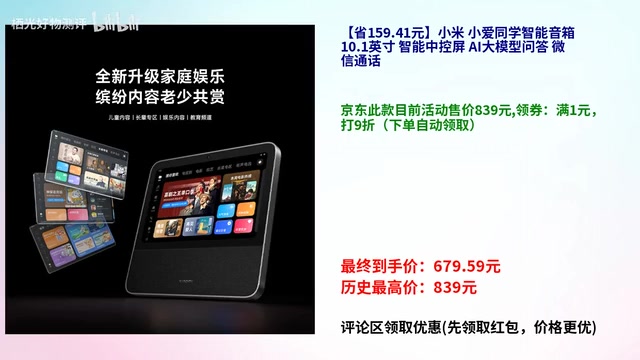
Compared to screenless speakers, the 10.1-inch touch display offers richer ways to present information. Viewing weather details, playing video content, and visually managing smart home devices—the presence of a screen greatly expands the device's use cases and makes operation more intuitive.
WeChat Calling: Easy for Elderly and Children
WeChat calling support is one of this product's standout features. Elderly family members and children can complete video calls via voice command or touchscreen tap without fumbling with a smartphone, greatly lowering the barrier to use. This also makes the device more suitable as a communication hub shared by the whole family, rather than serving only users familiar with tech products.
Xiaomi IoT Ecosystem: The Control Core of Whole-Home Smart Living
Xiaomi is renowned for its comprehensive IoT ecosystem, and this control panel is a key node in its smart home layout. To understand its ecosystem value, one needs to grasp the underlying technical architecture: the Xiaomi IoT platform adopts a multi-protocol fusion approach—Wi-Fi for devices with higher bandwidth needs (like cameras and TVs), Zigbee for low-power sensors and lighting, Bluetooth Mesh for near-field control, and the recently emerging Matter protocol as an open standard for cross-brand interconnection.
It's worth noting that although both Zigbee and Bluetooth Mesh operate in the 2.4GHz band and support mesh topologies, they differ significantly in design goals. Zigbee is based on the IEEE 802.15.4 standard, supports large-scale networks of hundreds of nodes, has a typical communication range of 10-100 meters, and is widely used in smart lighting and sensors; its main drawback is requiring a dedicated Coordinator as a gateway, and historically it had multiple incompatible application-layer profiles with poor interoperability—one important reason Matter was born. Bluetooth Mesh leverages the widely popularized Bluetooth chips to reduce device costs and is suited to low-latency scenarios like lighting; but its network scale and coverage are relatively limited, and its power consumption is higher than Zigbee and Thread. By deploying all three protocols across its product line, Xiaomi is essentially making dynamic trade-offs among coverage range, power consumption, cost, and compatibility with existing devices.
Matter is an open smart home interoperability protocol officially released by the Connectivity Standards Alliance (CSA) in 2022, built on IP networks (Wi-Fi and Thread) at its foundation. It aims to solve the fragmentation problem where ecosystems from Apple HomeKit, Google Home, Amazon Alexa, Xiaomi, and others have long operated in isolation. Matter is jointly driven by over 200 companies including Apple, Google, Amazon, and Samsung, making it the largest cross-industry standardization collaboration in the smart home field to date. Unlike previous protocols like Zigbee and Z-Wave that required dedicated gateways to relay, Matter devices can discover and control each other within the local LAN without relying on vendor cloud servers.
In terms of technical architecture, the Matter protocol is divided into four layers: the physical/link layer (Wi-Fi, Ethernet, or Thread), the network layer (IPv6), the transport layer (TCP/UDP), and the application layer (Matter data model and interaction model). The application layer defines standardized Device Types and attribute Clusters—for example, the "dimmable light" device type includes standard Clusters like On/Off and Level Control, which any compatible platform can invoke through the same interface. However, Matter currently only standardizes basic control operations; complex automation scenarios and brand-exclusive features still rely on each vendor's proprietary cloud ecosystem. Users can control the on/off and brightness of a Xiaomi bulb via Apple Home, but the "Mi Home smart" automation scenarios within the Xiaomi app cannot be recognized and executed by Apple Home—the boundaries of cross-platform interoperability remain clearly present.
Thread: The Low-Power Communication Foundation of Matter: Matter's underlying transport is divided into two layers—the Thread wireless mesh network for low-power sensors and lighting, and Wi-Fi/Ethernet for high-bandwidth devices. Thread is based on the IEEE 802.15.4 standard, operates in the 2.4GHz band, natively supports IPv6, and every node is both an endpoint device and a router, forming a self-healing mesh topology: when a node fails, data packets automatically reroute. Thread's typical power consumption is just one-hundredth that of Wi-Fi, making it well-suited for coin-cell-battery-powered sensors and smart locks. This self-healing property brings a practical advantage: the more Thread devices deployed in a home, the more reliable the network coverage—a stark contrast to the fragility of Wi-Fi's star topology, where a single point of failure means disconnection. In the Matter ecosystem, the Thread Border Router (usually integrated into a smart speaker or router) bridges the Thread network with the home Wi-Fi, allowing the controller to uniformly address and control all devices across both types of networks. Matter's security mechanism is based on a PKI certificate system; every Matter device comes with a built-in DAC (Device Attestation Certificate) from the factory, effectively preventing device counterfeiting, thereby simultaneously improving response speed and privacy security.
As of the end of 2024, the number of Matter-certified devices had surpassed 4,000. Xiaomi has announced support for the Matter protocol, theoretically enabling interconnection with ecosystems like Apple HomeKit and Google Home. However, the depth of Matter feature-set implementation still varies across platforms, and the complete cross-platform automation linkage experience is still maturing.
As of 2024, the number of devices connected to the Xiaomi IoT platform had exceeded 700 million, spanning dozens of vertical fields including appliances, lighting, security, and health. Through this control panel, users can uniformly control lights, air conditioners, robot vacuums, door locks, and various other devices in the Xiaomi ecosystem chain, achieving scene linkage and automated management.
Compared to a phone app, a fixed large-screen control panel better matches the intuition of home use: placed in the living room or entryway, family members can touch or voice-command it anytime, without having to pull out a phone and find an app every time. This "accessible everywhere" interaction experience is an important sign of the smart home maturing.
Price and Subsidy: An In-Depth Value Breakdown

The pricing logic of this product is as follows:
- Promotional price: 839 yuan
- 10% off with coupon
- Stacked with the national subsidy (15%–20% depending on region)
- Final actual price as low as 679.59 yuan
On the background of the national subsidy: in July 2024, the State Council launched a large-scale equipment renewal and consumer goods trade-in initiative, with central finance allocating 300 billion yuan of ultra-long-term special treasury bond funds in support. Ultra-long-term special treasury bonds are special financing instruments typically with terms of 20, 30, or even 50 years, not counted toward the fiscal deficit, dedicated to major strategic investments. From an economic logic standpoint, the trade-in subsidy is a form of targeted demand stimulus, aiming to replace old equipment in residents' existing assets with more energy-efficient new products, while also supporting manufacturing capacity utilization through a short-term demand pulse. About 150 billion yuan of this round is disbursed to provinces and cities via transfer payments, executed by local commerce departments in coordination with platforms. The smart home category saw its subsidy scope further expanded in 2025, with specific execution implemented by provinces and cities through designated platforms such as Meituan, JD, and Tmall.
Practical Details of Subsidy Application: In terms of the execution mechanism, central finance allocates funds to provinces and cities through ultra-long-term special treasury bonds, and local commerce departments then coordinate with e-commerce platforms, which deduct the subsidy directly at checkout—users do not need to apply for a rebate afterward. Taking the smart home category as an example, some provinces and cities require users to upload a "scrapping certificate" for old equipment or choose the platform's door-to-door recycling service to activate subsidy eligibility; other provinces and cities adopt a threshold-free direct subsidy model, requiring only real-name authentication to stack. Notably, some platforms set the national subsidy and platform coupons as mutually exclusive, so users need to carefully compare the actual final price between the two paths of "stacking national subsidy + brand coupon" and "pure platform discount" and choose the optimal combination. The subsidy cap per item is usually 500 yuan, and each type of product is limited to one purchase per person. Some provinces and cities have limited subsidy quotas on a first-come-first-served basis, so users are advised to lock in eligibility early in the campaign and confirm the specific local subsidy policy before ordering to ensure the best price.
Who Is It Suitable For?
Considering the product positioning and feature characteristics, the following types of users are most worth considering:
Smart home beginners: For users who have built or plan to build a Xiaomi IoT ecosystem, this control panel is a cost-effective choice as a control hub. Given that the core competitive moat of the Xiaomi ecosystem lies in its massive device-connection scale and mature multi-protocol support, users deeply invested in the Xiaomi ecosystem will get the most complete experience.
Families with elderly members or children: WeChat calling and large-screen interaction greatly lower the barrier to use, making it suitable as a family-shared communication device.
Users who want to experience an AI LLM at low cost: Without a high budget, you can experience the smart Q&A upgrade brought by large models—leaping from "table-lookup" keyword matching to genuine natural-language reasoning interaction. The foundation of this leap is the generational evolution of NLU technology from rule-based matching to end-to-end language models, along with the mature path by which consumer hardware "borrows" capabilities via cloud inference.
Of course, one should also view its limitations rationally: AI Q&A relies on the network, and response speed and privacy protection depend on cloud service quality (the experience noticeably degrades in weak-network environments, and voice data must be converted to text by ASR then uploaded to the cloud for processing); the ecosystem advantage is mainly concentrated in Xiaomi's own products, with relatively limited cross-brand compatibility—although the advancement of the Matter protocol is improving this situation, Matter's interoperability boundary currently remains at the basic control level, and cross-platform integration of complex automation scenarios will still take time.
Conclusion
This Xiaomi XiaoAI 10.1-inch smart control panel represents a tangible evolution of the smart speaker category. The addition of an AI large language model moves it from a "talking remote control" toward a true home smart assistant—behind which lies the generational leap in NLU technology from rule matching to end-to-end language models, model compression techniques like quantization/pruning/knowledge distillation that enable low-cost deployment of large models, and the mature architecture by which consumer hardware "borrows" capabilities via a cloud-based ASR+LLM inference chain. Meanwhile, the gradual rollout of the Matter protocol and Thread mesh network lays a standardized foundation for future cross-brand ecosystem interconnection, even though the current interoperability boundary still mainly rests at the basic control level, with complex cross-platform automation linkage still evolving. In the price range around 680 yuan, it achieves a good balance in hardware configuration, ecosystem integration, and AI capabilities. Combined with the current window of the national trade-in subsidy policy, this is an option worth focusing on for users who want to upgrade their home smart hub within a reasonable budget.
Related articles

GPT-Next Leak, Gemini 4 Argon Imminent: AI News Roundup
GPT-Next leak suggests extreme efficiency; OpenAI's 28-day shipping pledge boosts speed 50%; Gemini 4 Argon nears release; Anthropic subscription value report sparks debate.

GPT-Next Leaked, Gemini 4 Argon Speeds Up, Fable 5.5 May Launch Today
OpenAI's GPT-Next model leaks, expected to be extremely low-cost and possibly part of the 28-day release plan; Gemini 4 Argon internal testing accelerates, NanoBanana 2.1 is live; Semi Analysis tests show Claude Max's equivalent API value is about 5 times that of ChatGPT Pro; Fable 5.5 may launch today.

Gemini 4 Argon Launches Globally: Key Highlights from the AI Daily Brief
Google opens Gemini 4 Argon globally across Pro and Ultra subscriptions and the API, and demonstrates robot control. This article rounds up open-source models, Agent infrastructure, cost transparency, and safety governance updates.