Xing-Audio-NVVASR: A New Benchmark for Joint Recognition of Speech and Non-Verbal Vocalizations Trained on 80K Hours of Data
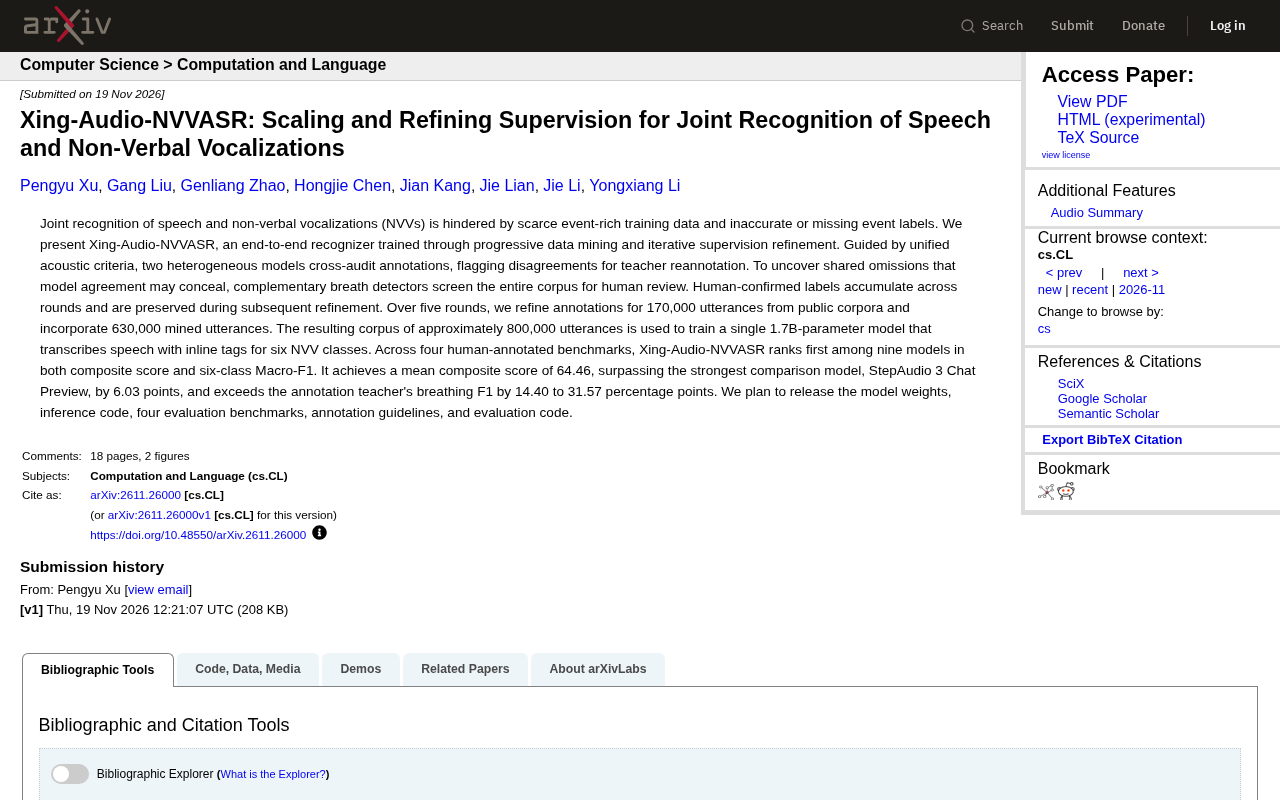
Xing-Audio-NVVASR mines 800K utterances via cross-audit and iterative refinement, enabling ASR to recognize six NVV categories.
Xing-Audio-NVVASR tackles ASR's neglect of sighs, laughter, and breathing (NVVs) through data engineering rather than model scaling. Two heterogeneous models cross-audit the same speech, flagging disagreements for teacher-model re-labeling, while a complementary breath detector catches shared omissions for human review. After five rounds, the team refined 170K public utterances and mined 630K more, totaling ~800K. The final 1.7B end-to-end model tags six NVV categories inline, ranking first among nine models on all four benchmarks with an average overall score of 64.46 (6.03 points ahead) and breath F1 14.40–31.57 points above teacher models. Weights, code, benchmarks, and guidelines will be open-sourced.
In the field of speech recognition, models typically care only about "what was said" while turning a blind eye to non-verbal vocalizations (NVVs) such as sighs, laughter, and breathing sounds. Yet these sounds precisely carry the speaker's emotional state and physiological cues. Xing-Audio-NVVASR attempts to systematically address this long-neglected problem.
Root of the Problem: Data Scarcity and Annotation Distortion
Joint recognition of speech and non-verbal vocalizations faces two core obstacles. The first is scarce event-rich training data—most public speech corpora target transcription as their primary goal, and NVV event annotations are either missing or scattered. The second is inaccurate annotation—even when annotations exist, the boundaries of short events like breathing and sighs are ambiguous, inter-annotator agreement is poor, and models struggle to learn reliable patterns from them.
Rather than choosing the "heavy" path of manually annotating more data, the Xing-Audio-NVVASR research team designed a progressive data mining and iterative supervision refinement pipeline that automatically improves annotation quality across multiple rounds.
Non-Verbal Vocalizations (NVVs) refer to sound events in speech that carry no lexical semantics but convey paralinguistic and physiological information, with typical categories including laughter, sighs, breathing, coughing, lip-smacking, and crying. They differ from "filler words" (such as "um" and "uh"): the latter are still hesitation markers within the linguistic system, whereas NVVs fall entirely outside the lexicon. In speech recognition and dialogue systems, NVVs are crucial for affective computing, mental health assessment, and natural interaction, but traditional ASR training objectives optimize only word error rate, causing such events to be discarded as noise. The difficulty of NVV annotation also lies in its short acoustic form, subjective boundaries, and frequent overlap with speech, which naturally makes annotation consistency lower than word-level transcription.
Cross-Audit Mechanism: Letting Models "Find Fault" in Each Other
The core innovation of this approach is using two heterogeneous models to cross-audit the same batch of speech. Guided by a unified acoustic standard, the two models each produce annotations, the system automatically flags segments where they disagree, and these are sent to a teacher model for re-annotation. The logic is: if two independently trained models disagree on whether an event exists, that location is likely a weak spot in annotation.
However, model consensus can also mask shared omissions—breathing events missed by both models will not be caught by cross-audit. To address this, the team introduced a complementary breath detector to screen the entire corpus, with suspicious segments sent for human review. Human-confirmed labels are continuously preserved in subsequent rounds and are not overwritten by later automated processes.
After five rounds of iteration, the team refined 170,000 utterances from public corpora and additionally mined 630,000 utterances, ultimately forming a training corpus of approximately 800,000 utterances.
Heterogeneous model cross-audit borrows ideas from ensemble learning and active learning: if two models differ in architecture, training data, or initialization, their error patterns are not fully correlated, and points of disagreement tend to be high-information hard samples. Unlike simple model voting, this approach does not directly adopt the majority opinion but treats disagreement segments as "annotation uncertainty zones" to be re-judged by a stronger teacher model, thereby converting inter-model differences into annotation improvement signals.
Iterative teacher-student refinement is a variant of self-training: the teacher model generates or corrects labels, the student model trains on these labels, and in the next round the updated model serves as auditor or teacher. The risk is that errors get amplified and self-reinforced, so human review is needed as an anchor and confirmed labels must be preserved from being overwritten—this is precisely why the pipeline includes a human step.
Model Architecture and Performance
The final trained model has 1.7B parameters and works end-to-end, transcribing speech while annotating six categories of non-verbal vocalizations as inline tags. On four human-annotated benchmarks, Xing-Audio-NVVASR ranks first among nine comparison models on both overall score and six-category Macro-F1.
Specifically, its average overall score is 64.46, 6.03 points higher than the strongest comparison model, StepAudio 3 Chat Preview. On breath detection alone, it outperforms the models that served as annotation teachers by 14.40 to 31.57 percentage points—an improvement magnitude that shows the iterative refinement pipeline genuinely enables the "student" to surpass the "teacher" in specific dimensions.
You may not have noticed that the team plans to open-source the model weights, inference code, four evaluation benchmarks, annotation guidelines, and evaluation code. For foundational work aimed at advancing the NVV recognition direction, the openness of benchmarks and annotation guidelines may have more long-term value than the model itself, because it means subsequent researchers have a reproducible comparison baseline.
Macro-F1 computes the F1 score for each NVV category separately and then takes the arithmetic mean. Unlike micro-F1, it gives rare categories such as breathing and sighs equal weight to laughter, making it more suitable for measuring fine-grained event recognition with highly imbalanced classes. Overall score is typically a weighted combination of transcription quality (such as word error rate) and NVV recognition F1, used to jointly constrain both objectives of "what was said" and "how it was said."
Inline tagging means inserting event markers directly at the corresponding positions in the transcription text stream, for example inserting [breath] or [sigh] into the word sequence, so that speech and events share the same timeline output and avoid the alignment and fusion overhead of independent detection modules. End-to-end here means a single model maps directly from audio to a sequence with inline tags, rather than cascading ASR and an event classifier.
Why This Matters
If a speech interaction system can only recognize text, it will lose a large amount of paralinguistic information in conversation. A recognizer that can accurately mark breathing, sighs, and laughter has direct application space in scenarios such as mental health monitoring, customer service quality inspection, and affective understanding in human-machine dialogue. Xing-Audio-NVVASR solves the annotation bottleneck through data engineering rather than simply scaling model parameters, and this approach also has reference value for other annotation-scarce fine-grained recognition tasks.
However, it should also be noted that current evaluation is concentrated on four self-built benchmarks, and the model's generalization ability in real noisy environments, multi-party conversations, and cross-lingual scenarios remains to be verified by the community. After open-sourcing, the answers to these questions will gradually become clear.
One-line Summary
Xing-Audio-NVVASR uses cross-audit and iterative refinement to mine 800,000 utterances of corpus, enabling ASR to recognize six categories of non-verbal vocalizations.
Paragraph Summary
Xing-Audio-NVVASR addresses the long-ignored problem in speech recognition of sighs, laughter, breathing, and other non-verbal vocalizations (NVVs), proposing data engineering rather than simply scaling models to solve the annotation bottleneck. Its core is having two heterogeneous models cross-audit the same batch of speech, automatically flagging disagreement segments for re-labeling by a teacher model, and using a complementary breath detector to screen events missed by both models for human review. After five rounds of iteration, the team refined 170,000 utterances from public corpora and newly mined 630,000, totaling about 800,000 utterances. The final 1.7B-parameter end-to-end model annotates six NVV categories with inline tags, ranking first among nine models on both overall score and six-category Macro-F1 across four benchmarks, with an average overall score of 64.46, leading the strongest comparison model by 6.03 points, and breath detection F1 14.40 to 31.57 percentage points higher than the teacher models. The team plans to open-source weights, code, benchmarks, and annotation guidelines.
Related articles
Zhipu GLM-5.4 Released: Loop Transformer Runs 28 Layers Twice
Zhipu releases GLM-5.4, the first Loop Transformer flagship: 28 layers run twice for 2-3T-equivalent intelligence, plus video and image input. API and open weights not yet released.

GLM-5.4 Coding Test 4.6x Slower? Unpacking the Loop Transformer Architecture
GLM-5.4 coding test took 431 minutes vs. competitor's 109, 4.6x more steps. We analyze its Loop Transformer architecture, KingBench4 score of 55.3, Max tier's 1.04M token cost, and tier selection advice.

Zhipu GLM-5.4 Quietly Released: A Debut for Loop Transformer Architecture
Zhipu GLM-5.4 quietly lands in coding plans: first Loop Transformer flagship with 750B params, 1M token context, AIM math up from 19.2 to 30.4, and native vision for coding from screenshots.