Xingchen 4.0 29B Open Source: 4B Active Parameters Bring Agent Capabilities Safely Into Enterprise Networks

Xingchen 4.0 29B open-source MoE model enables low-VRAM private deployment, solving enterprise AI data security challenges.
Data security is the core obstacle to enterprise AI adoption, and the open-source model Xingchen 4.0 29B addresses it by supporting fully private on-premises deployment, keeping code and data inside the internal network. Using a MoE architecture with 29B total parameters but only 4B active per inference, it requires roughly 15 GB of VRAM after 4-bit quantization. Real-world tests across business trip planning, project handover, and bug fixing demonstrate genuine risk identification and engineering discipline rather than mechanical execution. It is compatible with toolchains including Claude Code, vLLM, and LLaMA-Factory, supports Ascend and other domestic chips end-to-end, and is now open source on GitHub, Hugging Face, and ModelScope.
The Biggest Roadblock to Enterprise AI Adoption: Data Security
That AI can boost productivity is now widely accepted — but the number of enterprises actually putting it to work remains surprisingly small. The reason almost always comes down to one thing: data security. Core source code, business contracts, customer records — the moment any of it leaves the internal network and travels to the cloud, organizations get nervous. For many, improved efficiency and data sovereignty have felt like a forced binary choice.
A recently released domestic open-source model, Xingchen 4.0 29B, offers a new answer. At the 29B parameter scale, it focuses on strengthening Agent and Coding capabilities while supporting fully private, on-premises deployment. Once deployed inside an enterprise network, documents, code, and data all stay local — nothing has to be sent to an external cloud — eliminating data-exfiltration concerns at the source.

Even more importantly, it integrates with mainstream Agent and chat frameworks including Claude Code, Cline, and Hermes. This makes it more than a conversational assistant — it's a "work partner" that can actually execute tasks.
Real-World Testing: From Business Trip Planning to Inheriting an Abandoned Project
To see how the model's Agent capabilities hold up in practice, the author ran several tests.
The first task was using OpenCode to have Xingchen 4.0 plan a business trip from Beijing to Hangzhou. The model proactively read through multiple documents and cross-referenced flights, hotel bookings, meetings, and budget — flagging scheduling conflicts and over-budget items on its own. For issues it could resolve directly, it proposed alternatives; for decisions requiring human judgment, such as rebooking flights or making reservations, it listed them separately and waited for confirmation. It behaved like a reliable assistant who identifies risks before pushing forward, rather than blindly executing instructions.
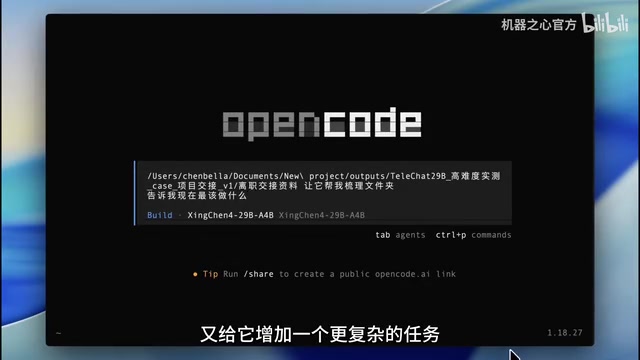
The second task was more complex: a project's original owner had abruptly resigned, leaving contracts, email threads, meeting notes, a project plan, and old to-do lists all jumbled together in a single folder. Rather than just summarizing the materials, the model quickly identified critical risks — delayed samples, scope creep, an ownership gap — then prioritized next steps by urgency. This is remarkably close to what a project assistant who can genuinely take over the work would actually do.
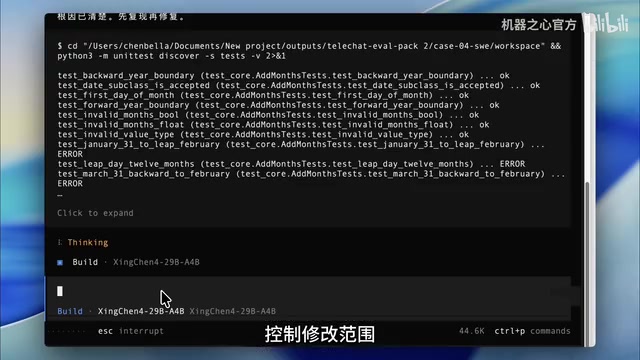
The third task tested Coding ability: hand it a small Git repository and have it fix a date-calculation bug. Instead of diving in and making random changes, it behaved like a real engineer — gathering evidence first, diagnosing the issue, keeping the scope of changes minimal, and finally running tests to confirm no other functionality had been broken. That "verify before you act" engineering discipline is precisely what separates a genuinely usable Agent from one that isn't.
29B Total Parameters, 4B Active: Runs on a Gaming GPU
Xingchen 4.0 29B uses a MoE architecture with 29B total parameters, but activates only 4B per inference — making it lighter and far less compute-intensive to run.
After 4-bit quantization, the model requires roughly 15 GB of VRAM on a single GPU, meaning it can be deployed on a consumer-grade gaming card. For individual developers and small-to-medium enterprises, this dramatically lowers the hardware barrier to private deployment.
On the tooling side, it is compatible with fine-tuning tools such as MindFormers and LLaMA-Factory, as well as mainstream inference frameworks including SGLang and vLLM. Whether for fine-tuning or production deployment, developers can stick with the toolchains they already know. Built on Zhiyuan FlagOS, it has also completed end-to-end adaptation for domestic chips including Ascend (Huawei), enabling cross-architecture migration and one-click deployment — without being locked into any single compute ecosystem.
The MoE (Mixture of Experts) architecture is the key to understanding this parameter design. Traditional dense models activate all parameters on every forward pass. MoE models instead split parameters across multiple "expert" sub-networks, with a router dynamically selecting a small subset of experts for each inference call. This means the model can maintain a massive "knowledge capacity" while dramatically reducing the actual compute (FLOPs) per inference. In Xingchen 4.0's case, the 29B total parameters provide a rich knowledge base, but only roughly 4B are activated per inference — making the computational cost roughly equivalent to a 4B dense model, while retaining the knowledge expressiveness closer to a much larger model. This is the underlying reason it can run on consumer GPUs: VRAM usage and compute requirements are determined by the number of active parameters, not the total parameter count.
The Full-Stack Technical Investment Behind It
This capability set is backed by a comprehensive technical design.
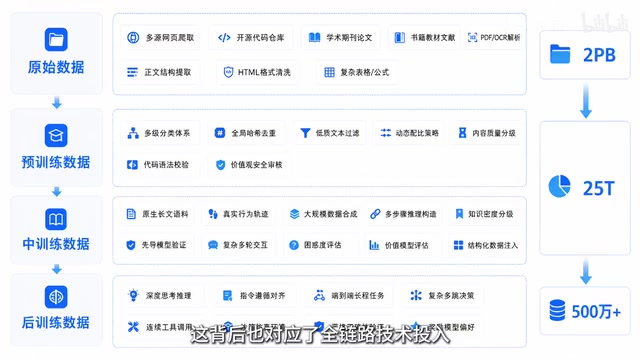
The model is built on a data foundation of tens of trillions of tokens, incorporating architectural designs including MLA, MTP, and MHC, with phased long-context training progressing from 4K to 32K, 128K, and 256K. For Agent, Coding, and Reasoning capabilities, the model underwent separate multi-expert reinforcement learning training, with the different expert capabilities ultimately merged via MoPD.
In practical terms, these technical choices translate into a model that can handle longer tasks and smoothly chain together entire workflows. Beyond Agent and Coding, these capabilities can also be applied to intelligent customer service — moving support agents beyond simply answering questions toward actively assisting with transactions.
The architectural abbreviations mentioned here each have specific meanings. MLA (Multi-head Latent Attention), introduced by DeepSeekAd, reduces VRAM overhead for long-context inference by compressing the key-value cache through low-rank decomposition. MTP (Multi-Token Prediction) trains the model to predict multiple future tokens simultaneously, improving inference speed and output consistency. MHC (Multi-Head Compression) applies structured compression to attention heads to eliminate redundant computation. MoPD (Mixture of Policy Distillation) is the critical fusion step: it distills the independently trained "expert policies" for Agent, Coding, Reasoning, and other tasks into a single unified model, giving one model cross-task generalist capability — rather than maintaining separate model copies for each use case.
Already Open Source — Ready to Use
Xingchen 4.0 29B is now available on GitHub, Hugging Face, and ModelScope. For teams that don't want to choose between productivity and data control, it offers a path worth trying: capabilities that stay within the internal network, manageable compute requirements, and an open tooling ecosystem. This may be exactly the form that enterprise-scale Agent deployment needs to finally become mainstream.
Related articles

Free Unlimited Claude Code Solution: Agnes AI + CC Switch Setup Guide
No paid subscription needed — pair the free AI platform Agnes AI with the open-source tool CC Switch to provide a backend for Claude Code, enabling unlimited free calls to text, image, and video models. This guide covers the full setup, test results, and usage boundaries.

A Complete Zero-Cost Guide to Getting Started with Claude Code for Beginners in China
A beginner's guide to Claude Code for users in China: two installation methods (command line and IDE plugin), full configuration steps for replacing the official API with the free domestic LongCat model, and a hands-on demo of building a small tool with natural language, plus tips.

When the NSA Gets Involved: The AI Supply Chain Crisis Behind Open-Source CVEs and API Key Hijacking
Multiple open-source projects disclosed severe CVEs in one day, PHP flaws alarmed the FBI, and Railway and OpenCode were breached with API keys stolen. This article breaks down the vulnerability window, AI-accelerated exploitation, and the AI supply chain crisis behind the API key black market, with a developer defense checklist.