Xiryn: The Open-Source Personal AI Assistant That Runs on Your Local Computer
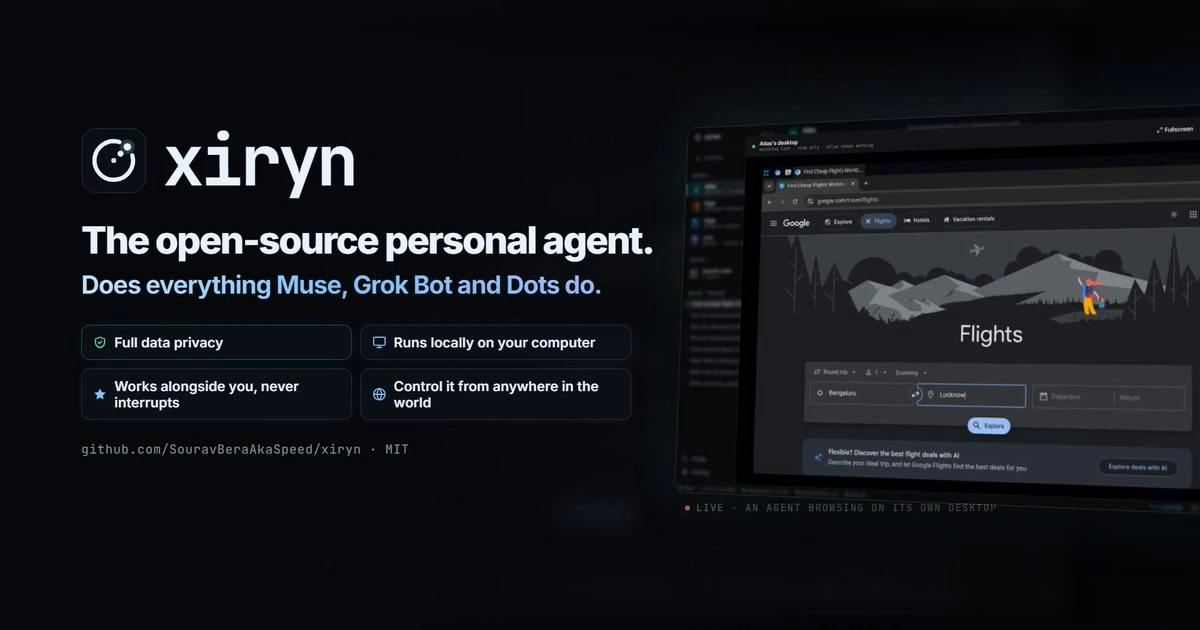
Xiryn is a free, open-source personal agent that runs entirely locally, championing privacy and data sovereignty.
Xiryn is a free, open-source personal agent gaining attention on Product Hunt, with a core proposition of bringing cloud AI assistant capabilities to the user's local machine so data never leaves the hard drive. Each agent has its own Docker Linux desktop environment, capable of operating browsers and graphical interfaces like a human, handling background browsing, research, coding, and form-filling without occupying the user's screen. It has no account system or telemetry, supports any model (including locally deployed ones), and enables remote command dispatch and one-tap payment approval via Telegram. Built by developer sourav bera, the project is still in its early stages with limited community feedback, and questions remain about the resource overhead of Docker desktops, actual stability, and configuration difficulty. It suits technical users who value data privacy and are willing to tinker with setup themselves.
While cloud-based AI assistants are proliferating, a product taking the opposite approach is gaining traction on Product Hunt: Xiryn, a free, open-source personal agent that runs entirely on the user's own computer. Its core proposition is straightforward — bring the capabilities of products like Muse, Grok Bot, and Dots to the local machine, so your data never leaves your hard drive.
What It Actually Does
Xiryn positions itself as a "personal agent" that can browse the web, research information, write code, fill out forms, and more on the user's behalf. Unlike most cloud-based agents, it doesn't take over your current screen — it runs independently in the background while you continue your normal work.
According to its Product Hunt page, each Xiryn agent gets its own Docker Linux desktop environment. This design is key to understanding the product: agents don't run abstractly inside some API — they have a complete, operable desktop system, capable of opening browsers, clicking interfaces, and typing content just like a human. This "agent with a screen" approach enables it to handle legacy systems or complex web pages that have no API and can only be operated through a graphical interface.
The project was built by developer sourav bera and received 90 upvotes on Product Hunt, ranking 20th, categorized under open source, privacy, artificial intelligence, and GitHub.
Docker and Containerized Desktop Environments
Docker is a lightweight virtualization technology that packages an application and its dependencies into an isolated "container," letting it run in a self-contained environment without emulating an entire set of hardware. Compared to traditional virtual machines, containers start faster and consume fewer resources. Xiryn assigns each agent a Dockerized Linux desktop environment, meaning that agent has its own operating system, browser, and graphical interface, isolated from the user's host machine. The upside: an agent's mistakes won't directly pollute the user's system, multiple agents won't interfere with each other, and exiting the container clears its state. The trade-off: each container consumes a certain amount of memory and CPU. This "give the agent a full desktop" approach stands in sharp contrast to lightweight agents that merely call APIs, and it's precisely why it can operate legacy graphical interface systems.
Privacy and Data Sovereignty
Xiryn's most distinctive differentiator is its privacy model. It has no account system and does no telemetry — the official statement is clear: "No account, no telemetry," with all data remaining on the user's disk.
For an agent that needs to access web pages, process forms, and even handle payments, this commitment carries significant weight. Cloud-based agents typically need to transmit task context, browsing content, login credentials, and other sensitive information to the service provider's servers, whereas Xiryn confines all of this within the local Docker container. For users handling contracts, finances, personal accounts, and similar scenarios, this is a decisive consideration.
That said, it warrants a rational perspective: running locally doesn't equal absolute security. Docker containers, model inference, and remote control channels each can introduce attack surfaces. The transparency of open-source code aids auditing but doesn't automatically eliminate risk.
Model Freedom and Remote Control
Xiryn takes an open stance on models, supporting any model, including locally deployed ones. This means users can either use cloud-based large models for stronger reasoning capabilities or run open-source models entirely offline for ultimate privacy. This flexibility is uncommon among similar products — many agent products lock users into a specific model provider.
Remote control is implemented through Telegram, which is a pragmatic choice. Users can issue instructions to the agent from their phone, approve payment operations with one tap, or take over the agent's screen remotely. The "one-tap payment approval" detail shows that Xiryn was designed with confirmation flows for high-risk operations in mind — the agent can execute autonomously, but anything involving money requires human intervention.
On installation, the official description emphasizes that "one command sets it up," lowering the barrier to entry.
The Trade-off Between Local and Cloud Models
Local model deployment means downloading open-source large language models (such as Llama, Qwen, Mistral, etc.) to your machine and running them directly through inference frameworks like Ollama or llama.cpp, with the inference process never touching the network. The advantages are that data stays local and there are no API call fees; the disadvantages are high GPU or memory requirements and reasoning capabilities that are typically weaker than top-tier cloud models. Cloud-based large models (such as the GPT and Claude series) offer stronger reasoning and faster responses but require sending prompt content to the service provider. Xiryn lets users choose freely between the two, effectively handing the "capability vs. privacy" trade-off to users to decide per task — sensitive tasks go to local models, complex reasoning goes to the cloud. This is an important design choice that sets it apart from products tied to a single provider.
Why Telegram as the Remote Channel
Telegram offers a mature bot API and end-to-end encrypted private messaging, letting developers implement remote command dispatch and message return without building their own server — which is why it's often used as a control entry point for personal automation projects. Users send tasks to the agent via Telegram, receive progress updates, and approve high-risk operations. The advantages of this approach are low setup cost, cross-platform availability, and timely mobile push notifications; the limitation is that it binds usability to a third-party platform — users who don't use Telegram need additional adaptation, and command traffic passes through Telegram's servers, creating some tension with the "fully local data" privacy claim.
A Few Points Worth Noting
Based on available information, Xiryn is still in its early stages. With only 3 comments on Product Hunt and limited community feedback, there's a lack of third-party validation of its actual stability and task success rate.
A few points potential users should consider: A Dockerized full Linux desktop implies significant resource overhead, and whether an ordinary laptop can smoothly run multiple agents remains unknown; the gap between the breadth of "any model" support and the actual difficulty of configuration needs hands-on testing; Telegram as the sole remote channel creates a barrier for users who don't use the platform.
Who It's For
Xiryn targets a fairly clear user profile: technical users who value data privacy, are willing to tinker with configuration themselves, and need an agent to handle graphical interface tasks. If you're already using local models, have concerns about where cloud-based agents send your data, or need an assistant that works in the background without hijacking your screen, this project is worth adding to your watchlist.
It represents a trend worth watching — pulling agent capabilities from the cloud back to the local machine, trading open source and containerization for privacy and controllability. Whether this path succeeds depends on community participation and the real-world reliability of the tasks it performs.
Related articles

M&M's Spent Millions Replacing Artificial Blue Dye — Why Is It So Hard?
Mars spent millions trying to replace artificial blue dye in M&M's with spirulina, but thick material clogs pipes and residue risks mold, forcing a full production-line rebuild. Here's the engineering behind the reformulation.
Teammate Wanted for Meta Global AI Developer Hackathon: Computer Vision & Medical AI
A Reddit developer seeks teammates for the Meta Global AI Developer Hackathon, focusing on computer vision and medical AI. This article analyzes the track logic, skills-complementarity needs, and topic selection strategy behind this teaming signal.
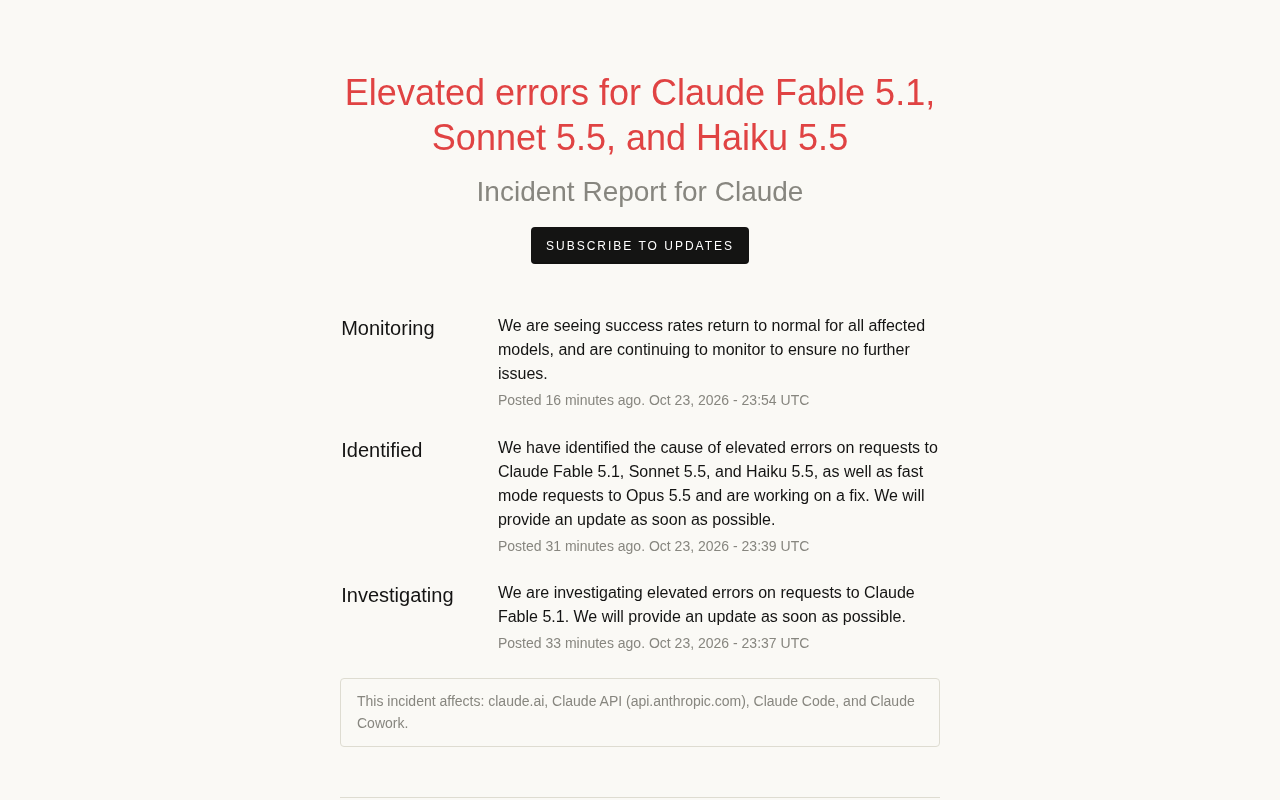
Multiple Claude Models Hit by Errors: A Postmortem of Fable 5.1, Sonnet 5.5, and Haiku 5.5
Claude Fable 5.1, Sonnet 5.5, Haiku 5.5, and Opus 5.5 fast mode saw elevated errors; Anthropic identified and resolved the issue in 17 minutes. This postmortem covers the timeline, the technical reasons for the multi-model cascading failure, and practical lessons for retry and degradation strategies.