YC Startups Are Abandoning .com Domains: The New Domain Name Trend in the AI Era

YC startups increasingly choose .ai and .io over .com as domain scarcity and AI branding reshape naming conventions.
A growing number of Y Combinator startups are abandoning .com domains in favor of alternatives like .ai, .io, and .dev. Driven by premium .com scarcity, the AI branding wave, and shifting user discovery habits, this trend reflects a fundamental evolution in internet branding logic. While supporters argue domain suffixes matter less in the age of search engines, skeptics warn of trust issues and geopolitical risks tied to country-code TLDs.
A Domain Migration Trend in Progress
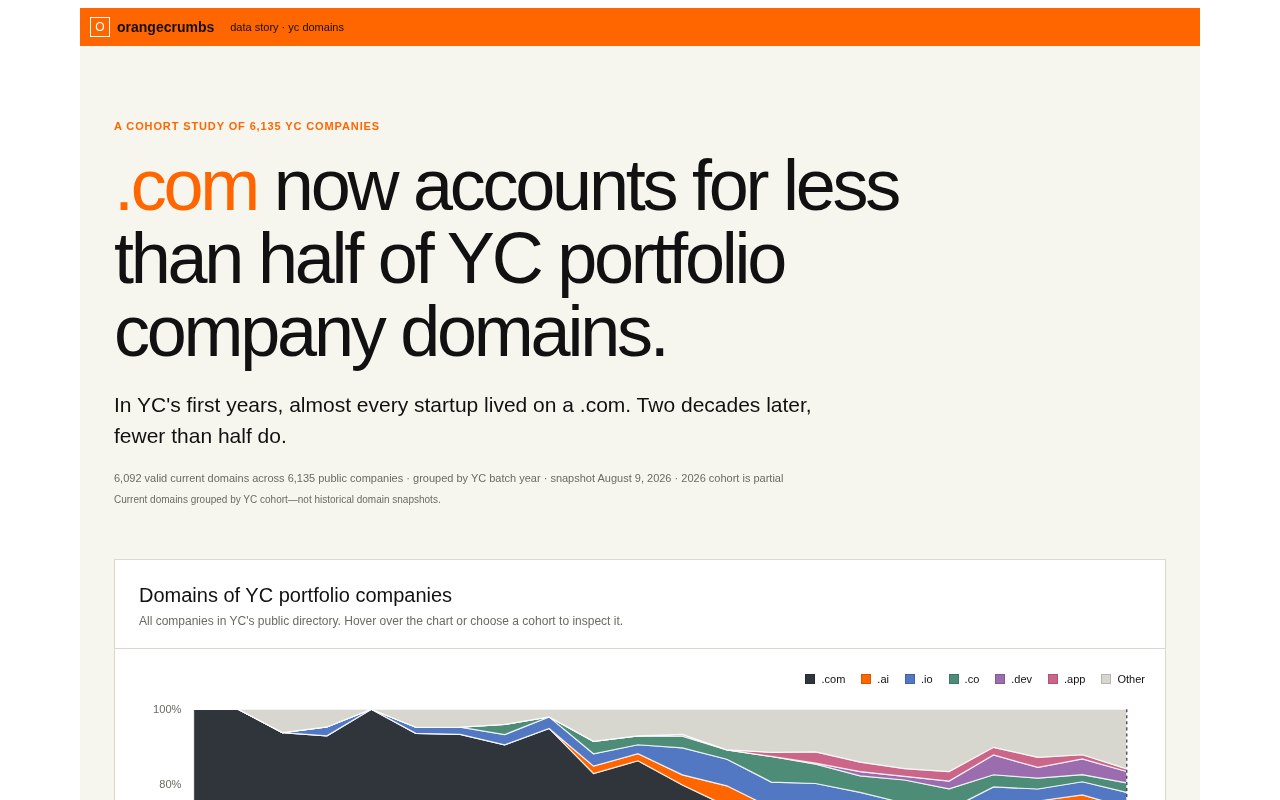
Recently, a Hacker News post titled "YC startups are abandoning .com" sparked widespread discussion across the startup and tech communities. The observation points to a quiet but significant shift: the .com domain—once the hallmark of the internet's golden age—is gradually losing its absolute dominance among startups.
For those who lived through the Web 1.0 and 2.0 eras, .com was practically synonymous with "legitimate internet company." However, when we look at the latest batch of Y Combinator (YC) startups, a clear trend emerges—more and more teams are choosing .ai, .io, .dev, .so, .co, and other non-traditional top-level domains (TLDs).
Y Combinator is one of the world's most influential startup accelerators, founded in 2005. It operates on a batch model, selecting hundreds of startups twice a year from thousands of global applications, providing seed funding and intensive mentorship. Its alumni network includes companies like Airbnb, Stripe, Dropbox, and Reddit, with combined valuations exceeding hundreds of billions of dollars. Because YC represents the cutting edge of startup trends, the domain choices of its portfolio companies carry significant signal value.
Why Startups Are Moving Away from .com Domains
Premium .com Domains Are Long Gone
The most direct reason is scarcity. After nearly three decades of cybersquatting and hoarding, virtually all .com domains composed of common English words or short phrases have been registered. For a newly founded startup with limited budget, obtaining a .com domain that precisely matches their brand name often means paying domain investors tens or even hundreds of thousands of dollars in premium fees.
Domain investing emerged in the mid-1990s and has grown into a secondary market with hundreds of millions of dollars in annual transactions. Platforms like Sedo, Afternic, and Dan.com specialize in brokering domain sales, with notable examples including voice.com selling for $30 million and insurance.com for $35.6 million. Large numbers of domains are held by professional investors and parked, generating revenue through display ads or awaiting premium buyout offers. This ecosystem directly prevents new startups from acquiring ideal .com domains at reasonable prices.
By contrast, newer top-level domains offer plenty of quality short domains still available for registration. A company called "Cursor" can easily secure a .sh or .dev domain with the same caliber of experience as cursor.com—without paying an astronomical price. This massive gap in cost and availability is the core driver of the migration.
It's worth noting that a Top-Level Domain (TLD) is the highest-level identifier in the Domain Name System (DNS) hierarchy. The earliest generic top-level domains (gTLDs) include .com, .org, and .net, assigned by IANA in 1985. ICANN launched the New gTLD Expansion Program in 2012, approving over 1,200 new suffixes in one go, such as .app, .dev, and .tech. Running parallel to these are country code top-level domains (ccTLDs), such as .io (British Indian Ocean Territory) and .ai (Anguilla), which were originally intended to serve specific countries and territories but have been widely adopted across industries, creating today's diverse domain landscape.
The .ai Domain Boom in the AI Wave
The most eye-catching element of this current trend is the explosion of .ai domains. With the rise of generative AI startups, .ai not only provides a perfect semantic match for company positioning but also carries the built-in brand signal of "we're an AI company." Although .ai (originally Anguilla's country code TLD) costs significantly more to register and renew than .com, AI-focused entrepreneurs view this expense as a necessary brand-building investment.
Anguilla is a British Overseas Territory in the eastern Caribbean with a population of only about 15,000. Its country code TLD .ai was virtually unknown before the AI wave, with low registration prices. As the AI industry exploded, .ai domain registration fees surged to approximately $100-150 per year, and the Anguilla government has consequently received substantial domain revenue—reportedly accounting for a significant portion of the territory's GDP in 2023. This phenomenon mirrors the historical precedent of Tuvalu, a Pacific island nation that generated income through its .tv domain—small countries whose two-letter codes happened to resonate semantically with hot industries.
As some community commenters have noted, browsing YC's latest batch of companies reveals a considerable proportion of .ai domains—something almost unimaginable five years ago.
Divided Opinions in the Tech Community on Abandoning .com
The Supporters: Domain Suffixes No Longer Matter
In the Hacker News discussion, one camp argues that as search engines and app stores become the primary channels for product discovery, the importance of TLDs is declining. Users increasingly rarely type URLs manually, instead finding products through Google searches, social media links, or direct app navigation. Under these usage patterns, the difference between .com and .io becomes negligible.
Regarding whether TLDs affect search rankings, Google has explicitly stated multiple times that its search algorithm does not grant ranking advantages or penalties based solely on domain suffix—new gTLDs are treated equally to .com in terms of search weight. However, .com domains, due to historical accumulation, often have more backlinks and higher Domain Authority, which reflects time and ecosystem advantages rather than algorithmic bias. For newly registered domains, regardless of suffix choice, search engine visibility must be built from scratch—which objectively levels the competitive starting point across different TLDs.
For startups primarily targeting developers or B2B customers, the target audience already has high acceptance of emerging TLDs, and .dev or .io are even seen as more "tech-savvy" choices.
The Cautious: Non-.com Domains Still Carry Hidden Costs
However, many experienced practitioners caution that abandoning .com is not without costs. First is the trust issue: for consumer-facing products, users may be suspicious of unfamiliar suffixes, or even mistake them for phishing sites. Second is the memorability cost—when users share products by word of mouth, they tend to default to adding .com, causing traffic to leak to domain squatters.
Additionally, some country code TLDs (such as .ai and .io) are fundamentally subject to the policy management of specific countries or territories, carrying certain geopolitical and regulatory risks. History has seen cases where country domains were suspended from resolving due to political or administrative reasons.
This risk is far from theoretical. After Myanmar's military coup in 2021, .mm domain management fell into chaos. A more famous case involves .ly domains (Libya)—in 2010, a URL shortening service called vb.ly had its domain forcibly revoked for content that violated Libya's Islamic regulations. .io domains face potential risk as well: the UK has expressed intent to return sovereignty of the Chagos Islands (British Indian Ocean Territory) to Mauritius, and if this materializes, .io domain governance could change, although ICANN has indicated it would handle such transitions carefully. For companies that view their domain as a core asset, this uncertainty represents a real business risk.
Deeper Implications of This Trend
A Shift in Internet Branding Logic
The change in startup domain choices fundamentally reflects the evolution of internet branding logic. In the early days, a domain was the core vehicle of a brand; in today's era of mobile apps and platforms, brands increasingly exist within app icons, social media handles, and product experiences—URLs are just one of many touchpoints.
This means entrepreneurs can make more flexible trade-offs between "brand fit," "cost," and "availability," without obsessing over that sky-high .com.
Practical Advice for Startup Domain Selection
For startup teams just getting started, this trend offers several pragmatic takeaways:
- If your target users are developers or technical audiences, emerging TLDs have virtually no negative impact
- If you're targeting the mass consumer market, carefully evaluate the risks of brand trust and traffic leakage
- Regardless of which suffix you choose, it's best to defensively register the corresponding
.comdomain (if reasonably priced) to prevent competitors or squatters from intercepting traffic - Consider the cultural context of your target market: in certain countries and regions (such as China), users may have lower awareness and trust of non-
.comdomains - Evaluate your long-term brand strategy: if your company plans to expand beyond AI in the future, an overly vertical
.aisuffix could actually constrain brand extension
Conclusion
"YC startups are abandoning .com" is less an isolated phenomenon than the convergence of three forces: the maturation of internet infrastructure, the rise of the AI startup wave, and shifts in user behavior. .com won't disappear—it remains the most universally trusted top-level domain—but its era as the "default choice" for startups may be slowly drawing to a close. For the new generation of entrepreneurs, domain selection is no longer a black-and-white decision, but rather a comprehensive balancing act involving brand identity, cost, and user perception.
Related articles

EmbeddedSass for .NET: A Sass Compilation Solution Without Node.js Dependencies
EmbeddedSass for .NET uses the official Embedded Sass Protocol, enabling .NET developers to compile Sass/SCSS natively without Node.js. Learn how it works and integrates with ASP.NET.

San Francisco to Singapore Time Difference: The Trans-Pacific Routine of Silicon Valley Tech Workers
SF and Singapore are 15-16 hours apart, and frequent travel between them is now routine for tech workers. Explore the time difference challenges, AI industry globalization, and talent flows.

Anthropic Launches Official Claude Code Plugin Directory: A Curated High-Quality Extension Ecosystem
Anthropic launches claude-plugins-official, a curated directory of high-quality Claude Code plugins. Learn about its positioning, core value, and impact on the AI coding ecosystem.