YCSE's Rave Reviews: Politically Polarizing, Yet Everyone Agrees on Nathan Fielder

*YCSE* divides viewers on politics but unites them on Nathan Fielder's quality.
The article explores a Twitter observation about *YCSE*: audiences are deeply split on its characters, plot, and political metaphors, with different ideological camps reading completely different things into the same film—yet nearly everyone agrees it's another Nathan Fielder masterwork and a contender for best film of 2026. The author credits the film's ambiguity and narrative gaps, ties it to Fielder's style from *Nathan for You* to *The Rehearsal*, and draws lessons for creators about not sacrificing complexity to cater to any one group.
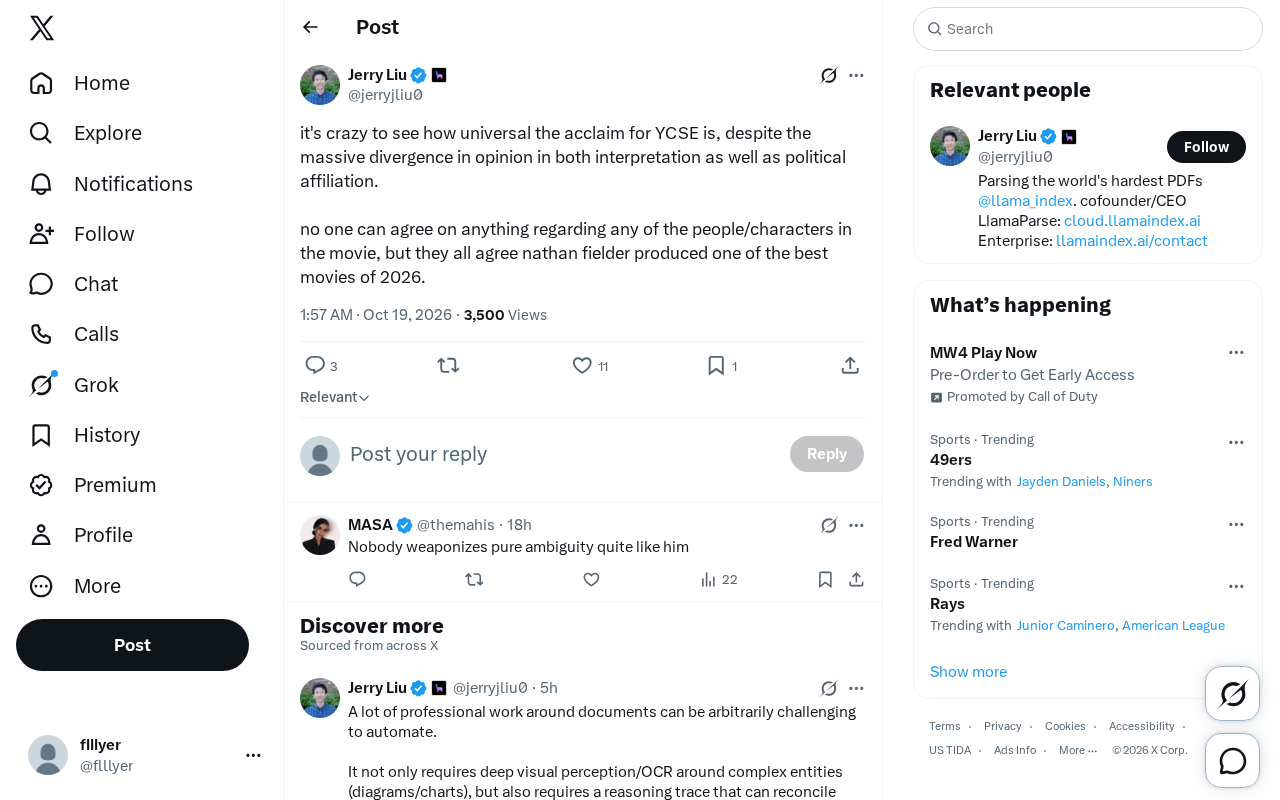
A Twitter observation struck a chord with many: the film YCSE has received remarkably consistent praise, even though audiences are deeply divided over the characters and political stances in the film. No one can agree on any character in the movie, but everyone agrees—Nathan Fielder has made one of the best films of 2026.
Rare Consensus Amid Polarization
What makes YCSE peculiar is that it simultaneously produces two diametrically opposed effects. On one hand, viewers argue endlessly about the characters, the direction of the plot, and even the implicit political metaphors; on the other hand, almost no one denies the film's production quality and overall caliber. This kind of "consensus within disagreement" is extremely rare among today's cultural products.
According to the Twitter user's observation, discussions around YCSE are filled with ideological opposition—viewers with different political leanings read completely different things from the same film. But whichever camp they belong to, they give highly consistent assessments: this is another masterwork from Nathan Fielder and a strong contender for film of the year.
Why Disagreement Actually Strengthens the Buzz
When a work allows viewers with wildly different stances to each find an entry point, it often possesses a certain ambiguity. YCSE seems to be exactly that—its narrative gaps and character complexity let viewers from different backgrounds project their own interpretations. This openness doesn't weaken its appeal; instead, it keeps discussions heating up, creating a cycle of "the more people argue, the more others want to see it."
Nathan Fielder's Auteur Signature
Nathan Fielder has long been known for his distinctive comedic style and uncomfortable sense of realism. From Nathan for You to The Rehearsal, he excels at creating tension on the boundary between documentary and fiction. YCSE continues this lineage and seems to push his authorial identity to new heights.
You may not have noticed that viewers' divergent interpretations of the film's content do not extend to questioning Fielder's creative ability. On the contrary, this disagreement actually confirms his control as a creator—the ability to precisely craft a text open to multiple interpretations while maintaining consistent overall quality.
Nathan for You is a mockumentary-style comedy that Fielder aired on Comedy Central from 2013 to 2017, in which he plays a "business consultant" who helps small businesses solve operational problems with absurd and even boundary-pushing schemes; the humor is often built on real passersby's genuine reactions to extreme situations. The Rehearsal (on HBO since 2022) goes further: Fielder builds elaborate scenario rehearsals for ordinary people to help them pre-enact life's challenges, yet the process constantly blurs the line between helping and manipulating, documentary and performance. Together these two works establish Fielder's core methodology: using real people and real emotions as material, triggering uncontrollable moments through highly designed frameworks, and keeping viewers perpetually uncertain whether they're watching a documentary or a drama. Understanding this lineage helps grasp why YCSE naturally possesses room for multiple interpretations.
Lessons for Content Creators
The YCSE phenomenon offers a case worth pondering: in an environment of extreme polarization, a work can still earn cross-camp recognition through sheer quality. For content creators, this means there's no need to sacrifice the complexity of expression to cater to a particular group; truly solid work can instead build broader trust amid controversy.
Of course, this "universal praise" comes with risks—when everyone says it's good, discussion tends to slide into empty flattery. But for YCSE, at least for now, the disagreement itself is providing an endless supply of conversational fuel.
One-line Summary
YCSE leaves viewers on opposing sides deeply divided in interpretation, yet unanimously acknowledging Nathan Fielder's creative quality.
Paragraph Summary
The article centers on a Twitter observation about the film YCSE: viewers' interpretations of its characters, plot direction, and political metaphors are highly split—different ideological camps read completely different things from the same film—yet almost everyone agrees it's another masterwork from Nathan Fielder and even one of the best films of 2026. The author attributes this phenomenon to the work's ambiguity and narrative gaps, arguing that they allow viewers from different backgrounds to project their own interpretations, with debate actually boosting buzz and word-of-mouth. The article also connects Fielder's consistent creative style from Nathan for You to The Rehearsal, noting that the disagreement centers on content interpretation rather than creative ability—precisely confirming his authorial control—and draws a lesson for content creators: in a polarized environment, there's no need to sacrifice expressive complexity to cater to any one group.
Related articles

AI Digital Twin in Action: Using DOT to Automatically Track Bugs and User Feedback
DOTS engineers demonstrate how AI digital twin DOT collects cross-platform user feedback, categorizes issue themes, opens threads to investigate bug root causes, and submits PRs—showcasing a complete AI agent workflow for defect triage with auditable design.

Why Transistors Are No Longer Flat: The Evolution from Planar to Gate-All-Around
Transistor evolution from planar to FinFET to gate-all-around: why gates went from three-sided to four-sided wrapping to suppress short-channel effects and leakage current, extending Moore's Law.

Swarm Intelligence = a Single RL Agent? A Proof of Multi-Armed Bandit Equivalence
A paper proves that collective decision-making through local imitation in swarms is mathematically equivalent to single-agent reinforcement learning: N blind imitators act as N parallel environment samples, with an effective learning rate of 1/N. This article explains the derivation and implications of the Maynard-Cross Learning algorithm.