yggy: An AI Tool for Building Your Own Knowledge Graph — Say Goodbye to Sourceless RAG
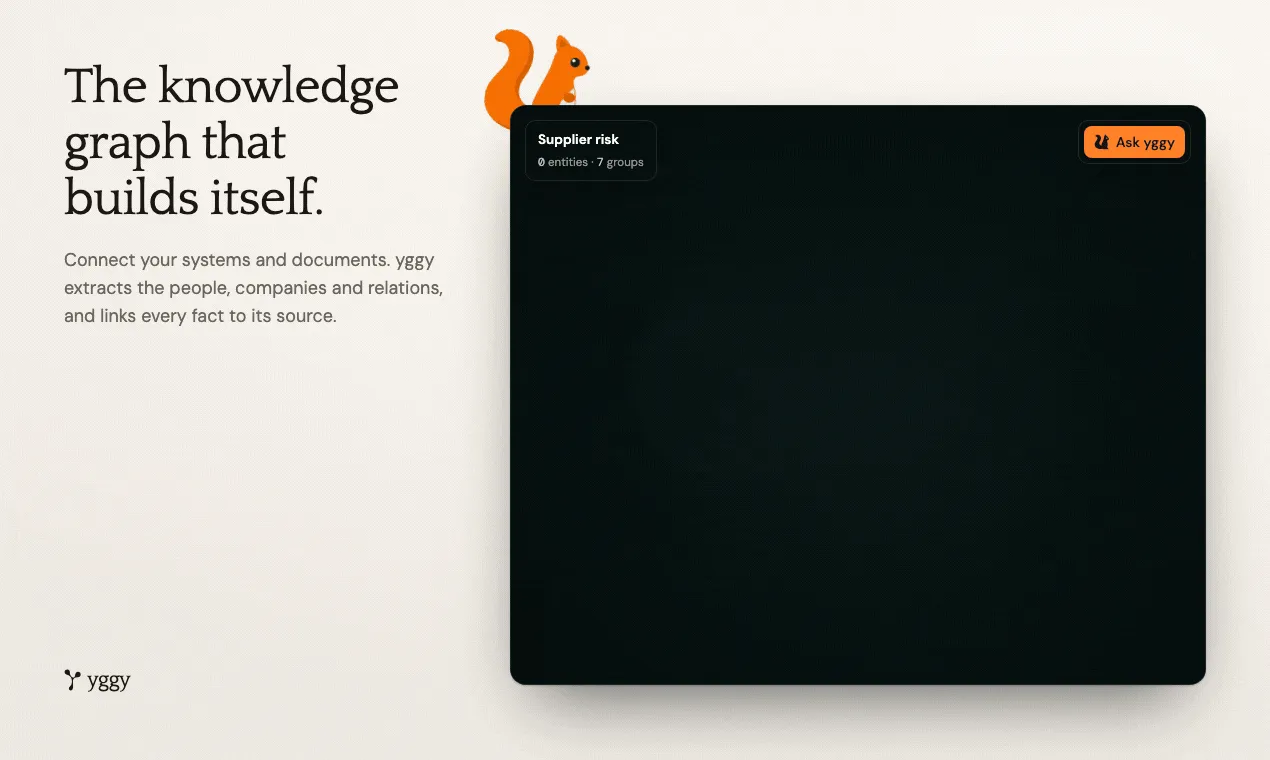
yggy replaces traditional RAG with a schema-free knowledge graph where facts are traceable and auditable.
yggy is a knowledge management tool launched on Product Hunt that breaks away from the traditional RAG paradigm of chunking, vectorizing, and similarity retrieval. Instead, it automatically extracts entities and relationships from messy documents and interconnected systems to build a schema-free knowledge graph. Every fact retains its source, duplicate entities are merged automatically with reversible merges, and a single graph serves teams, developers, and AI agents through the app UI, API, and MCP. Hosted in the EU, it emphasizes data sovereignty and compliance. The article argues it may outperform pure vector retrieval for multi-hop reasoning and precise fact queries, but extraction accuracy, coverage of unstructured text, and early-stage ecosystem integrations still need time to prove out.
Most "chat with your data" tools just dump a pile of text chunks into a model and hope for the best. yggy chooses to do what they skip: turning your messy files and interconnected systems into a real knowledge graph — no schema design, no pipelines to run. Every fact retains its source, duplicates are merged automatically and reversibly, and a single graph serves teams, code, and AI agents alike.
Why build your own knowledge graph?
The typical approach of traditional RAG (Retrieval-Augmented Generation) is to chunk documents, vectorize them, and retrieve by similarity. This works reasonably well for simple Q&A, but often falls short on complex queries — the model only sees scattered fragments and struggles to understand the deeper relationships between entities. More critically, the fragments themselves lose context and provenance, leading the model to fabricate plausible-sounding but baseless answers.
yggy starts from a completely different premise. It holds that knowledge shouldn't be a pile of flat text chunks, but a graph that is structured, sourced, and traceable. By automatically extracting entities and relationships, yggy builds a genuine knowledge network where every fact can be traced back to an original document or system. This not only improves answer accuracy but also makes the knowledge base auditable.
RAG (Retrieval-Augmented Generation) is a technical paradigm in which a large language model retrieves relevant chunks from an external knowledge base before generating an answer. Its standard pipeline typically includes: splitting documents into small chunks (chunking), converting each chunk into a vector using an embedding model, storing them in a vector database, and at query time recalling several chunks by similarity and concatenating them into the prompt. RAG's advantage is that it can tap private knowledge without retraining the model, but its limitations are obvious — it recalls isolated text chunks lacking explicit relationships between entities, and the model struggles to judge the logical connections between chunks. Multi-hop questions (e.g., "where is the alma mater of A's founder") easily break the chain.
A knowledge graph, by contrast, uses "entity—relationship—entity" triples as its basic unit, organizing information into a directed network. Compared with vector retrieval, graphs excel at expressing multi-hop relationships and structural constraints, and queries can traverse precisely along relationship paths. Traditional knowledge graph construction requires manually designing an ontology (schema) and running extraction pipelines, which is costly and time-consuming; yggy's "schema-free" approach is precisely an attempt to bypass this bottleneck, letting the graph grow automatically with the data.
How does yggy work?
According to its Product Hunt page, yggy's core capabilities revolve around "automatic construction":
- Schema-free design: Users don't need to predefine entity types or relationship schemas; the system automatically identifies and organizes information.
- Source preservation: Every extracted triple comes with its provenance, ensuring answers are verifiable.
- Smart deduplication and reversible merging: When the same entity appears in different forms, yggy merges them automatically, but users can undo any merge at any time to prevent error accumulation.
- Unified outputs: The graph is served through three channels — the application UI, API, and MCP (Model Context Protocol) — meeting the needs of human users, developers, and AI agents simultaneously.
This design makes yggy not just a knowledge management tool but a knowledge infrastructure for the AI era. Teams can collaborate and browse within the app, developers can integrate it into their own systems via API, and AI agents can query the graph directly through MCP to obtain structured, traceable knowledge.
MCP (Model Context Protocol) is a protocol proposed and open-sourced by Anthropic to let AI applications connect to external data sources and tools in a standardized way. It uses a client-server architecture: AI applications (such as Claude Desktop or IDE plugins) act as clients and communicate with MCP servers via JSON-RPC, while servers expose three types of capabilities — "resources" (readable data), "tools" (callable functions), and "prompt templates." For yggy, providing an MCP interface means any AI agent supporting the protocol can query the knowledge graph directly without writing separate integration code for each agent. This greatly lowers the barrier to "letting AI access structured knowledge" and makes the graph a shared knowledge layer reusable by multiple agents.
Multi-source support and hosting advantages
yggy emphasizes its ability to integrate "messy documents and interconnected systems," meaning it can extract knowledge from a variety of sources (such as document repositories, databases, and collaboration tools) and unify them into a single graph. For enterprises, this reduces data silos and lets knowledge flow.
Another noteworthy detail is that it is hosted in the EU. Amid increasingly strict data privacy regulations, EU hosting provides additional assurance for compliance-conscious teams. The official statement explicitly says "your knowledge always belongs to you," addressing enterprises' concerns about data sovereignty.
Differences from traditional RAG
yggy's Product Hunt description directly targets the pain point of traditional RAG: "throwing a pile of text chunks at a model and hoping for the best." While it doesn't completely dismiss the value of vector retrieval, by building a knowledge graph, yggy attempts to establish structured understanding before retrieval. This approach may be more advantageous in scenarios requiring multi-hop reasoning or precise fact queries.
However, the quality of knowledge graph construction depends heavily on the accuracy of the extraction model. How does yggy handle extraction errors? The reversible merge feature partially mitigates this, but users still need to keep an eye on merge results. Moreover, in scenarios with a very high proportion of unstructured text, graph coverage may be less flexible than pure vector retrieval.
Multi-hop reasoning refers to questions that require chaining multiple facts to answer, such as "what data privacy regulations exist in the continent where yggy is hosted." Single-hop retrieval can only recall the chunks most similar to the keywords, whereas multi-hop reasoning requires the system to expand layer by layer along entity relationships. Knowledge graphs naturally support this kind of traversal: starting from "yggy," find "hosting location: EU," then find regulation nodes such as "GDPR" associated with "EU." However, the recall quality of multi-hop queries depends on the graph's connectivity and extraction completeness — if a relationship at some hop isn't extracted, the reasoning chain breaks. Therefore, graph-based solutions usually need to complement vector retrieval: use the graph to ensure structural precision and vectors to cover the long tail.
Who is yggy for?
Judging from its positioning, yggy suits the following scenarios:
- Team knowledge bases: Need unified management of scattered documents and verifiable answers.
- Developers building AI applications: Quickly integrate structured knowledge via API or MCP, reducing the engineering effort of building a graph themselves.
- Compliance-sensitive industries: EU hosting and source tracking meet audit requirements.
Currently, yggy has 83 upvotes and 9 comments on Product Hunt, ranking 20th for the day — moderate traction. As an early-stage product, its ecosystem integrations and extraction accuracy still need time to prove themselves, but the "build-your-own-graph" approach is worth watching.
Conclusion
yggy represents a new direction for knowledge management tools: no longer content to let models "read" documents, but first helping models "understand" relationships. Its schema-free, traceable, multi-output design gives it the potential to become the knowledge foundation for AI applications. For teams tired of RAG hallucinations, it may be worth a try.
One-line Summary
yggy replaces traditional RAG with a schema-free knowledge graph, making facts traceable and auditable.
Related articles
Three New Metapunk Skills: Building a Closed Loop for AI Software Development
Metapunk's new version adds Implement Spec, PR, and Retro skills to complete the AI software development loop. This article analyzes each skill's features and workflow to help improve AI Agent development efficiency and code quality.

6 Dark Tales of Terror: TED-Ed Uses Animation to Illustrate Fables of Human Nature
TED-Ed's six horror stories collection includes The Monkey's Paw, the Japanese tale of Oiwa, Death's Godfather, Beowulf, Poe's The Masque of the Red Death, and Hoichi the Earless. This article analyzes how these animated shorts use cross-cultural fables to explore desire, betrayal, and the price of death—and why they suit classroom discussion.
A Practical Guide to Calling Lightweight Ollama Models from Python
A complete hands-on guide to installing Ollama, pulling a 0.8B lightweight model, and calling it from Python—covering service startup, model name matching, first-load delays, and other pitfalls, with a measured 0.23s per call.