Your Charger Is Watching You: A Hacker Reveals the Security Traps in Everyday Devices

A security expert demonstrates how cheap devices and data breaches can expose everything about a person in 20 minutes.
The article recounts an interview with a security expert who roamed hacker forums since age nine and now works on child crime and anti-trafficking. He demonstrates modified USB charging cables and portable Wi-Fi/Bluetooth attack devices, showing that cheap smart devices can almost all be controlled and that physical and cybersecurity have become fused. Using only a data breach database, he reconstructed the host's old passwords and the gym he frequented 12 years ago within 20 minutes. The latter half turns to the grim "764" network, whose manuals teach members to extort children aged 8 to 11. His basic advice: start with your phone, check permissions, disable unnecessary connections, and trust no cheap device—treat suspicion as an ongoing security habit.
A security expert who has been roaming hacker forums since the age of nine and now works on child crime and anti-trafficking gave an interview revealing how the seemingly harmless devices around us can become surveillance tools. In just 20 minutes, using data breach records, he found the host's old passwords, the gym he frequented, and more. This isn't a movie plot—it's happening right now.
Every Cheap Device You Buy Could Be Controlled by Hackers
The expert put it bluntly: "Don't trust any device, because any of them can be hacked." From cheap cameras bought on Amazon to ordinary-looking iPhone charging cables, a tiny computer may be hidden inside. He showed a USB cable that looks identical to a genuine Apple cable but contains a complete attack module.
Even more unsettling is that these devices are almost always communicating with the outside world. In the screenshot he states clearly: "They almost all communicate with China." Rather than phone tapping, what worries him more is the data exfiltration behind these devices.

The USB cable described in the article—"identical in appearance to a genuine Apple cable, yet with an attack module integrated inside"—is commonly known in security circles as the O.MG Cable. Developed by security researcher Mike Grover, it looks exactly like an ordinary Lightning or USB-C cable, but a tiny Wi-Fi-enabled chip is embedded in the connector. It can emulate keyboard input, inject malicious commands, and steal data—attackers can even control it remotely through a browser. The emergence of such products shows that the barrier to supply chain attacks has dropped dramatically: an attacker doesn't need to touch the victim's device, only to get the victim to plug in a cable that "looks fine."
A related concept is "BadUSB," which exploits the fact that USB device firmware can be rewritten, allowing flash drives, keyboards, network adapters, and the like to masquerade as other device types. Operating systems trust plugged-in USB devices by default, so when a cable poses as a keyboard, it can execute commands with the user's privileges. For defense, besides not plugging in cables of unknown origin, you can use a USB data blocker (which supplies power only and blocks data) to reduce risk.
Three "Gadgets" That Can Cripple Your Phone and Knock Out Cameras
The interview showcased several portable attack devices. The first, called "Biscuit," can launch Wi-Fi and Bluetooth attacks, instantly making everyone in the studio have notifications pop up on their phones and rendering them nearly unusable. The second, disguised as a mint tin, can actually force cameras offline, place scam calls, and even hack drones.
The existence of these devices shows that physical security and cybersecurity have become completely fused. An attacker doesn't need to crack your account—just get near your device and everything can spiral out of control.

The portable devices such as "Biscuit" mentioned in the interview belong to a class of wireless attack platforms. They are usually based on low-cost Wi-Fi/Bluetooth chips such as the ESP32 and can run attacks like deauthentication (forcing disconnections), Bluetooth spam broadcasts, and fake hotspots. The so-called "making everyone in the studio have notifications pop up on their phones" is most likely exploiting the Bluetooth Low Energy (BLE) advertising mechanism or Wi-Fi management frame injection to push a large number of connection requests or notifications to nearby devices, causing harassment or even denial of service.
It's important to distinguish that most of these attacks don't crack encryption; they exploit "trust defaults" in protocol design: devices actively scan for and respond to nearby signals. Protective measures include turning off automatic Bluetooth and Wi-Fi connections when not in use, disabling "ask to join networks" pop-ups, and avoiding turning on hotspots in public places. For enterprises, these devices also highlight the importance of physical access control—an attacker only needs to get close to potentially bypass all account-level protections.
20 Minutes: From a Data Breach to Your Old Passwords and Gym
The most spine-chilling segment of the show was the expert's live demonstration of information gathering. He first used a data breach database to identify the host's email, then linked it to the gym he frequented 12 years ago, old passwords, and other private information. The host exclaimed "Oh my God" on the spot and admitted, "I was afraid you'd do that."
Behind this is the cumulative effect of public data breaches. A single breach may seem trivial, but once cross-platform correlation is applied, a person's life trajectory can be almost completely reconstructed.
The "data breach database" mentioned in the article refers to leaked-credential aggregation platforms commonly used by attackers and security researchers, such as Have I Been Pwned (HIBP) and various dark web datasets. HIBP, maintained by security researcher Troy Hunt, catalogs email addresses and password hashes from hundreds of large-scale data breaches, and users can check whether their email has been affected. Attackers go further, cross-referencing multiple breach databases by email, phone number, and username to form an "identity graph."
This is the core method of so-called OSINT (open-source intelligence) gathering: a single breach exposes only an email and password, but combined with publicly available social media information, old forum usernames, and password reuse habits, years of a person's life trajectory can be reconstructed. The reason the "gym from 12 years ago" in the article could be found is often that the email had once registered for a related service, or that an old password was reused on another platform. The key to defense is not reusing passwords, enabling two-factor authentication, and regularly checking on platforms like HIBP whether your email has appeared in new breaches.
Darker Than Privacy Leaks: The 764 Network and Child Extortion
The latter half of the interview turned to a heavier topic. The expert mentioned an organization called "764," describing it as a "nihilistic, Satanist cult" that specifically targets children who are bullied at school and have suicidal tendencies. They have hundreds of pages of manuals teaching members how to extort and groom victims, some as young as 8 to 11 years old.
After seeing the related materials, the host broke down emotionally and asked for the page to be closed. The expert's current work is precisely to combat this kind of crime, and he stressed that these cases often begin with seemingly ordinary private messages on social platforms.
"764" is a type of cybercriminal gang that has drawn intense attention from law enforcement in recent years. Its name comes from the number of an online chat group; members are mostly teenagers who espouse extreme nihilism and Satanism as an "ideological packaging" for violence and extortion. Their usual tactic is "sextortion": first approaching minors in game chats or social platform private messages while posing as peers, luring them into sending private images, then using these to blackmail them into self-harm or recruiting other children.
The danger of such cases is that they occur entirely within the platforms minors use daily, making them hard for parents to detect. Agencies such as the U.S. Federal Bureau of Investigation have issued repeated warnings that 764 and related groups are linked to multiple suicides and violent incidents involving minors. For prevention, platforms need to strengthen private message risk controls and age verification, while parents should pay attention to their children's online social contacts and make sure children know: if threatened, they should immediately tell a trusted adult and preserve evidence, rather than compromising alone.
The Most Basic Security Advice: Start With Your Phone
When asked how ordinary people can improve their security, the expert's first suggestion was to examine their own phone. He joked that he had spent 24 hours looking for his phone, reminding everyone that phones carry too much identity information yet are often overlooked.
The specific steps aren't complicated: check app permissions, turn off unnecessary Bluetooth and location services, don't casually connect to unfamiliar Wi-Fi, and stay wary of cheap smart devices. More importantly, don't assume any device is safe by default.

Security is not a one-time task but an ongoing habit. When chargers, cameras, and even mint tins can all become attack vectors, maintaining suspicion is the best line of defense.
One-line Summary
A security expert demonstrates how cheap devices and data breaches can expose everything about a person in 20 minutes.
Paragraph Summary
The article recounts an interview with a security expert who roamed hacker forums since age nine and now works on child crime and anti-trafficking. He demonstrates modified USB charging cables, portable Wi-Fi/Bluetooth attack devices, and other "gadgets," showing that nearly all cheap smart devices can be controlled and that physical security and cybersecurity have become completely fused. On the show, using only a data breach database, he reconstructed the host's old passwords, the gym he frequented 12 years ago, and other private information within 20 minutes, revealing the cumulative effect of cross-platform correlation. The latter half of the interview turns to the grim "764" network, an organization whose hundreds of pages of manuals teach members to extort and groom children aged 8 to 11. The expert's basic advice is to start with your phone: check permissions, turn off unnecessary connections, trust no cheap device, and treat suspicion as an ongoing security habit.
Related articles

GLM-5.4 Is 5x Cheaper Than Claude — But at What Cost?
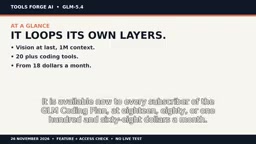
GLM-5.4 offers near-Claude coding ability at $18/month, about one-fifth the cost, but lacks flagship benchmarks and max effort can exhaust quotas on a single 7-hour task. This article combines the official paper and three independent reviews to explain the recurrent Transformer architecture and offer practical advice.
GLM-5.4 Open-Source Coding Model Tested: The Strongest, But It Takes 7 Hours
Z.AI releases GLM-5.4 coding model with Loop Transformer architecture, called the strongest open-source coding model by independent review, but it takes over 7 hours and ~15x tokens on the same benchmark. Here's the architecture, test scores, pricing, and competitive landscape.

GLM-5.4 Hands-On: Loop Transformer Gives Coding a Big Boost, But It's Not Frontier Yet
GLM-5.4 hands-on: a loop transformer runs 28 layers twice, markedly improving code fixes over 5.3, but bug hunting still trails Gemini 4 Neon—solid iteration, not frontier.