YourSitee Review: Redefining Bio Link Pages with Component-Based Design

YourSitee uses drag-and-drop components and AI migration to transform Bio link pages into personalized digital storefronts.
YourSitee is a Bio link aggregation tool that reached #3 on Product Hunt by addressing the sameness of traditional link-in-bio pages. It offers 20+ drag-and-drop widgets for modular page building, AI-powered one-click Linktree migration, and built-in analytics. By shifting from functional link lists to personalized expression platforms, it represents the next evolution in the creator economy's digital infrastructure.
From "Link Lists" to "Personal Homepages": An Evolution
In an era dominated by social media, platforms like Instagram, TikTok, and YouTube typically only allow a single link in your profile. This gave rise to "Bio link aggregation tools," with Linktree being the most widely recognized example.
The rise of Link-in-Bio tools stems from social platforms' strict restrictions on external links. Since 2014, Instagram has only allowed one clickable link in a user's bio, and short-video platforms like TikTok and YouTube Shorts have adopted similar policies. This limitation gave birth to tools like Linktree (founded in Australia in 2016), which transforms a single link into an intermediary page containing multiple links. As of 2024, Linktree boasts over 50 million users and a valuation of $1.3 billion. While the overall market size of this space is difficult to quantify precisely, its core value—efficiently directing social media traffic to external destinations—makes it an important component of the creator economy infrastructure.
But as more creators, indie developers, and small businesses have entered the scene, a common pain point has emerged: almost all Bio pages look exactly the same—a bunch of neatly arranged buttons, cold and lacking any personality.
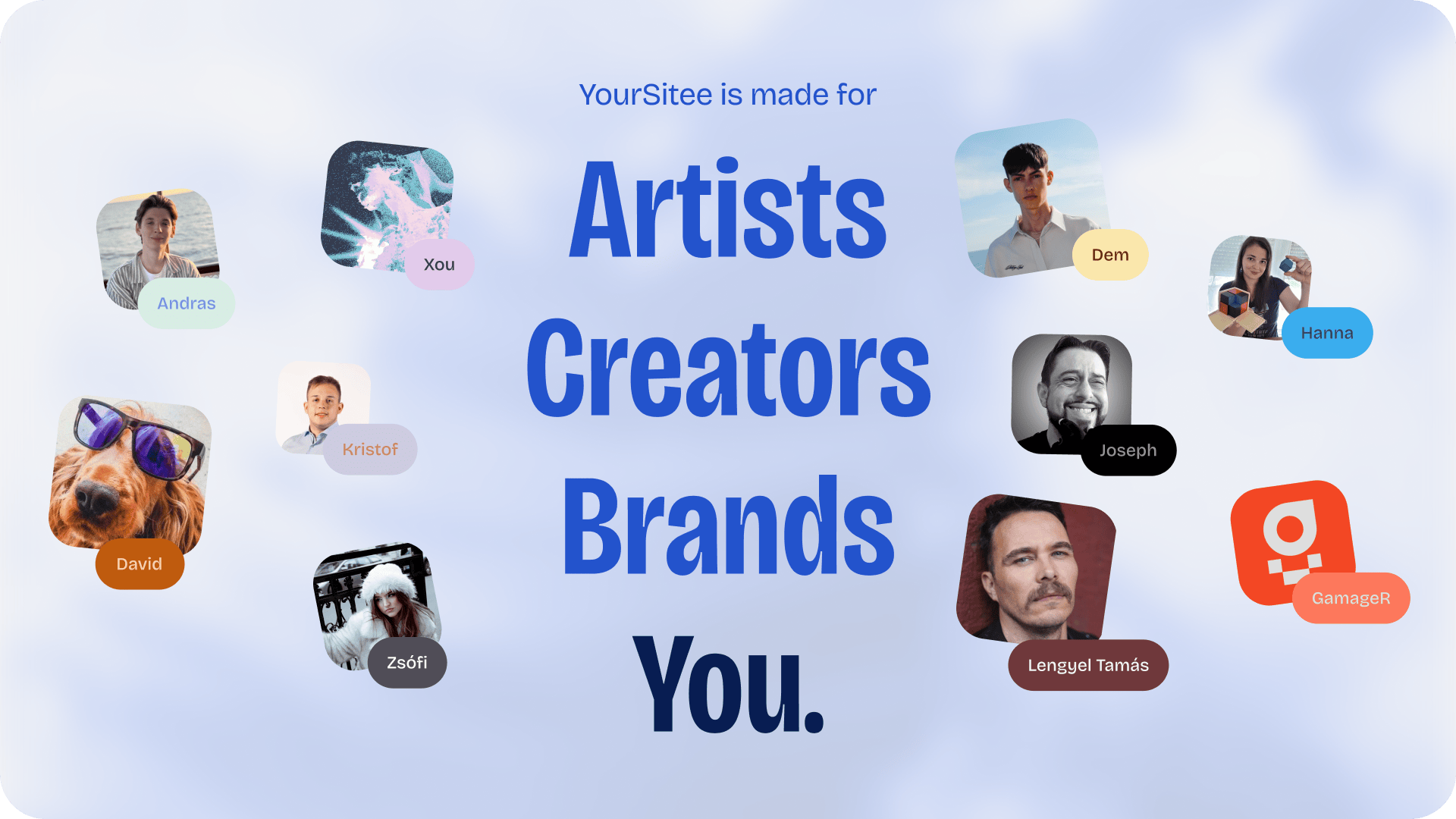
YourSitee, which recently reached #3 on the Product Hunt leaderboard (earning 112 upvotes and 19 comments), targets precisely this pain point. Its slogan hits the mark: "Make your bio link worth clicking." It aims to consolidate your scattered online identities into a visual page that "looks like you" rather than just another list of buttons.
YourSitee Core Features Breakdown
Based on the official introduction, YourSitee focuses on three core capabilities, each directly addressing the shortcomings of existing Bio link tools.
20+ Drag-and-Drop Components for Personalized Visual Pages
Unlike the rigid "one link, one button" model of traditional aggregation tools, YourSitee offers over 20 drag-and-drop Widgets (components). This means users can do more than just add links—they can embed images, videos, text blocks, social feeds, and other diverse content modules to build page layouts with genuine personal style.
For content creators, this "modular building" approach is closer to a lightweight no-code personal website than a simple navigation page. The No-Code movement has been a significant trend in software development in recent years, with the core philosophy of enabling users without programming skills to build applications or web pages through visual interfaces. Representative products include Webflow (website building), Notion (knowledge management), and Airtable (databases). YourSitee's "drag-and-drop Widget" model essentially borrows the Block-based editing design philosophy from Notion and Framer—breaking page content into independent, composable modular units that users can arrange through dragging, reordering, and styling. This design pattern lowers the barrier to entry while giving users far more freedom than template restrictions allow. It strikes a balance between No-Code ease of use and the expressiveness of custom pages.
AI One-Click Linktree Import: Zero Migration Cost
Migration cost is often the biggest growth barrier for competing products. Users have already carefully configured all their links on Linktree—why would they start over from scratch?
YourSitee answers this with its AI Import from Linktree feature—it uses AI to automatically scrape and migrate users' existing Linktree content, dramatically lowering the switching threshold.
From a technical implementation perspective, this feature likely relies on a combination of Web Scraping and content parsing. Since Linktree page structures are relatively standardized (typically a title, avatar, and a list of link buttons), AI can analyze the page's DOM structure or rendered visual elements to automatically identify and extract link text, URLs, arrangement order, and other key information. Going further, the AI may also attempt to understand content semantics, automatically matching extracted links to the most appropriate Widget types (such as converting YouTube links into video embed modules).
This is a classic "targeting competitor users" growth strategy: attracting the opponent's existing user base with minimal friction. This "competitor data migration" strategy has precedent in the SaaS space—email marketing tool ConvertKit once offered one-click subscriber list migration from Mailchimp, and Figma provided one-click import of Sketch files. The core logic is consistent: when users' sunk costs are zeroed out, the switching decision becomes purely a product experience comparison.
Built-in Analytics: See What Users Are Clicking
The third major selling point is the built-in Analytics feature. Users can intuitively see which links visitors are clicking and which content is most popular.
For creators who rely on Bio links for monetization or traffic generation, this data is crucial—it helps determine which platform brings the most valuable traffic, enabling optimization of page structure and content arrangement. Building analytics in as a core feature rather than a paid premium add-on also reflects the product's emphasis on "data-driven decision making" as a key user need.
Why Did YourSitee Reach the Top 3 on Product Hunt?
Bio link aggregation is a space that appears saturated but is still actively evolving. YourSitee's achievement of reaching #3 on Product Hunt can be attributed to several noteworthy product strategies:
First, a positioning upgrade from "tool" to "expression." Early aggregation tools solved the functional problem of "not enough room for links," while YourSitee addresses the higher-level need of "how to present your unique self in the digital world." This aligns perfectly with the broader creator economy trend—according to a Goldman Sachs 2023 report, the global creator economy market is approximately $250 billion and is expected to grow to $480 billion by 2027. In this ecosystem, a creator's "digital storefront" is becoming increasingly important. Consistent with the core tenets of Personal Branding theory: in an era of scarce attention, differentiated visual presentation and consistent brand experience are key to building trust and memorability. Once baseline features become homogenized, visual personalization and brand feel become the new competitive dimensions.
Second, AI is used in the "right place." The AI here isn't piled on to ride the hype wave—it's precisely applied to the practical scenario of reducing migration costs. This is a pragmatic AI application approach—using AI to eliminate the biggest barrier to users switching products. In the current overheated AI market, this philosophy of "AI for solving real pain points rather than showing off" is actually more likely to earn user trust.
Third, the data loop is complete. Build pages (Widgets) → Import content (AI) → Track results (Analytics)—YourSitee forms a complete usage loop, ensuring users not only "enjoy using it" but also "get returns from using it."
Challenges and Competitive Landscape for YourSitee
Of course, competition in the Bio link space is fierce. Beyond industry benchmark Linktree, there are numerous players like Beacons, Bio.link, and Carrd, some of which also emphasize personalization and AI capabilities. For YourSitee to break through, a feature list alone isn't nearly enough. The key factors are:
- Template and Visual Quality: Since the product positions itself around being "worth clicking," the aesthetic quality of out-of-the-box templates and the degree of customization freedom will directly determine first impressions.
- Loading Performance: As a traffic entry page, page load speed directly impacts conversion rates—the richer the components, the more demanding the performance optimization. Google's research shows that when mobile page load time increases from 1 second to 3 seconds, bounce rate rises by 32%; at 5 seconds, bounce rate increases by 90%. For Bio link pages, users clicking from social media are typically in a rapid browsing state with extremely limited attention windows. When pages embed numerous rich media components, they must rely on Lazy Loading, CDN distribution, image compression, and frontend framework-level performance optimization (such as SSR server-side rendering or ISR incremental static regeneration) to ensure first-screen load time stays within 1-2 seconds.
- Pricing Strategy: The generosity of the free tier and the placement of the paywall will significantly impact its ability to steal users from Linktree.
Conclusion: The Next Step for Bio Link Tools Is Personalized Expression
YourSitee represents a typical evolution of Bio link tools—moving from functional fulfillment to personal expression, using AI to lower migration barriers, and using analytics to close the value loop. For creators, indie developers, and freelancers who are tired of cookie-cutter Bio pages, it's worth a try.
For the broader "personal homepage as storefront" market, this reaffirms a trend: when basic features become universal, experience and personalization are the true moats for retaining users. The evolution of Bio link pages from functional tools to personalized expression platforms is a microcosm of the creator economy's maturation—when everyone has a link page, real competitive advantage isn't about "having one" but about "whether it looks like you."
Related articles

Uber Deploys ChatGPT Work Company-Wide: AI in the Workplace Enters the Scaled Implementation Phase
Uber deploys ChatGPT Work to 30,000+ employees, extending it from engineering to all roles. We analyze its expert-engineer pairing, end-to-end automation, and questions of AI control and power concentration—insights for scaling AI in the workplace.

Shift at Midnight Hands-On: When "ID Verification" Becomes Alien Hunting
Shift at Midnight blends ID verification with horror survival in a four-player co-op game. We break down its inspection mechanics and chaotic humor.

Zelensky Recounts the Outbreak of War: I Need Ammunition, Not a Ride
Zelensky recalls the first day of war in a YouTube interview: farewell to family, rejecting Biden's evacuation offer with "I need ammunition, not a ride," and how Bucha shaped his stance on compromise and peace talks.