YouTube Slaps "Made with AI" Labels on AI-Generated Songs
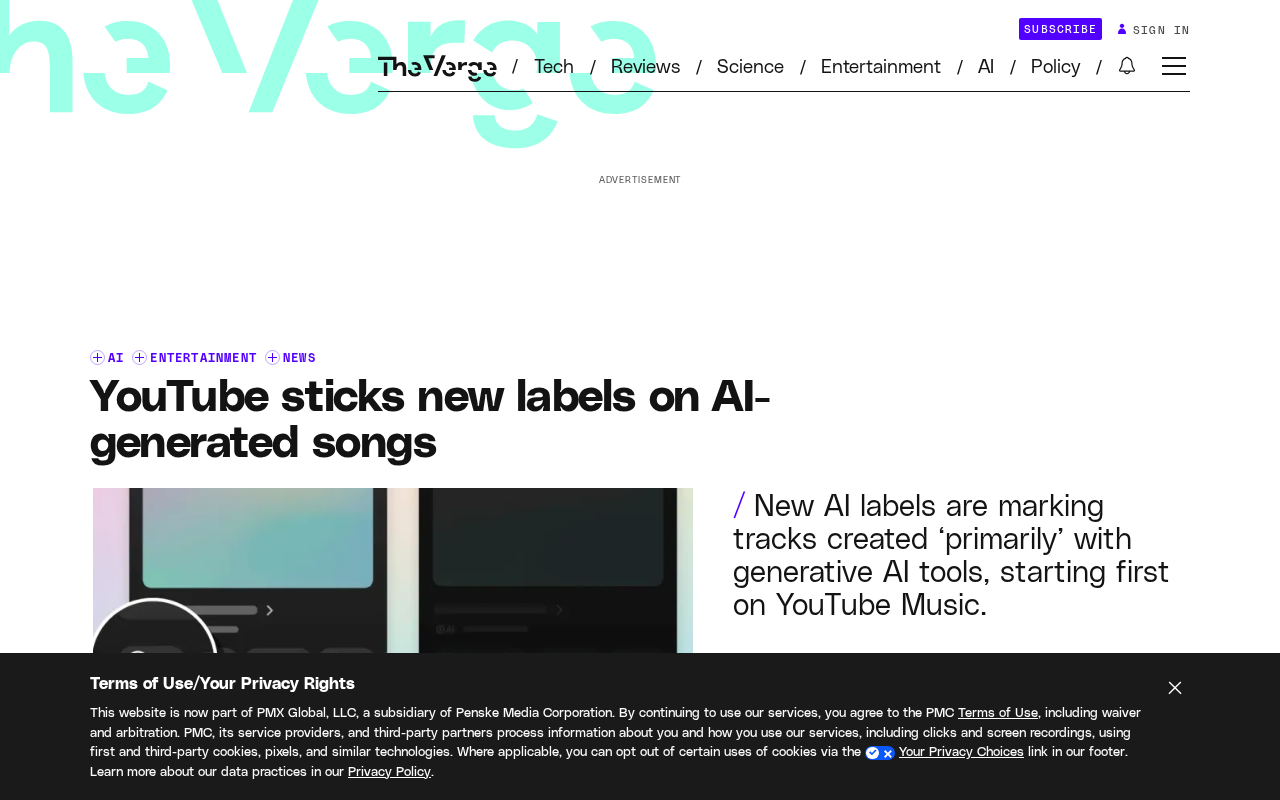
YouTube adds a "Made with AI" label to AI-altered or generated music, extending its video labeling framework.
YouTube has announced it will add a "Made with AI" label to music tracks on its platform that are "altered or entirely generated" by AI, extending its existing AI labeling system in the video space. The label does not cover all AI tool usage scenarios—auxiliary activities such as mastering, noise reduction, and assisted arrangement do not trigger it; it only appears when AI substantively alters or generates content. This definition reflects the reality that music labeling is more complex than video: AI has deeply integrated into routine production workflows including mixing, mastering, and sound design, and labeling everything would render the label meaningless. The move is part of a broader AI transparency trend across platforms, but execution details—identification technology and whether it's mandatory—remain unclear. For independent musicians, the label aids transparency but may also be misread by listeners as indicating low quality or non-originality, and platforms need to find a balance between transparency and creator interests.
YouTube is adding a "Made with AI" label to music tracks on its platform that are "altered or entirely generated" by AI, following the same approach as its existing video AI labeling system.
Scope of the Label: Not All Uses of AI Tools
According to YouTube, this label will not cover every scenario where AI tools are involved in music production. In other words, using AI for mastering, noise reduction, or assisted arrangement may not trigger the label; it only appears when a track is "altered or entirely generated" by AI.
This approach essentially continues YouTube's strategy in the video space—it attempts to distinguish between "AI-assisted creation" and "AI-generated content," two fundamentally different activities. In the former, humans lead and AI lends a hand; in the latter, AI takes on the role of creative主体.
Why Music Is Harder to Label Than Video
AI labeling for video is relatively straightforward: face-swapping, AI voiceovers, generated visuals—these operations have fairly clear boundaries. But music is different.
In modern music production workflows, AI has already permeated mixing, mastering, sound design, and even melody suggestions. A single DAW (Digital Audio Workstation) may have multiple built-in AI features that producers use as naturally as EQ and compressors. If all of these counted as "Made with AI," virtually all contemporary music would be labeled, and the label itself would lose its distinguishing meaning.
By choosing to focus on "altered or entirely generated," YouTube is effectively drawing a line: whether AI substantively changed the work itself, rather than merely participating in the production process.
DAW (Digital Audio Workstation) is the core software platform for music production, including Logic Pro, Ableton Live, FL Studio, and others. It integrates recording, arrangement, mixing, and mastering, serving as the foundational tool for modern industrialized music production. In recent years, mainstream DAWs and their companion plugins have increasingly integrated AI features—for example, iZotope's intelligent noise reduction and mastering assistant, Ableton's chord and melody generation suggestions, and various AI timbre separation and replacement tools. These features are embedded in everyday workflows, and producers often don't consciously distinguish between "AI involvement" and "traditional processing" when using them. Precisely because of this, if "whether AI was used" were the labeling criterion, nearly all modern music would be covered, and the label would lose its filtering value. This is the context behind YouTube's emphasis on the substantive standard of "altered or entirely generated."
An Extension of the Platform Labeling Trend
YouTube's move is not an isolated event. From image platforms to music streaming services, major content platforms are exploring how to label AI-generated content.
For YouTube, the music label is an extension of its overall AI transparency framework. The platform has previously applied similar AI labels to videos, and now replicating this logic for music maintains strategic consistency while responding to concerns about the proliferation of AI content.
But the challenges at the execution level are significant. Unlike video, music has no visuals to compare against, and determining whether a song is "AI-generated" often requires audio fingerprint analysis or proactive disclosure by the creator. YouTube has not yet detailed what technical means it will use for identification, nor whether the label is mandatory or voluntary.
Audio fingerprint analysis is a technology that identifies or matches tracks by extracting acoustic features from audio signals (such as spectral peaks, rhythmic patterns, etc.). Shazam's song recognition and copyright holders' Content ID systems are both based on it. In theory, it can also be used to detect AI-generated music: audio produced by AI models (such as Suno, Udio) often carries statistical features that can be identified by machine learning classifiers, and researchers have developed various AI audio detectors. However, such detection has clear limitations—features are weakened after mixing, compression, or secondary editing, leading to high false-positive rates, and as generation models iterate rapidly, detectors easily become obsolete. Therefore, if YouTube relies on automated identification, both accuracy and coverage face challenges, which explains why the platform has not yet announced specific technical solutions and why proactive creator disclosure may remain an important supplementary means.
What It Means for Creators
For independent musicians, this label may bring mixed feelings.
On one hand, transparency helps listeners understand the source of what they're hearing, preventing AI-generated tracks from masquerading as human creations. On the other hand, in the current public opinion environment, the "Made with AI" label may be equated by some listeners with "low quality" or "non-original," even if the creator only used AI for some auxiliary processing.
YouTube needs to find a balance between transparency and creator interests. If the label trigger conditions are too broad, it may unfairly penalize creators who normally use AI tools; if too lenient, it fails to achieve the labeling purpose.
Currently, YouTube's "altered or entirely generated" standard is a relatively conservative starting point. But how exactly it will be implemented and whether it will be adjusted as AI music tools become more widespread remain to be seen.
One-line Summary
YouTube adds a "Made with AI" label to AI-altered or generated music, extending its video labeling framework.
Paragraph Summary
YouTube has announced it will add a "Made with AI" label to music tracks on its platform that are "altered or entirely generated" by AI, extending its existing AI labeling system in the video space. The label does not cover all scenarios where AI tools are used—auxiliary activities such as mastering, noise reduction, and assisted arrangement do not trigger the label; it only appears when AI substantively alters or generates content. This definition reflects the reality that music labeling is more complex than video: AI has deeply integrated into routine production workflows including mixing, mastering, and sound design, and labeling everything would render the label meaningless. The move is part of a broader AI transparency trend across platforms, but execution details—identification technology and whether it's mandatory—remain unclear. For independent musicians, the label aids transparency but may also be misread by listeners as indicating low quality or non-originality, and platforms need to find a balance between transparency and creator interests.
Related articles

Free Unlimited Claude Code Solution: Agnes AI + CC Switch Setup Guide
No paid subscription needed — pair the free AI platform Agnes AI with the open-source tool CC Switch to provide a backend for Claude Code, enabling unlimited free calls to text, image, and video models. This guide covers the full setup, test results, and usage boundaries.

A Complete Zero-Cost Guide to Getting Started with Claude Code for Beginners in China
A beginner's guide to Claude Code for users in China: two installation methods (command line and IDE plugin), full configuration steps for replacing the official API with the free domestic LongCat model, and a hands-on demo of building a small tool with natural language, plus tips.

When the NSA Gets Involved: The AI Supply Chain Crisis Behind Open-Source CVEs and API Key Hijacking
Multiple open-source projects disclosed severe CVEs in one day, PHP flaws alarmed the FBI, and Railway and OpenCode were breached with API keys stolen. This article breaks down the vulnerability window, AI-accelerated exploitation, and the AI supply chain crisis behind the API key black market, with a developer defense checklist.