Zed Editor Releases v1.30.0-pre Preview: What Signals Does the Pre-Release Send?

Zed releases v1.30.0-pre pre-release, with the 1.30 series entering the release channel.
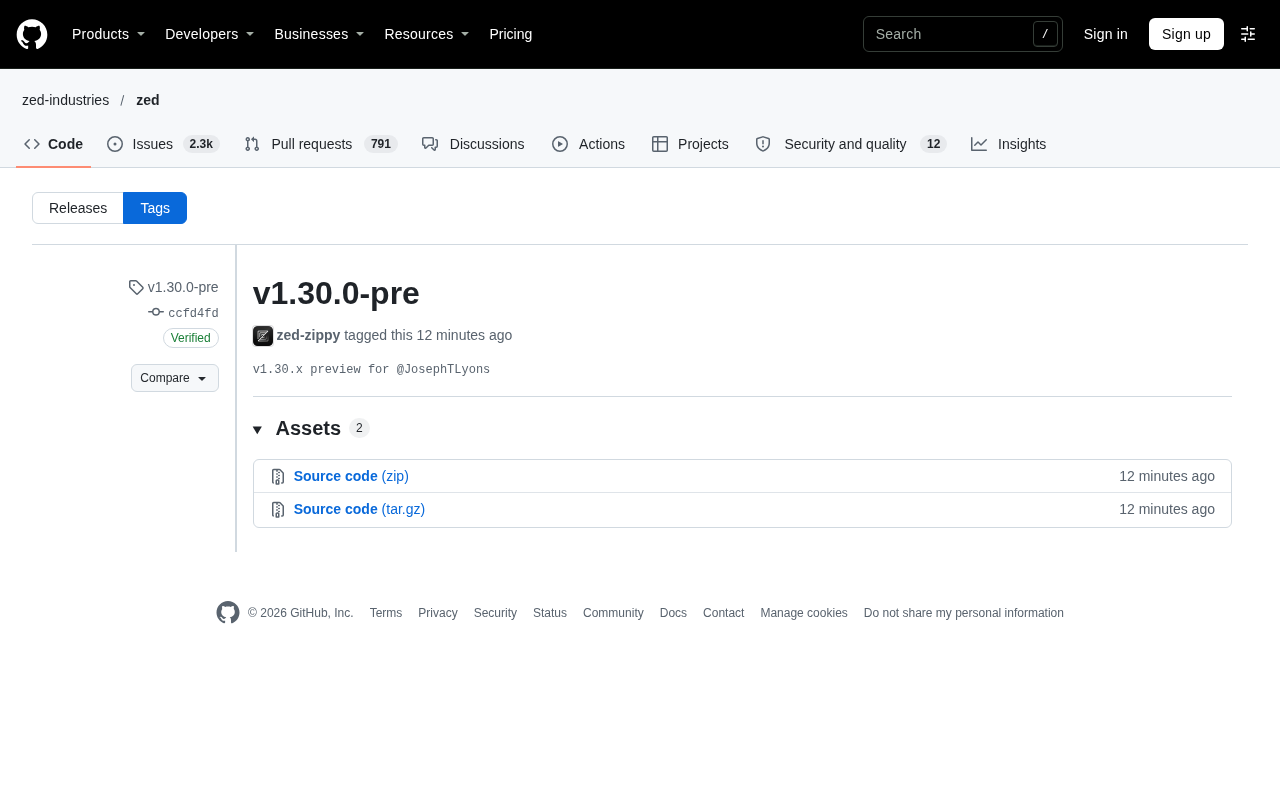
The Zed editor has released the v1.30.0-pre pre-release on GitHub, tagged by zed-zippy on November 18 with commit hash ccfd4fd and a GitHub-verified signature. The Release notes mention @JosephTLyons, indicating the version is primarily for verification by internal maintainers or collaborators. The article explains the meaning of the -pre suffix: it's a preview build before the official 1.30.0 release, typically containing the major changes of the next stage but not yet fully stability-validated, and not recommended for daily primary development environments. The Release provides 2 Assets, though the tag comparison page shows a loading error that doesn't affect the version's validity. The article recommends regular users wait for the official release, while early adopters can download build artifacts or compare commit differences to learn about specific changes, and notes that this pre-release pattern serves as both a quality gate and a team collaboration node.
The Zed editor has released the v1.30.0-pre pre-release on GitHub, and the information behind this version number is more than it appears. For developers watching the editor landscape and the open-source tooling ecosystem, a release with a -pre suffix often marks the starting point of a new round of feature iteration.
Basic Information About the Pre-Release
From the GitHub repository, we can see that v1.30.0-pre was tagged by zed-zippy on November 18 at 16:00, with commit hash ccfd4fd. The commit has a GitHub-verified signature with GPG key ID B5690EEEBB952194, indicating this is a formal operation from an official maintainer. The Release page notes @JosephTLyons, suggesting this preview version is primarily intended for verification by specific maintainers or collaborators.
The Release also provides 2 Assets, consistent with Zed's practice of distributing pre-compiled artifacts as a desktop editor. However, the tag comparison and filtering features on the page failed to load — this is typically a rendering issue on GitHub pages when there are many tags or network conditions are poor, and it does not affect the validity of the version itself.
GPG signature verification is an integrity safeguard in the open-source release process. Maintainers sign Git commits or tags with their private keys, and GitHub verifies the signature using the public key registered on the maintainer's account, displaying a "Verified" badge next to the commit. The GPG key ID (such as B5690EEEBB952194 mentioned above) is the last 16 hexadecimal characters of the public key fingerprint, used to locate the corresponding public key on key servers. Signature verification proves that the commit was indeed created by someone holding the corresponding private key and has not been tampered with in transit, but it does not guarantee code quality or security. For teams concerned with supply chain security, checking the signature status of release tags is the first line of defense in determining whether build artifacts come from official maintainers.
What the Version Number Tells Us
Zed uses semantic versioning, and the -pre in v1.30.0-pre indicates this is a preview build before the official 1.30.0 release. This naming convention is common in open-source projects: release as a pre-release first, gather feedback, fix issues, then move to the official version. For a fast-iterating editor project like Zed, pre-release versions often already contain the major changes of the next stage, just without full stability validation.
For regular users, -pre versions are not recommended for daily primary development environments, as they may contain changes that haven't been fully tested. But for early adopters, or plugin authors and power users who need to adapt to new behavior in advance, trying pre-release versions early is an effective way to understand where the project is heading.
Semantic Versioning (SemVer) is a version naming convention in the form MAJOR.MINOR.PATCH. The major version increments on incompatible API changes, the minor version increments when backward-compatible functionality is added, and the patch version increments for backward-compatible bug fixes. SemVer also allows pre-release identifiers (such as -pre, -alpha, -beta, -rc.1) and build metadata (such as +build.123) appended to the version number. A pre-release identifier means the version is not yet stable and may be missing some features or contain known defects; according to the SemVer specification, pre-release versions have lower precedence than the corresponding official version. Zed's v1.30.0-pre means a preview build before the official 1.30.0 release, with lower precedence than v1.30.0, and package managers typically will not select pre-release versions by default when resolving dependencies.
A Release Cadence Worth Watching
Zed's version cadence is itself an observation window. From the version number 1.30, we can infer that the project has gone through a considerable number of iteration cycles, gradually growing from an early experimental tool into a product with a stable release line. This pre-release was operated by zed-zippy and named JosephTLyons, hinting at a clear division of labor within the team: some handle the build and release process, others handle verification of specific modules.
This release pattern offers a reference for open-source collaboration — a pre-release version is both a quality gate and a coordination point for the team. It distinguishes "about to ship" from "already stable," allowing the community to provide feedback before the official release.
How to Follow This Version
If you use Zed, you can watch the GitHub Release page for follow-up updates and wait for the official v1.30.0 release before upgrading. If you're interested in the pre-release content, you can download the build artifacts from Assets for testing, but it's advisable to keep a stable version installer on hand for rollback.
Since the Release notes this time are relatively brief, the specific feature list and fixes are not detailed on the page. To learn about the detailed changes, the most direct way is to compare the commit differences between v1.30.0-pre and the previous official version, or follow the changelog of the official Zed repository.
Overall, v1.30.0-pre is a routine step forward in the version cadence — limited information but a clear signal: Zed's 1.30 series is entering the release channel.
One-line Summary
Zed releases v1.30.0-pre pre-release, with the 1.30 series entering the release channel.
Paragraph Summary
The Zed editor has released the v1.30.0-pre pre-release on GitHub, tagged by zed-zippy on November 18 with commit hash ccfd4fd and a GitHub-verified signature. The Release notes mention @JosephTLyons, indicating the version is primarily for verification by internal maintainers or collaborators. The article explains the meaning of the -pre suffix: it's a preview build before the official 1.30.0 release, typically containing the major changes of the next stage but not yet fully stability-validated, and not recommended for daily primary development environments. The Release provides 2 Assets, though the tag comparison page shows a loading error that doesn't affect the version's validity. The article recommends regular users wait for the official release, while early adopters can download build artifacts or compare commit differences to learn about specific changes, and notes that this pre-release pattern serves as both a quality gate and a team collaboration node.
Related articles

Zed Editor Releases v1.29.2: Observations on a Routine Version Iteration
Zed editor releases patch v1.29.2, version bump by @JosephTLyons, commit verified via GitHub signature. This article covers the release's basic info, what a patch version means, and practical upgrade advice for users.

Anthropic IPO Questioned: Hacker News Debates Timing of Going Public
A Hacker News post titled "Just say no to Anthropic's IPO" sparks debate on the timing of Anthropic's public listing and AI capitalization, touching on valuation bubbles and mission independence.

Hands-On with the Genie 4 World Model: Directing Worlds in Real Time Like a Puppeteer
Google DeepMind's Genie 4 world model in depth: Special Guest X's hands-on demo of real-time scene direction via prompts, custom interactive apps in Project Genie, and prompts-as-seeds reproducibility.