Zed Editor v1.20.2 Released: Fixes Payment Error Misattribution and Snippet Extension Conflicts

Zed v1.20.2 fixes misleading AI payment error prompts and snippet extension conflicts.
Zed v1.20.2 is a focused bug-fix release that addresses two issues affecting daily use. First, payment errors from third-party AI providers like OpenAI or Anthropic were incorrectly surfaced as Zed Pro upgrade prompts — now the real provider error is shown. Second, multiple snippet extensions for the same language were overwriting each other; the fix corrects the merge logic so all snippet sets coexist properly. The release uses an immutable format with a verified GitHub signature.
Zed v1.20.2 Overview
Zed editor has received a v1.20.2 patch update. As a modern code editor built on Rust with a focus on high performance and collaboration, Zed has garnered significant attention in the developer community in recent years thanks to its fast responsiveness and increasingly capable AI integration — the project has now accumulated over 91,000 stars on GitHub.
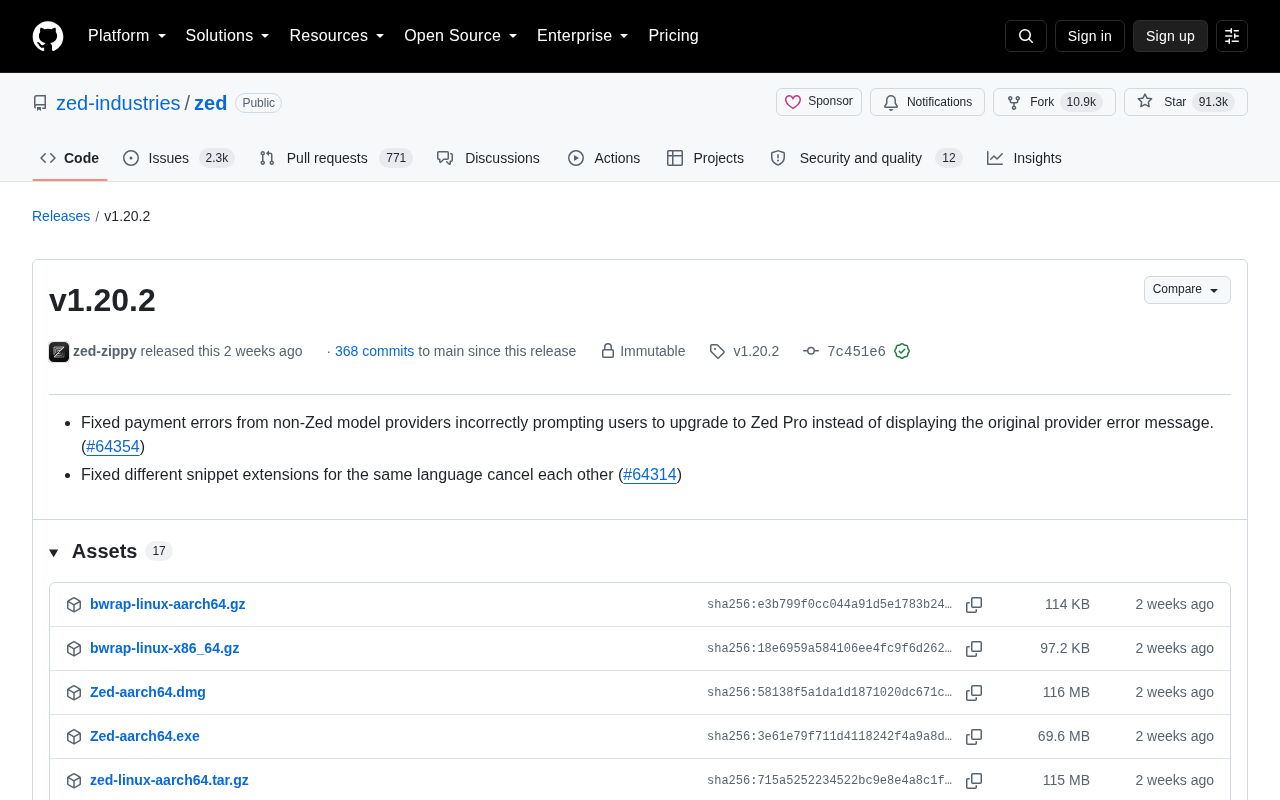
This v1.20.2 release is a small, bug-fix-focused update pushed by the official release account zed-zippy, sitting 368 commits ahead of the main branch. While it introduces no major new features, it addresses two issues that directly affect the day-to-day user experience.
What This Update Fixes
Fix for Misleading Payment Error Prompts with Third-Party Model Providers
The first fix (#64354) targets error-handling logic related to AI model providers. Previously, when users encountered payment-related errors while using a third-party model provider (not Zed's own), the editor would incorrectly prompt them to upgrade to Zed Pro instead of surfacing the actual error returned by the provider.
This was genuinely misleading in practice. For example, when a developer integrates an external model service like OpenAI or Anthropic and runs into a quota or billing issue on that account, the correct behavior is to pass the provider's real error message through to the user — so they know the problem lies with the external service. The old version instead wrapped it as a "upgrade to Zed Pro" prompt, causing confusion and potentially leading users to believe the issue was a Zed subscription limitation. This fix restores accurate, transparent error reporting.
Zed's AI integration architecture supports two modes: using Zed's officially hosted model services via a Zed Pro subscription, or configuring a third-party provider's API key directly so requests go to OpenAI, Anthropic, Google, and others. In the latter mode, Zed is essentially just a request-forwarding layer — the billing and quota relationship exists entirely between the user and the third-party provider, with no connection to Zed Pro subscription status. This fix corrects the boundary detection logic: when an HTTP response contains a payment-related status code like 402 (Payment Required), the old error-handling code failed to distinguish the error's origin and universally triggered the "upgrade to Zed Pro" prompt, sending users down the wrong troubleshooting path.
Fix for Snippet Extensions Conflicting with Each Other for the Same Language
The second fix (#64314) resolves a compatibility issue with snippet extensions. In the previous version, different snippet extensions installed for the same programming language would "cancel each other out" — meaning that when you had multiple snippet-providing extensions for a given language, they couldn't coexist, and the one loaded later could effectively disable the one loaded earlier.
For users who rely on the extension ecosystem to boost coding efficiency, this fix is meaningful. Code snippets are an important tool for speeding up repetitive code writing, and the ability for multiple extensions to coexist directly determines whether developers can flexibly combine the various snippet resources offered by the community.
Snippets are one of the foundational features of editor extension ecosystems, allowing developers to expand predefined code templates via short trigger words — commonly used for boilerplate, function skeletons, regex patterns, and other frequently repeated structures. In Zed's extension system, multiple extensions can each declare snippet contributions for the same language, which theoretically should be merged and applied together. But the prior implementation had a registration conflict — a later-loaded extension could overwrite or clear the snippet table registered by an earlier-loaded one, leaving users with only one extension's snippets actually working. This fix (#64314) corrects the merge logic for snippet registration, allowing snippets from multiple extensions to correctly coexist under the same language — a particularly welcome improvement for users who have both framework-specific snippet packs (like React or Tailwind) and general-purpose language snippet packs installed simultaneously.
How to Think About This Kind of Patch Update
The version number v1.20.2 indicates this is the second revision in the 1.20 series. These "polishing" updates may not generate the same buzz as a major release, but they reflect the engineering maturity of a project.
Both fixes revolve around accuracy in user experience: one makes error messages more honest, the other makes the extension ecosystem more reliable. For an editor that is iterating rapidly while making a significant bet on AI-assisted programming, maintaining transparency around third-party model provider integrations is especially critical — it speaks to user trust in the platform and reflects Zed's effort to strike a balance between its open ecosystem and its own commercial offering (Zed Pro).
This release uses an immutable release format and has been verified with GitHub's signing key (GPG key ID: B5690EEEBB952194), ensuring the integrity and trustworthy origin of the release package. Community reception has been positive, with the release page receiving plenty of favorable engagement.
Summary
If you're a Zed user — especially one who has integrated third-party AI model providers or relies on multiple snippet extensions — upgrading to v1.20.2 is recommended. The update is small, but it meaningfully reduces friction and confusion in everyday use. For developers tracking Zed's trajectory, this kind of consistent attention to detail is also an important signal of the project's long-term reliability.
Related articles

AI-Powered SRC Vulnerability Hunting: A Hands-On Guide to Building the Hermes Agent Workbench
Based on a hands-on Bilibili video: how to build an AI-powered SRC vulnerability hunting workbench—three-step method, four report elements, Agent mode vs web chat, and tool selection.

CLI-Anything Complete Beginner's Guide: How AI Operates Software — Principles and Practice
A complete beginner's guide to CLI-Anything: how AI Agents operate professional software via the command line, covering the three-layer architecture, CLI Hub installation, DrawIO practice, generator principles, and limits.

Carbon-X: A 14.8B Open-Source Model That Handles DNA and Text Simultaneously
Carbon-X is a 14.8B open-source multimodal model on Hugging Face where DNA and text share a token stream. 6-mer tokenization, 302B token mid-training, deployable on a single 80GB GPU, 66.7% average on five DNA benchmarks, Apache 2.0 license.