Zed v1.22.0 Released: AI Subagents, BYOK Support, and Multiple Editing Experience Upgrades

Zed v1.22.0 deepens AI multi-agent capabilities with subagent model switching, auto-compaction, and cross-platform UX improvements.
Zed v1.22.0 centers on expanding AI agent architecture: `spawn_agent` gains a `model` parameter for per-subagent model selection, and automatic compaction is now enabled to handle context bloat in long-running tasks. On the model ecosystem side, BYOK support arrives for GPT-4.1 Sol, Grok 4.7 becomes the recommended default for xAI/SuperGrok, and OpenCode models are now dynamically fetched. Git diff gains unified/split view toggling, the terminal gets inheritance expansion syntax, macOS adds three-finger gesture support, and Windows introduces Mica backdrop themes. The release also fixes terminal memory leaks, column selection offsets, cursor drift, and several language server issues, with breaking changes to the dock close shortcut and Threads Sidebar settings requiring attention before upgrading.
Zed editor arrives at v1.22.0, with this week's release focused heavily on deep AI capability expansion: subagent models can now be switched on demand with automatic compaction, BYOK support for GPT-4.1 Sol has been added, and OpenCode model lists are now fetched dynamically. Beyond AI, Git diff, terminal, and macOS/Windows platform experiences have also seen meaningful improvements.
AI Capabilities: Subagents Become More Flexible and Autonomous
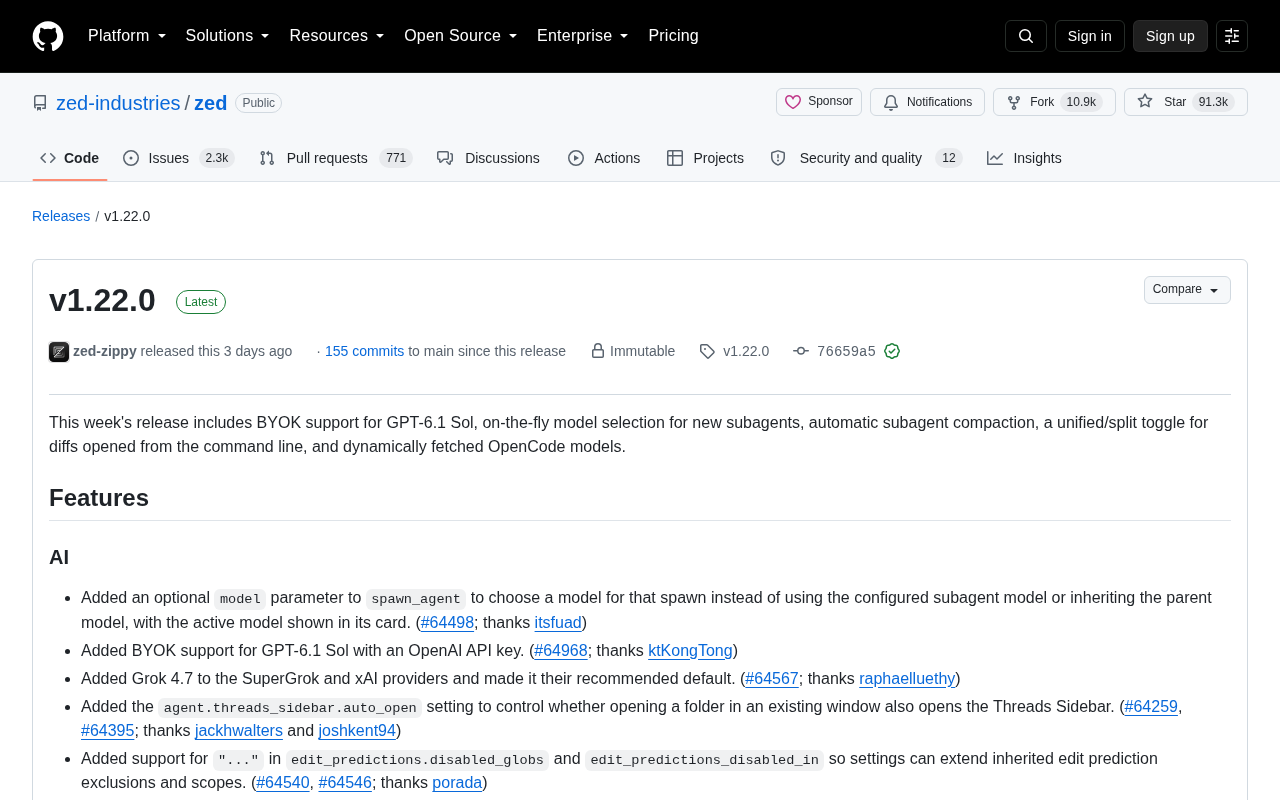
The most noteworthy changes in this release revolve around a series of improvements to subagents. Zed has added an optional model parameter to spawn_agent, meaning developers can specify a dedicated model for each subagent they spawn — rather than inheriting the configured subagent model or the parent agent's model. The currently active model is displayed directly on the agent card, making model assignments across multi-agent collaborations immediately clear.
Complementing this, automatic compaction for subagents is now officially enabled. In long-running agent tasks, context accumulates rapidly; automatic compaction effectively controls context bloat, preventing runaway performance and cost issues. Together, these two changes reflect Zed's push to evolve AI agents from a "single assistant" toward an "orchestratable multi-agent system."
On the model ecosystem front, Zed adds BYOK (Bring Your Own Key) support for GPT-4.1 Sol, allowing users to connect via their own OpenAI API key. Grok 4.7 has been added to the SuperGrok and xAI providers and set as the recommended default model. OpenCode models now dynamically fetch the Zen and Go model lists rather than relying on a static list bundled with Zed, with improved parsing performance and outdated models hidden from view. This dynamic fetching mechanism lets users access the latest models faster without waiting for an editor update.
Subagents and multi-agent collaboration represent one of the core evolutionary directions for AI coding tools in recent times. Traditional AI assistants handle tasks through a single conversational thread, while multi-agent architectures allow a complex task to be decomposed into multiple parallel or sequential subtasks, each executed by an independent agent instance. spawn_agent is the core primitive in Zed for spawning subagents — calling it creates a new agent context that either inherits or independently configures tools and models. The new model parameter makes it possible to mix different models within a single task — for example, using a lightweight model for code search and a more powerful one for final generation — striking a balance between quality and cost.
Automatic compaction addresses the context window overflow problem in long-running conversations. Most language models have a fixed token limit, and when an agent executes multi-step tasks, tool call records and intermediate outputs quickly fill up the context. Automatic compaction frees up space by summarizing or trimming historical messages, allowing the agent to keep running without interruption from exceeding limits, while also reducing API call costs billed per token.
Git and Terminal: Polishing the Details
The diff view opened from the command line via zed --diff <old> <new> now supports toggling between unified and split views, accommodating different user preferences for comparison. Additionally, when a branch diverges significantly from its base branch, the speed at which branch diffs display the first set of changes has improved — a genuinely practical experience enhancement when dealing with large merges day-to-day.
On the terminal side, terminal.path_hyperlink_regexes now supports "..." syntax, allowing inherited regex rules to be extended without repetitive rewriting. This configuration inheritance design philosophy appears repeatedly throughout this update, reflecting Zed's emphasis on composability in its settings system.
Cross-Platform Experience: Gains for Both macOS and Windows
macOS users gain three-finger Look Up and translation gesture support in focused Markdown previews, further aligning with native system interactions. Windows users are treated to MicaBackdrop and MicaAltBackdrop options in the theme's background.appearance setting, allowing window backgrounds to display Windows 11's signature Mica material effect.
Other general improvements include: when manually checking for updates and already on the latest version, the title bar now provides a clear confirmation; the pending key binding indicator is also more complete, with support for grouped bindings, scrollable lists, and combinations like cmd-k prefix keys with no timeout.
Mica Backdrop is a system-level window background effect introduced in Windows 11. By sampling the desktop wallpaper color and applying Gaussian blur and noise, it creates a visual blending effect between the application window and the desktop environment. MicaBackdrop produces the standard Mica effect, while MicaAltBackdrop has a darker tone suited for dark themes. This feature has already been widely adopted in applications like Windows Terminal and VS Code; Zed's implementation moves it a step forward in terms of native feel on Windows 11. Note that the Mica effect depends on the system compositor (DWM) and may not display correctly in virtual machines or on systems with transparency effects disabled.
Fix Log: Stability and Editing Precision
This release fixes a considerable number of issues across memory, editor interactions, and language services. Notable fixes include: a bug where the terminal retained approximately 2 MB of memory per command after it ended; a memory leak when closing macOS windows with experimental accessibility features enabled; and a crash on Linux (X11) caused by immediately redrawing the window after GPU device recovery.
For editing precision, issues fixed include: column selection landing in the wrong column near non-ASCII text, tabs, soft wraps, and folded content; cursor drift when character widths differ; and block cursor animations obscuring underlying characters. On the language services side, fixes address language servers failing to start when opening files via UNC paths on Windows, and Markdown syntax highlighting breaking in the history commit view.
Breaking Changes to Note
There are a few changes to be aware of before upgrading. The shortcut for closing the active dock has changed from cmd-w/ctrl-w to a unified cross-platform ctrl-alt-w, with the original shortcut restored to closing the current panel item. Threads Sidebar settings have been reorganized into agent.threads_sidebar.position, default_width, and auto_open — existing configurations will be automatically migrated.
On the configuration side, top-level "..." entries in terminal.path_hyperlink_regexes now signify inserting inherited regexes; if you intended to match three literal periods, this should be rewritten as ["..."]. Additionally, Zed no longer imports VS Code's files.watcherInclude as file_scan_inclusions. These adjustments move overall toward a more consistent and inheritable configuration model, but it's still worth reviewing your custom settings when migrating from an older version.
The "..." syntax is a special placeholder in Zed's configuration system for inheritance expansion, semantically similar to JavaScript's spread operator. When a configuration item supports arrays and allows inheritance, placing the string "..." in the array means "insert the parent/default configuration values here," allowing users to append custom entries before or after without manually copying all default values. This update assigns this semantics to top-level "..." entries in terminal.path_hyperlink_regexes, so what was previously a regex literal matching "three English periods" must be rewritten as the array form ["..."] to distinguish it. This "configuration composability" design significantly reduces conflicts between customization and upgrades, but does require users to carefully review configuration sections containing "..." when migrating.
Related articles

GPT-Next Leak, Gemini 4 Argon Imminent: AI News Roundup
GPT-Next leak suggests extreme efficiency; OpenAI's 28-day shipping pledge boosts speed 50%; Gemini 4 Argon nears release; Anthropic subscription value report sparks debate.

GPT-Next Leaked, Gemini 4 Argon Speeds Up, Fable 5.5 May Launch Today
OpenAI's GPT-Next model leaks, expected to be extremely low-cost and possibly part of the 28-day release plan; Gemini 4 Argon internal testing accelerates, NanoBanana 2.1 is live; Semi Analysis tests show Claude Max's equivalent API value is about 5 times that of ChatGPT Pro; Fable 5.5 may launch today.

Gemini 4 Argon Launches Globally: Key Highlights from the AI Daily Brief
Google opens Gemini 4 Argon globally across Pro and Ultra subscriptions and the API, and demonstrates robot control. This article rounds up open-source models, Agent infrastructure, cost transparency, and safety governance updates.