Zero-Code AI Resume Screening Workbench: A Hands-On Look at Lù Xiǎofēi

AI Lù Xiǎofēi turns a plain-language prompt into a working HR resume screening tool in minutes — no coding needed.
AI Lù Xiǎofēi positions itself as an all-in-one programming Agent that lets non-developers generate usable applications through natural language alone. The demo centers on an HR resume pre-screening tool: a single plain-language description of the desired layout and features produces a complete workbench with match scoring, confirmation checkboxes, and interview follow-up suggestions. The tool is designed to assist HR in organizing information rather than replacing hiring decisions, helping avoid algorithmic bias risks. It runs on Token-based billing, with a launch promotion offering 200,000 Tokens for one cent. The article also notes its limits: the demo used preset data, and real-world accuracy, complex resume parsing, and commercial-grade stability remain to be validated.
When Coding Is No Longer Just for Programmers
The AI Lù Xiǎofēi team describes itself with refreshing directness — a group of engineers with a combined 50+ years of development experience across Java, Python, C, C++, Go, and more. For the past year, they've poured their efforts into a single goal: enabling ordinary people with zero development background and no knowledge of programming languages to describe what they want in plain language and walk away with a working, even commercially viable product.
In traditional software engineering, that idea sounds like wishful thinking. Requirements gathering, prototyping, front-end and back-end development, testing, delivery — every step demands specialized roles. AI Lù Xiǎofēi bills itself as the "world's first all-in-one programming Agent," with a core promise: describe your product requirements in natural language, and it will help you build, run, revise, and deliver a first version of your application.
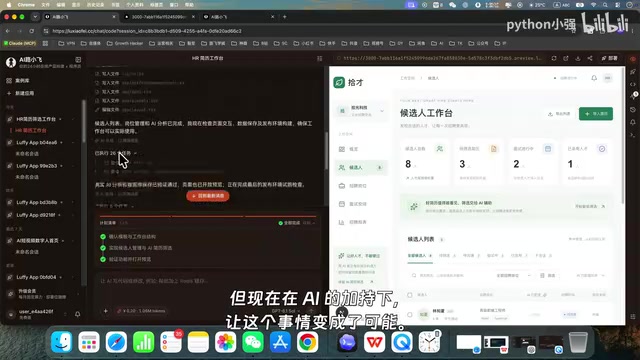
One important clarification: "programming" here doesn't mean turning you into a developer. Rather, it treats coding as a means to an end — a way to fulfill business needs. Any repetitive business process, whether it's an HR team screening resumes or a sales team organizing client data, can theoretically be turned into a tool this way.
Building an HR Screening Tool with a Single Prompt
The demo scenario was HR resume pre-screening — a classic high-frequency, repetitive task. The conventional path involves briefing a product manager, looping in developers, going through multiple rounds of requirement discussions, and waiting in a development queue. In this demo, the operator simply described their need to AI Lù Xiǎofēi:
Help me build a resume pre-screening tool. On the left, I'll enter the job requirements. On the right, I'll paste the candidate's resume. It should automatically organize matching points, include confirmation checkboxes, and suggest follow-up interview questions.
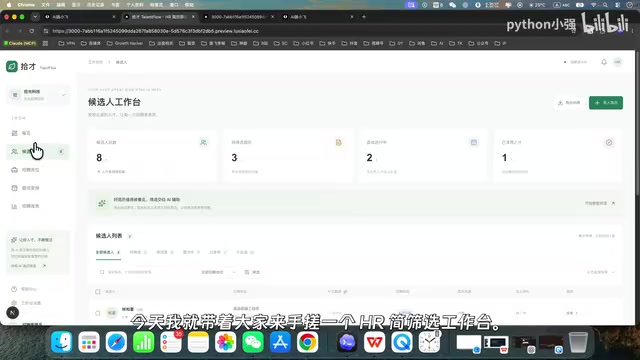
That single description covered page layout (two-column split), core functionality (match organization), interaction details (confirmation checkboxes), and output requirements (interview follow-up questions). The AI used this to simultaneously generate the UI and wire up the screening logic and interactions. Within minutes, a fully usable HR resume pre-screening workbench was ready.
From an engineering perspective, this type of task is well-suited for AI generation because the requirements are relatively well-defined, the UI patterns are mature, and the business logic can be expressed as rules. Compared to complex distributed systems, lightweight "form + rules + text analysis" applications are squarely in the sweet spot of today's AI code generation capabilities.
How the Screening Logic Works
Using the generated tool is straightforward: paste the job requirements and the candidate's resume into their respective sides, and the system analyzes the candidate's experience, skills, and project history against the requirements — producing a match score and interview suggestions on the same screen.
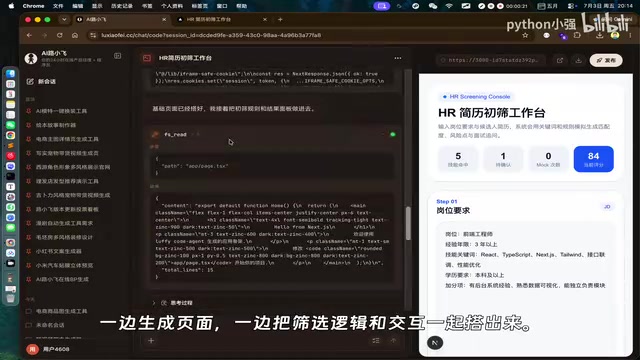
What matters more is the dynamic behavior. Swap in a different resume, and the score updates to reflect how well that candidate's background aligns with the job requirements, flagging key conditions that need confirmation. This reflects a sensible product philosophy:
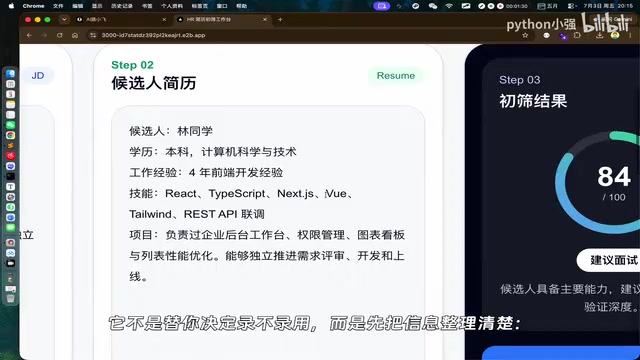
The tool doesn't decide who gets hired — it organizes the information first: which criteria are met, and which need further probing. When HR communicates with the hiring manager, they can quickly articulate why a candidate is worth recommending. This "assist the decision, don't replace it" boundary is exactly the right posture for AI in sensitive contexts like hiring. It sidesteps the risk of algorithmic bias while keeping humans firmly in control of the final call.
Algorithmic bias is a concern that regulators and ethics researchers have consistently raised around AI in recruitment. Historical cases have shown that when hiring AIs are trained on historical data, they can inadvertently encode characteristics unrelated to job performance — such as gender, race, or age — into their scoring weights. Amazon famously scrapped an internal recruiting AI in 2018 after discovering it systematically downgraded female candidates. This is precisely why positioning AI as an "information organizer" rather than a "hiring decision-maker" is not just a modest product design choice — it's also a proactive step toward legal risk mitigation. Multiple jurisdictions, including the EU AI Act, already classify automated hiring decisions as high-risk AI applications, requiring that a human review step be preserved.
The Value and Limits of Zero-Code Tools
The real problem this category of product addresses is dramatically shortening the chain from "I have a need" to "I have a working tool." For non-technical roles like HR, operations, and sales, the choices used to be either living with the fixed functionality of off-the-shelf SaaS products or enduring a lengthy custom development process. Zero-code Agents offer a third option: quickly build a small tool that fits your actual workflow, on your own terms.
That said, a clear-eyed view is warranted. This demo used preset demonstration data. How the tool performs in real-world scenarios — scoring accuracy, parsing complex or unconventional resumes, handling bulk multi-role screening — still needs to be validated through actual use. "Commercially viable" is also a significant claim, touching on stability, data security, and compliance, none of which can be fully assessed from a demo.
On the commercial side, the platform is running a launch promotion: register and top up with just one cent to receive 200,000 Tokens — enough, they say, to build several tools like the one demonstrated. The Token-based billing model means real usage costs will accumulate with generation volume and call frequency, which is something potential users should factor in for long-term use.
Token-based billing is the dominant pricing model for AI services, and it's worth understanding for non-technical users. Tokens are roughly the basic unit of text measurement — approximately every 750 English words or 500 Chinese characters corresponds to 1,000 Tokens. The 200,000 Tokens offered in the promotion are more than sufficient for generating a moderately complex small application, but continuous rounds of revision, bulk data processing, or frequent API calls can burn through them quickly. For reference, 200,000 Tokens on public AI API markets costs roughly ¥0.1 to ¥2 RMB, depending on the underlying model. For users planning to use this as a long-term production tool, estimating your actual usage frequency and per-session Token consumption before committing to a paid plan is key to keeping costs under control.
Takeaway
Judging from this resume screening demo, AI Lù Xiǎofēi demonstrates a complete pipeline from natural language description to working application, and it genuinely delivers value for repetitive office workflows. Its significance isn't in replacing professional developers — it's in lowering the barrier for lightweight, rules-based tool development to near zero. For anyone stuck in repetitive tasks, the experience of "describe what you need and get a tool" is worth trying firsthand before making a final judgment.
Related articles

Uber Deploys ChatGPT Work Company-Wide: AI in the Workplace Enters the Scaled Implementation Phase
Uber deploys ChatGPT Work to 30,000+ employees, extending it from engineering to all roles. We analyze its expert-engineer pairing, end-to-end automation, and questions of AI control and power concentration—insights for scaling AI in the workplace.

Shift at Midnight Hands-On: When "ID Verification" Becomes Alien Hunting
Shift at Midnight blends ID verification with horror survival in a four-player co-op game. We break down its inspection mechanics and chaotic humor.

Zelensky Recounts the Outbreak of War: I Need Ammunition, Not a Ride
Zelensky recalls the first day of war in a YouTube interview: farewell to family, rejecting Biden's evacuation offer with "I need ammunition, not a ride," and how Bucha shaped his stance on compromise and peace talks.