Zero-Cost Agentic RAG Architecture: Why the LLM Is Your Least Reliable Node

How a zero-cost Agentic RAG system achieves 99.9% uptime by treating the LLM as the least reliable node.
An open-source developer built an 11-node LangGraph Agentic RAG pipeline on a free 512MB container achieving 99.9% uptime. Key patterns include a single health endpoint solving both container and database keep-alive, hybrid parsing routing that prioritizes deterministic tools over hallucination-prone Vision LLMs, circuit breakers for external API calls, and confidence gating that bypasses LLM synthesis when retrieval evidence is weak.
Introduction: The Architectural Wisdom Behind 99.9% Uptime
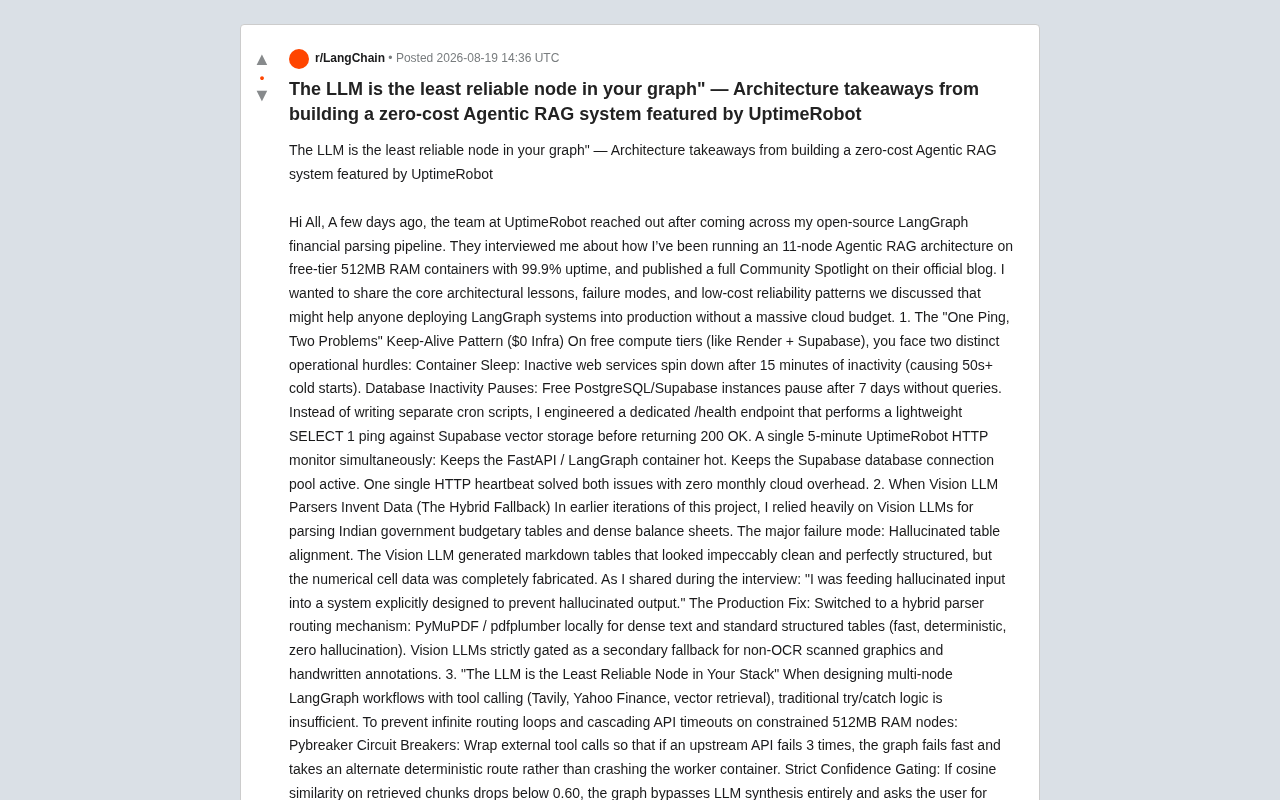
When deploying LangGraph systems in production, many developers instinctively assume the biggest challenges come from compute power, memory, or cloud costs. But an open-source developer offered a counterintuitive insight during an in-depth interview with monitoring service provider UptimeRobot: "The LLM is the least reliable node in your entire tech stack."
This developer built a financial document parsing pipeline based on LangGraph—an Agentic RAG architecture with 11 nodes, all running on a free-tier 512MB memory container—yet achieved 99.9% uptime. UptimeRobot's official blog published a Community Spotlight feature about the project. This article distills the most valuable architectural lessons, failure modes, and low-cost reliability design patterns from that interview, offering significant reference value for any team looking to deploy RAG systems on a limited budget.
Zero-Cost Infrastructure: One Heartbeat to Keep Both Container and Database Alive
Two Operational Pitfalls of Free Compute Tiers
Running services on free compute platforms like Render + Supabase exposes you to two distinctly different yet equally fatal operational challenges:
- Container Sleep: Idle web services automatically go offline after 15 minutes of inactivity, resulting in cold-start delays of 50+ seconds on the next access.
- Database Inactivity Pause: Free PostgreSQL / Supabase instances get paused after 7 days without any queries.
These two problems operate on completely different time scales—one is minute-level, the other day-level. Traditional approaches often require writing multiple independent cron scripts to address each one separately.
Platform Context: Render is a PaaS provider offering fully managed cloud platform services. Its free tier provides web service containers with 512MB of memory but enforces strict sleep policies—services enter a suspended state after 15 minutes without inbound requests, and the next request must go through a full container rebuild and application initialization (i.e., cold start). Supabase is an open-source Backend-as-a-Service platform built on PostgreSQL, whose free-tier databases are automatically paused after 7 consecutive days without active queries, requiring several minutes to restore. This combination of platforms is extremely popular in the open-source community because they can provide a "zero monthly cost" full-stack deployment experience, but their sleep mechanisms pose a fundamental challenge for production services that require continuous availability.
The "One Ping Solves Both Problems" Keep-Alive Pattern
The author's clever solution was designing a dedicated /health endpoint. Before returning 200 OK, this endpoint first executes a lightweight SELECT 1 query against the Supabase vector store.
This way, configuring a single UptimeRobot HTTP monitor that triggers every 5 minutes simultaneously achieves:
- Keeping the FastAPI / LangGraph container in a warm-start state;
- Keeping the Supabase database connection pool active.
UptimeRobot is a free website availability monitoring service that sends HTTP requests from multiple global nodes to target URLs at configured intervals (minimum every 5 minutes), determining service health based on response status codes and response times. When a service is unresponsive or returns a non-2xx status code, alerts are sent via email, Webhook, and other channels. In this scenario, UptimeRobot's HTTP probes are cleverly "repurposed" as a keep-alive mechanism—the health check requests every 5 minutes themselves constitute "meaningful traffic," thereby preventing the Render container from entering sleep mode. This design of using a monitoring tool simultaneously as a keep-alive mechanism is a widely adopted operational pattern in free-tier deployments.
One HTTP heartbeat, zero monthly cloud spend, simultaneously solving both the container sleep and database pause problems. This is a textbook case of using architectural design to compensate for budget constraints—not buying more expensive services, but keeping free resources continuously in a "being used" state.
When Vision LLMs Start Fabricating Data: The Necessity of Hybrid Parsing Routing
Hallucinated Inputs Poisoning Anti-Hallucination Systems
Early in the project, the author relied heavily on Vision LLMs (multimodal large language models) to parse Indian government budget tables and dense balance sheets. This exposed a subtle yet dangerous failure mode: Hallucinated table alignment.
The Markdown tables generated by Vision LLMs looked impeccable—flawlessly structured and neatly formatted—but the numerical data in the cells was entirely fabricated. The author summarized it incisively during the interview:
"I was feeding hallucinated inputs into a system specifically designed to prevent hallucinated outputs."
This statement highlights an often-overlooked truth about RAG systems: no matter how rigorous the downstream retrieval augmentation and deterministic logic, once the data ingestion stage is contaminated, the entire pipeline becomes "garbage in, garbage out."
The Production Fix: Hybrid Parsing Routing
The author ultimately switched to a hybrid parsing routing mechanism that routes by document type:
- PyMuPDF / pdfplumber: Local processing of dense text and standard structured tables. Fast, deterministic results, zero hallucinations.
- Vision LLM: Strictly confined as a secondary fallback, used only for scanned graphics and handwritten annotations that cannot be OCR'd.
Tech Stack Deep Dive: Vision LLMs (such as GPT-4V, Claude 3's vision capabilities, Gemini Pro Vision, etc.) are multimodal large language models that can directly accept image inputs and generate text outputs. In document parsing scenarios, they're used to "understand" screenshots of PDF pages and extract text, tables, and chart information from them. In contrast, deterministic parsing tools like PyMuPDF (a high-performance PDF parsing library that directly extracts PDF-embedded text layers and table structures) and pdfplumber (a Python library optimized for table extraction that rebuilds table structures by analyzing line and character positions in PDFs) don't rely on any probabilistic models—their output is entirely determined by the input PDF's binary structure. Their limitation is that they cannot handle scanned documents (image-based PDFs) or handwritten content, since such documents lack a parseable text layer.
The core principle: If it can be solved with deterministic tools, never hand it to a probabilistic LLM. This also echoes the article's central thesis—LLMs should be constrained to scenarios where they are truly irreplaceable.
LLM Fault Tolerance: Circuit Breakers and Confidence Gating
Why Traditional try/catch Isn't Enough
When designing multi-node LangGraph workflows with tool calls (Tavily search, Yahoo Finance, vector retrieval), traditional try/catch error handling is woefully inadequate. On memory-constrained 512MB nodes, once an external API fails, it can easily trigger infinite routing loops and cascading timeouts, ultimately bringing down the entire worker container.
Two Critical Lines of Defense
The author introduced two classic reliability engineering patterns:
1. Pybreaker Circuit Breaker
All external tool calls are wrapped: if an upstream API fails 3 consecutive times, the graph "fails fast" and switches to a fallback deterministic path rather than letting the container crash. This is a mature pattern borrowed from the microservices domain, equally applicable in Agentic workflows.
The circuit breaker pattern was first systematically described by Michael Nygard in the book Release It! and has since become a standard fault tolerance pattern in microservices architecture. Its core concept borrows from electrical engineering circuit breakers: when sustained failures in a downstream service are detected, the call chain is proactively "broken" to prevent requests from piling up and exhausting resources. A circuit breaker has three states—Closed (normal traffic flow), Open (immediately rejecting requests and returning degraded responses), and Half-Open (allowing a small number of probe requests through to determine if the service has recovered). Pybreaker is a Python implementation of this pattern, allowing developers to configure failure thresholds, recovery timeouts, and other parameters. In LangGraph's Agentic workflows, each external tool call (such as the Tavily search API or Yahoo Finance API) can fail due to network timeouts, rate limiting, or server-side errors, and circuit breakers prevent these failures from being amplified into systemic faults across the graph's multiple routing cycles.
2. Strict Confidence Gating
When retrieved text chunks have a cosine similarity below 0.60, the graph completely bypasses the LLM synthesis step and instead asks the user for clarification, or falls back to evidence-based live web search.
Mathematical Basis of Cosine Similarity: Cosine similarity is the most commonly used distance metric in vector retrieval, calculating the cosine of the angle between two vectors. It ranges from -1 (completely opposite) to 1 (identical), and in practical text embedding scenarios typically falls between 0 and 1. After a user query is encoded into a vector, the system finds the text chunks in the vector database with the highest cosine similarity. A threshold of 0.60 means that only when retrieved text chunks are sufficiently "close" to the user query in semantic space will the system feed them as context to the LLM for answer synthesis. Retrieval results below this threshold are considered "insufficient evidence"—having the LLM force-generate an answer based on weakly related text has an extremely high probability of producing hallucinations. The choice of this threshold typically requires experimentation on annotated datasets, and different embedding models and business scenarios will have different optimal values.
The philosophy behind this design is worth pondering: Rather than letting the LLM force-generate a plausible-sounding but fabricated answer when evidence is insufficient, it's better to honestly say "I need more information." Confidence gating essentially kills hallucination risk before the synthesis stage.
Infrastructure Health vs. Semantic Health: The Blind Spot in RAG Monitoring
The interview raised an open question that the entire GenAI community is grappling with: How do we monitor the silent degradation of answer quality?
The author precisely distinguished three levels of observability:
- Uptime monitoring: Can only tell you whether the HTTP server returns
200 OK; - LangSmith / Langfuse tracing: Can tell you about latency and token consumption;
- But no existing tool can alert you when the semantic quality of answers is slowly declining.
Here lies a fatal blind spot: A container can report 99.9% uptime while continuously outputting subtly hallucinated answers. The infrastructure is healthy, but the semantics are "sick."
LLM-as-a-Judge Methodology: LLM-as-a-Judge is an approach that uses a large language model itself to evaluate the output quality of another LLM, first systematically studied in a paper by LMSYS. The basic idea is: design a set of evaluation prompts that have the evaluator LLM score or judge generated answers on dimensions like accuracy, relevance, and completeness. LangSmith and Langfuse are two observability platforms in the LangChain ecosystem that provide LLM call chain tracing, latency analysis, and cost statistics, but are fundamentally still "infrastructure-level" monitoring. The blind spot the author identifies is that these tools cannot automatically detect "slow degradation in answer semantic quality"—for example, when an upstream embedding model is updated, noisy documents are added to the vector database, or the LLM provider quietly switches the underlying model version, causing answer quality to gradually decline over days or weeks without triggering any traditional alerts.
The author believes that integrating synthetic "LLM-as-a-judge" evaluations into a continuous automated alerting system is the next major milestone. In other words, future production-grade RAG systems need to monitor not just "is the service alive" but also "are the answers correct."
Conclusion: Resource Constraints Foster More Elegant RAG Architecture
What's most impressive about this project is that it demonstrates how strict resource constraints can actually force more elegant architectural design. When you can't throw money at compute power, you're forced to think carefully about the true responsibility boundaries of each component.
Several immediately actionable Agentic RAG architecture lessons:
- Use a single health check endpoint to simultaneously solve container and database keep-alive problems;
- Prioritize deterministic tools—let the LLM only do what it's truly irreplaceable for;
- Use circuit breakers and confidence gating to build "fail fast" rather than "force output" fault tolerance logic;
- Invest in semantic-level observability—don't be lulled by 99.9% uptime numbers.
For any team deploying Agentic RAG on a limited budget, the statement "the LLM is your least reliable node" should perhaps be inscribed on the first page of their architecture design.
Related articles

Uber Deploys ChatGPT Work Company-Wide: AI in the Workplace Enters the Scaled Implementation Phase
Uber deploys ChatGPT Work to 30,000+ employees, extending it from engineering to all roles. We analyze its expert-engineer pairing, end-to-end automation, and questions of AI control and power concentration—insights for scaling AI in the workplace.

Shift at Midnight Hands-On: When "ID Verification" Becomes Alien Hunting
Shift at Midnight blends ID verification with horror survival in a four-player co-op game. We break down its inspection mechanics and chaotic humor.

Zelensky Recounts the Outbreak of War: I Need Ammunition, Not a Ride
Zelensky recalls the first day of war in a YouTube interview: farewell to family, rejecting Biden's evacuation offer with "I need ammunition, not a ride," and how Bucha shaped his stance on compromise and peace talks.