Zero-Cost Global Deployment with Supabase + Vercel: A Needora Case Study

Deploy a global MVP for free using Supabase + Vercel — no ICP registration required.
Using the real product Needora as a case study, this article explains how indie developers can leverage Supabase (open-source BaaS with a free 500MB PostgreSQL database, auth, and storage) and Vercel (serverless deployment with a free domain) to bypass China's ICP registration and ship an MVP globally at minimal cost. A custom domain from Alibaba Cloud costs around ¥15/year. The article also covers using Claude Code with the DeepSeek API for AI-automated deployment, while cautioning that Agent tasks consume tokens quickly and costs can add up.
For indie developers and solo founders, the hardest part of validating an MVP (Minimum Viable Product) often isn't writing the code — it's getting the thing live. Buying a server, filing for ICP registration, configuring a database... the whole process costs both money and time. This article uses Needora, a product built and launched by a Bilibili creator, as a real-world example to break down how you can use two free platforms — Supabase and Vercel — to ship a product globally at near-zero cost.
Why Choose Overseas Free-Tier Services
Deploying inside China comes with a catch: if your server is hosted on the Chinese mainland, you typically need to complete ICP registration, on top of the server costs themselves. For a demo still in the validation stage, the ROI just doesn't make sense.
The creator's reasoning is straightforward: the core goal at the MVP stage is to validate demand, not handle massive traffic. Given that, launching on overseas free-tier services first is the more rational choice. The stack he uses is two "free tier" platforms — Supabase for the data layer, Vercel for the deployment layer. The free database quota is 500MB, which is more than enough for personal projects or validating a demo.
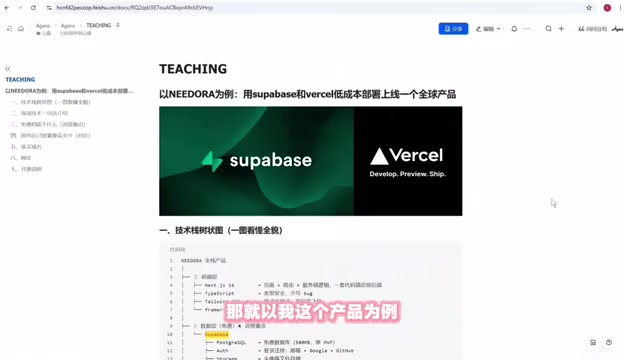
Worth noting: this combination solves both "saving money" and "going global" at the same time. Overseas platforms inherently don't require mainland Chinese registration, so once your product is live, users worldwide can access it.
Supabase: Open-Source Backend as a Service
Supabase is an open-source BaaS (Backend as a Service) platform with around 100,000 stars on GitHub. You can self-host the entire project using Docker images, or simply use the official cloud service — just log in with a Google account and start working with your database.
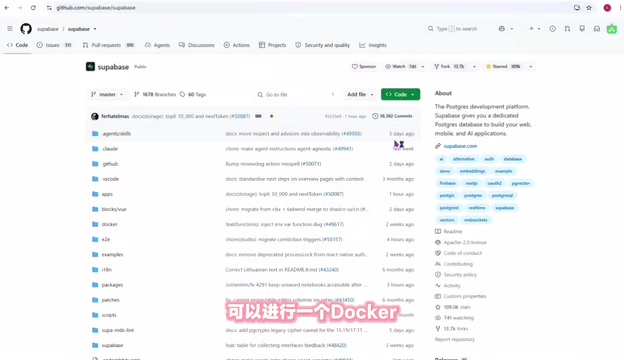
At its core, Supabase runs on PostgreSQL, a relational database similar in philosophy to MySQL. But Supabase's real value is in its packaging — it bundles user authentication, file storage, real-time subscriptions, and other common backend capabilities into a single platform.
The creator puts it plainly: if you're using a bare MySQL database, you still have to figure out where to put user login logic, file storage, and so on — all requiring extra setup. Supabase ships all of those modules out of the box, saving you from assembling a backend piece by piece. The problem it solves is simple: "What data does my website need to store, and where does user information live?"
What is BaaS? Backend as a Service is a form of cloud service where developers skip building and maintaining server infrastructure, database connections, and authentication systems from scratch — instead calling platform-provided APIs and SDKs directly. Firebase (by Google) is another well-known example, but it's a closed-source commercial product backed by Google's proprietary database. Supabase differentiates itself with "open source + PostgreSQL" — all code is publicly auditable, and the data structure is a standard relational database, making future migration or self-hosting straightforward. For indie developers, the core value of BaaS is compressing what would take weeks of backend setup into a few minutes of configuration, freeing you to focus on product logic.
Vercel: The Deployment Layer That Gets Your Site Live
If Supabase handles "where data lives," Vercel handles "how everyone accesses your website."
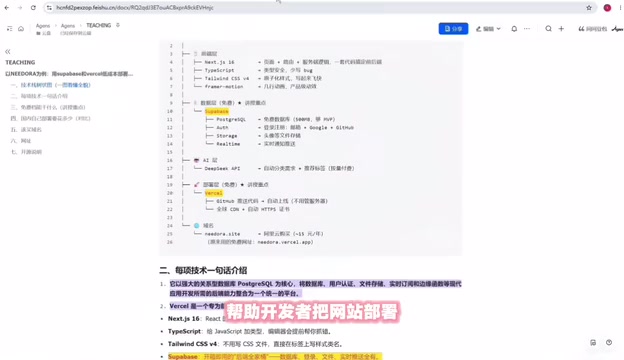
The creator describes Vercel as "a platform that helps developers deploy and run websites" — conceptually the same as renting a server for public access, except it has a free tier. Even better, Vercel gives you a free .vercel.app subdomain out of the box.
If the default domain feels too generic or unprofessional, you can purchase a custom domain to replace it. The creator bought a domain on Alibaba Cloud for around ¥15 per year. Importantly, buying a domain itself does not require ICP registration — only hosting a server on the Chinese mainland does. His take: there's no need to buy an expensive domain for MVP testing; just pick something that fits.

How Vercel works under the hood: Vercel uses serverless deployment rather than a traditional fixed-configuration cloud server. It dynamically allocates compute resources based on actual request volume — no idle costs when traffic is low. The free tier is generous for personal projects, with monthly bandwidth and function invocation quotas that comfortably cover low-traffic MVPs. Vercel integrates deeply with GitHub: once you connect a repository, every code push automatically triggers a build and deployment with no manual server management required. It has best-in-class support for Next.js (Vercel is also the company behind Next.js), but it equally supports Vue, Svelte, static sites, and other mainstream frontend stacks.
Automating Deployment with an AI Agent
Beyond manually creating projects and configuring databases, the creator also mentions a more hands-off approach — just let an AI Agent do it for you.
The method: copy your Supabase API key to the Agent and let it automatically handle server deployment, database project creation, and related tasks. He uses Claude Code connected to the DeepSeekAd API to do this.
That said, there's an honest cost caveat here: he admits DeepSeek can get "pretty expensive" — one time, just a couple of exchanges cost him ¥58. This is a real reminder that while AI-automated deployment is convenient, token consumption and billing need monitoring, especially during repeated debugging sessions.
About Claude Code + DeepSeek: Claude Code is a developer-focused AI coding Agent from Anthropic that can read and write files, execute commands, and call external APIs directly from the terminal — handling end-to-end tasks from code generation to project deployment. Connecting it to the DeepSeek API means using DeepSeek's model as the inference backend, typically as a cost-saving measure since DeepSeek's API pricing is lower than Anthropic's native models. However, Agent-type tasks involve multiple rounds of tool calls and large amounts of context, consuming far more tokens per interaction than a regular chat session — which is exactly why the creator mentioned spending dozens of yuan on just two exchanges. When using AI Agents for automated deployment, it's wise to test on small tasks first to gauge token consumption before scaling up.
What Is Needora?
Needora (尼多拉), the product used as the case study here, is a "needs platform" — a place where anyone can post their needs, ideas, or requests, essentially aggregating demand in one place.
It's currently in early/pre-testing mode, a demo-level MVP that hasn't been publicly promoted on social platforms yet. The product includes a landing page and a public listing hall, and the code is open-sourced on the creator's GitHub.
Takeaway: A Low-Cost Combo for the MVP Stage
The value of this approach isn't in technical sophistication — it's in lowering the barrier to launch as far as possible for indie developers:
- Data layer: Supabase free tier (500MB + out-of-the-box backend capabilities)
- Deployment layer: Vercel free tier (free domain, no mainland Chinese registration required)
- Custom domain: Optional, ~¥15/year on Alibaba Cloud
- Productivity boost: AI Agents like Claude Code can automate deployment — but watch the API costs
For developers who want to quickly validate an idea without burning money upfront, this is a path worth trying. For specific project setup and deployment details, refer to the official documentation and community tutorials to fill in the gaps.
Related articles

Random Pruning of the DPO Computation Graph: 1.4x Training Speedup and Lower Peak Memory
DPO training too slow and memory-hungry? This paper proposes a random pruning framework for the DPO computation graph, sampling independently across position, sequence, and branch dimensions; branch pruning achieves a 1.426x step-time speedup and cuts training time by about 30%, with in-depth attribution of memory and time gains.

Why Does JEPA Underperform MLM in Longitudinal EHR Representation Learning?
New study compares JEPA and MLM for longitudinal EHR representation learning on MIMIC-IV: three JEPA variants train stably without collapse but underperform MLM; target size, not heterogeneity, drives prediction error.

Transfer Learning + Visible Light Communication: A New Approach to Energy-Efficient Indoor Positioning
A study proposes a transfer learning-based visible light communication indoor positioning method, achieving 47% accuracy improvement on the BOSCH factory dataset, 67.5% model efficiency under high noise, and introducing the ME composite metric for energy-efficient positioning in energy-constrained industrial IoT scenarios.