Zero-to-Hired in Software Testing: A One-Month Learning Roadmap for Career Changers

A four-week roadmap from zero to entry-level QA: foundations, API testing, automation, and real project practice.
This article breaks down a four-week software testing learning plan shared by a Bilibili creator, structured as: foundational skills → API testing → automation frameworks → real-world projects. Week one covers test case design, Linux commands, and networking basics. Week two introduces Fiddler and JMeter for API testing. Week three tackles Python + Pytest + Allure automation with an emphasis on code encapsulation. Week four focuses on e-commerce project practice and interview prep. The article also offers a realistic correction to common marketing claims — one month gets you to entry-level interview readiness, not mastery, and sustained execution is what actually determines success.
Software testing has long been one of the more accessible entry points into the IT industry, especially for those looking to switch careers. A Bilibili content creator recently shared a four-week study plan designed for complete beginners, arguing that with a reasonable daily time commitment, anyone can acquire the core skills of a QA engineer within a relatively short timeframe. This article breaks down the curriculum structure, charts a clear learning path, and offers some extended analysis of the key stages involved.
The Reality Check Before You Start
The tutorial opens with a few baseline conditions worth addressing upfront: be under 40, don't be the type to quit after three days, and commit to roughly two hours of study per day. These may sound simple, but they essentially determine the floor of your learning outcomes.
While software testing is easy to get into, consistency matters far more than raw talent when it comes to reaching an employable level. Two hours a day for a month adds up to roughly 60 hours of focused study — enough to cover the fundamentals, but calling that "mastery" would be optimistic. A more realistic expectation: one month can get you ready to interview for functional testing roles. Automation, performance testing, and other advanced areas will need to be developed on the job over time.
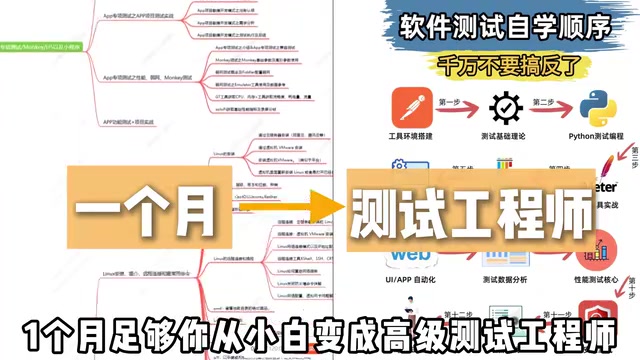
Week 1: Building Core Foundational Skills
Week one focuses on the "common language" of the testing industry, broken into three areas:
- Test case design: This is the fundamental skill of a QA engineer. Techniques like equivalence partitioning, boundary value analysis, and scenario-based testing determine whether you can translate requirements into meaningful test coverage.
- Common Linux commands: Most test environments run on Linux servers. Checking logs, monitoring processes, and managing files all require command-line familiarity.
- Networking basics: Concepts like the TCP three-way handshake, four-way termination, HTTP status codes, and DNS resolution are prerequisites for understanding API testing and diagnosing issues.
As the tutorial puts it: "Without these, you won't even be able to read a requirements document." These fundamentals may seem dry, but they're the foundation everything else is built on. Beginners shouldn't skip this section — even if the concepts don't sink in completely at first, building a mental framework matters.
Week 2: API Testing and Packet Capture
Week two dives into core tooling, focusing on API testing and traffic interception. The tutorial covers using Fiddler to intercept data and JMeter to simulate high-concurrency loads.

API testing is the backbone of modern QA work. Compared to purely clicking through a UI, validating at the API layer is more stable and gets closer to the actual business logic. Once you're comfortable with packet capture tools, you can see exactly what data is being exchanged between the frontend and backend — which directly helps with root cause analysis and test case construction.
The creator claims that completing this week gives you enough skills to interview for functional testing roles with a monthly salary above 10,000 RMB. That's somewhat reasonable for tier-one cities, though salary depends heavily on location, company size, and individual performance. Still, API testing is genuinely a dividing line in functional QA careers — being able to use packet capture tools and JMeter fluently does differentiate you from purely manual testers in interviews.
The core mechanism behind packet capture tools is the man-in-the-middle proxy: the tool sits between the client and server, intercepting and reconstructing HTTP/HTTPS traffic. Fiddler works by configuring a local proxy (default port 8888) so that all traffic is routed through it, enabling capture and modification. Decrypting HTTPS traffic requires installing Fiddler's root certificate on the device — it replaces the server's certificate with a self-signed one, completing a "decrypt → inspect → re-encrypt" cycle. This is why packet capture is often called a "man-in-the-middle attack": in a testing context, it's an invaluable tool for pinpointing frontend/backend data discrepancies; in a security context, it's exactly the kind of attack that needs to be defended against. Understanding this principle helps learners quickly identify certificate trust issues when HTTPS capture fails, rather than being left with no idea where to start troubleshooting.
Week 3: Building an Automated Testing Framework
Week three is described by the creator as the "salary inflection point" — this is where automation testing begins, using the Python + Pytest + Allure stack.

This combination is one of the more mainstream automation solutions in the Python ecosystem: Pytest handles test organization and execution, while Allure generates visual test reports. The tutorial specifically emphasizes that this step is "not just about writing scripts — it's about learning to decouple and encapsulate logic at the code level."
That observation cuts to the heart of what makes automation testing valuable. Many beginners think of automation as "record and replay," but the engineers who are actually competitive in the job market are those with strong code design skills — knowing how to make scripts maintainable, reusable, and extensible. This is precisely why automation roles typically command higher salaries: they require not just a testing mindset, but real programming ability.
For zero-experience learners, the difficulty curve spikes noticeably in week three. If the Linux and networking foundations from weeks one and two aren't solid, this section will be a struggle. It's worth treating basic Python syntax as a prerequisite before starting this week, or you're likely to get stuck.
The division of responsibilities in the Pytest + Allure combination deserves a closer look. Pytest is the dominant testing framework in the Python ecosystem, providing test discovery, parameterization, fixtures, and a rich plugin architecture — it's more concise and extensible than unittest. Allure is a standalone reporting framework that works via the pytest-allure plugin: during test execution, it writes results to intermediate JSON files, which the Allure CLI then renders into visual HTML reports complete with step-by-step breakdowns, failure screenshots, and historical trend data. These reports carry real communication value in the workplace — they let product managers and project managers with non-technical backgrounds intuitively understand test coverage and failure details, making your work visible and legible across the team. In practical terms, "decoupling and encapsulation" in this stack means separating element locators, API request logic, and assertion methods into distinct layers, preventing test scripts from breaking en masse whenever business logic changes.
Week 4: Real-World Projects and Interview Prep
The final week circles back to employability, with an emphasis on hands-on practice using real projects. The tutorial mentions roughly 20 enterprise-level e-commerce projects available for practice, along with a "must-know interview guide" and resume templates.

From a job-hunting perspective, this is a sensible design. E-commerce projects cover typical business flows — registration and login, product management, order processing, payments — which are exactly the scenarios that come up most often in QA interviews. Working through real projects helps you build resume material and gives you concrete testing approaches to discuss in interviews.
One important caveat: the value of "project practice" comes from actually running through the complete workflow yourself, not from copying the project experience onto your resume. Interviewers will probe for details, and project experience without hands-on backing is easy to see through.
An Honest Assessment of This Roadmap
Overall, the structure of this four-week plan is clear and logically sound: foundational skills → API testing → automation → real-world projects. Each stage builds on the last with no major knowledge gaps in between.
That said, a few pieces of the marketing language deserve some healthy skepticism. Phrases like "job-ready after completion" and "from complete beginner to mastery" are typical enrollment-pitch language. A more realistic outcome for one month of effort is: "qualified to interview for entry-level positions." The software testing job market is also increasingly competitive — pure manual testing skills alone are no longer enough to stand out, and automation and programming ability are steadily becoming baseline expectations.
For anyone seriously considering this career transition, this roadmap is a solid framework to reference. But the more critical factor is execution and sustained commitment. Whether you actually land a role ultimately comes down to whether you genuinely work through — and truly internalize — all four stages.
Related articles

Uber Deploys ChatGPT Work Company-Wide: AI in the Workplace Enters the Scaled Implementation Phase
Uber deploys ChatGPT Work to 30,000+ employees, extending it from engineering to all roles. We analyze its expert-engineer pairing, end-to-end automation, and questions of AI control and power concentration—insights for scaling AI in the workplace.

Shift at Midnight Hands-On: When "ID Verification" Becomes Alien Hunting
Shift at Midnight blends ID verification with horror survival in a four-player co-op game. We break down its inspection mechanics and chaotic humor.

Zelensky Recounts the Outbreak of War: I Need Ammunition, Not a Ride
Zelensky recalls the first day of war in a YouTube interview: farewell to family, rejecting Biden's evacuation offer with "I need ammunition, not a ride," and how Bucha shaped his stance on compromise and peace talks.