Zero Tolerance for Failure: TechCrunch Disrupt Spotlights High-Stakes AI Deployment

Waabi, Shield AI, and GM convene at TechCrunch Disrupt 2026 to tackle zero-failure-tolerance AI in high-stakes real-world deployments.
TechCrunch Disrupt 2026's Real World AI stage centers on a critical question: when AI errors cost lives rather than user experience, how do you build truly trustworthy systems? Waabi, Shield AI, and General Motors represent three paths — autonomous freight, defense autonomous flight, and mass-market automotive manufacturing — each facing the ultimate test of reliability and verifiability. Their first-hand experience shifts the conversation from "what AI can do" to "how AI can be reliable enough when the stakes are highest."
When AI Failure Is Not an Option: Technical Challenges in High-Stakes Environments
In autonomous driving, defense unmanned systems, and automotive manufacturing, an AI error can cost lives — not just user experience. The Real World AI stage at TechCrunch Disrupt 2026 will bring together technology leaders from Waabi, Shield AI, and General Motors to explore how to build reliable, verifiable AI systems under the premise that failure is simply not an option.
This topic matters because the fault-tolerance logic of consumer AI breaks down entirely in these environments. If a chatbot gives a wrong answer, the user just asks again. But a single misjudgment by an autonomous vehicle or an incorrect response from a defense system can have irreversible consequences. The three companies represent three distinct technical paths — autonomous freight, defense autonomous systems, and large-scale automotive manufacturing — yet they share a common core challenge: making AI trustworthy in the real physical world.
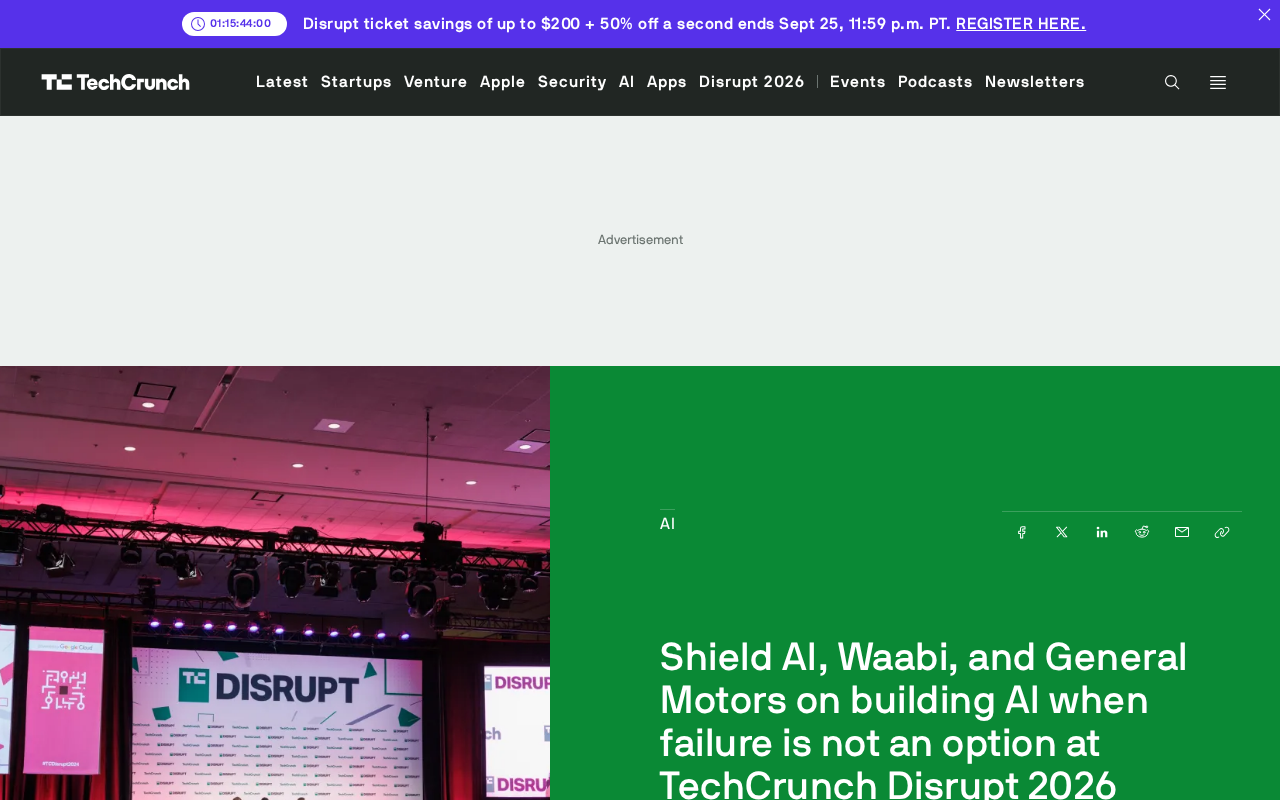
Three Companies, Three Distinct Perspectives
Waabi: Verifiability in Autonomous Driving
Waabi has long advocated for developing autonomous driving technology through interpretable, simulation-verified methods rather than relying purely on massive road-test data stacking in a "black box" approach. The core of this strategy is using high-fidelity simulation to reproduce extreme and rare scenarios — known as long-tail cases — so that the safety boundaries of a system can be quantitatively understood before deployment.
Long-tail cases refer to rare situations that almost never occur during real-world road testing, but can cause serious harm when they do — such as a wrong-way vehicle suddenly appearing in a nighttime construction zone, driving across a bridge in strong crosswinds, or multiple sensor failures occurring simultaneously. Traditional data-driven road testing faces a fundamental dilemma: these events occur so infrequently in nature that even billions of miles of driving can't produce enough samples. Waabi's simulation-first approach attempts to bypass this bottleneck — by building high-fidelity virtual physical environments and artificially injecting extreme conditions, stress-testing system boundaries in a controlled, repeatable way, and ultimately quantifying safety as a probabilistic metric rather than relying on the empirical endorsement of "nothing has gone wrong yet." This is also a concrete manifestation of the industry debate between "explainable AI" and "black-box neural network" approaches.
Shield AI: Defense-Grade Autonomous Systems
Shield AI focuses on autonomous flight systems for defense and security applications. In this context, AI must not only operate in GPS-denied, communications-degraded adversarial environments, but also maintain robust decision-making under extreme uncertainty. The demands placed on system robustness and anti-jamming capability in defense applications represent another extreme end of the AI reliability spectrum.
One of Shield AI's core products is Hivemind, an AI pilot software platform for drones and manned/unmanned teaming platforms. Its design premise is a "GPS-denied, comms-denied" environment — increasingly common in modern electronic warfare scenarios, where adversaries can disable systems that rely on external positioning through jamming or signal spoofing. In such environments, autonomous systems must rely on onboard sensor fusion (such as inertial navigation and visual odometry) and edge inference to independently perform situational awareness and mission decision-making. Compared to civilian autonomous driving, defense scenarios add an adversarial dimension — the environment contains actors actively trying to subvert AI judgment. This expands the definition of "robustness" from handling random noise to countering deliberately designed attacks, representing a fundamentally different order of magnitude and nature of technical challenge.
General Motors: Engineering Constraints of Large-Scale Deployment
As a legacy automotive giant, General Motors faces the challenge of integrating AI capabilities into large-scale mass production systems. Compared to startups, it must strike a balance between cost, supply chain, regulatory compliance, and long-term maintenance — providing yet another real-world perspective on the engineering deployment of AI.
Why "Real World AI" Deserves Attention
Over the past few years, the generative AI wave has been concentrated at the digital content and software layer, while physical-world AI applications have often been underestimated. Real-world AI has a far higher bar: it requires real-time interaction with sensors, actuators, and physical environments, where any latency or error is amplified.
The value of this discussion lies in shifting the focus from "what AI can do" to "how AI can be reliable enough under high-risk conditions." For practitioners focused on AI engineering, safety verification, and industrial deployment, first-hand experience from these three distinct sectors carries far more practical weight than abstract technical visions.
Event Information
According to the official announcement, TechCrunch Disrupt 2026 is offering limited-time ticketing discounts: save up to $200 on tickets purchased before the deadline on the evening of September 25, with a 50% discount available on a second ticket. The Real World AI stage will be one of the central sessions at this year's event exploring physical-world AI deployment.
It should be noted that this article is based on pre-event announcement materials; specific talk content and technical details will be revealed at the event itself. The practical methodologies these three companies have developed for "zero-tolerance for failure" scenarios remain to be further elaborated on site.
Related articles

Free Unlimited Claude Code Solution: Agnes AI + CC Switch Setup Guide
No paid subscription needed — pair the free AI platform Agnes AI with the open-source tool CC Switch to provide a backend for Claude Code, enabling unlimited free calls to text, image, and video models. This guide covers the full setup, test results, and usage boundaries.

A Complete Zero-Cost Guide to Getting Started with Claude Code for Beginners in China
A beginner's guide to Claude Code for users in China: two installation methods (command line and IDE plugin), full configuration steps for replacing the official API with the free domestic LongCat model, and a hands-on demo of building a small tool with natural language, plus tips.

When the NSA Gets Involved: The AI Supply Chain Crisis Behind Open-Source CVEs and API Key Hijacking
Multiple open-source projects disclosed severe CVEs in one day, PHP flaws alarmed the FBI, and Railway and OpenCode were breached with API keys stolen. This article breaks down the vulnerability window, AI-accelerated exploitation, and the AI supply chain crisis behind the API key black market, with a developer defense checklist.