Zetik: An AI Intelligence Staff Team in Your Pocket to End Information Anxiety

Zetik uses AI multi-agent teams to turn information overload into actionable intelligence briefings.
Zetik is a new AI-powered intelligence tool that acts as a "chief of staff in your pocket." Using a multi-agent architecture modeled after professional intelligence cycles, it continuously collects information from podcasts, papers, code repositories, tweets, and news, then filters, analyzes, and delivers personalized briefings 24/7 in near real-time — democratizing intelligence capabilities previously reserved for executives and leaders.
When CEOs Have Strategy Teams, Ordinary People Just Have Endless Scrolling
Presidents and CEOs are surrounded by dedicated strategic advisory teams that help them distill key intelligence from massive amounts of information and support decision-making. Meanwhile, ordinary people facing the flood of information often find themselves trapped in endless "doomscrolling" — swept along by algorithmic feeds, attention scattered by fragmented content, yet never able to systematically grasp what truly matters.
The term "doomscrolling" became widely used during the 2020 COVID-19 pandemic, referring to the compulsive behavior of continuously scrolling through negative news. The underlying mechanism stems from humanity's evolutionary "negativity bias" — the brain naturally assigns higher weight to threat-related information, and social media recommendation algorithms exploit this psychological trait by maximizing user dwell time to drive advertising revenue. A 2022 Stanford University study showed that the average internet user passively receives information equivalent to 174 newspapers per day, yet less than 3% is truly relevant to personal decision-making. This enormous gap between information overload and information value is precisely the market void that a new generation of AI information tools is trying to fill.
Zetik, which recently launched on Product Hunt, targets exactly this pain point. Its tagline is direct and powerful — "A chief of staff in your pocket." The product received 108 upvotes on launch day, ranking #3 on the leaderboard, and is categorized under Productivity, News, and Artificial Intelligence.
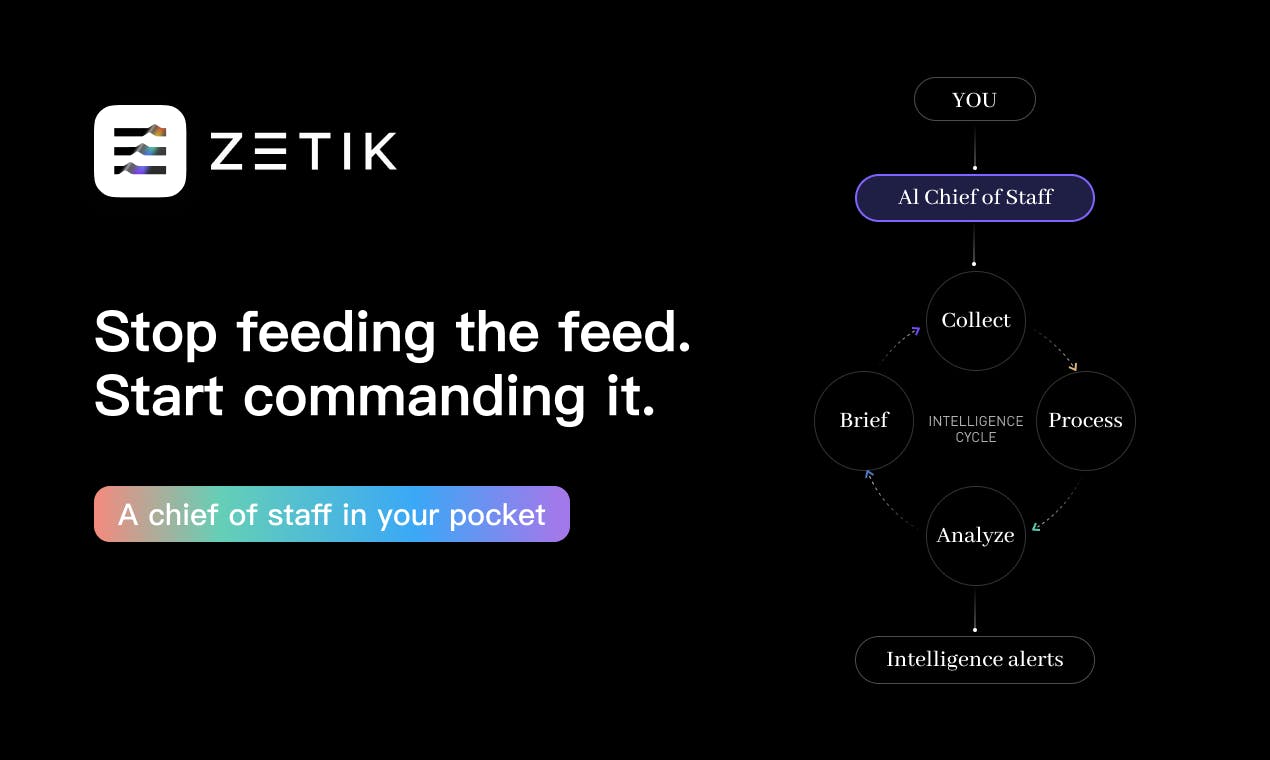
A Tireless AI Intelligence Cycle
Zetik's core philosophy is to build an AI agent team that collaboratively executes a complete "intelligence cycle." This concept draws from the workflows of professional intelligence agencies, and Zetik breaks it down into four stages.
It's worth noting that the Intelligence Cycle is a core methodology in national security and military intelligence, first systematized by the U.S. Central Intelligence Agency (CIA). It typically includes five phases: planning and direction, collection, processing, analysis and production, and dissemination. The framework's core value lies in transforming massive raw data into actionable intelligence. The business world later adapted it into "Competitive Intelligence" methodology, championed by strategic scholars like Michael Porter, who proposed the Five Forces Model. Zetik automates and democratizes this professional framework, essentially rebuilding the operational logic of a miniature intelligence agency using AI.
Collect
Zetik continuously gathers content from multiple information sources covering a remarkably broad range: podcasts, papers, code repositories, tweets, and news. This cross-media collection capability means it's not just an RSS aggregator — it can simultaneously monitor audio, text, code, and other heterogeneous information streams.
It's important to distinguish Zetik from traditional RSS aggregation tools. RSS (Really Simple Syndication) was a popular information subscription protocol during the Web 2.0 era of the 2000s, with Google Reader being the most well-known RSS reader before its shutdown in 2013. RSS's limitation is that it can only handle standardized text feeds — it cannot cover podcast audio transcription, GitHub repository commit records, papers on academic preprint servers (like arXiv), or unstructured content on social media. Processing heterogeneous information streams requires multimodal AI capabilities — including Automatic Speech Recognition (ASR) for podcasts, NLP for text, and code comprehension for repository changes. The technical threshold for cross-modal collection is far higher than traditional RSS aggregation.
Filter
After massive collection, the real challenge is noise reduction. Zetik intelligently filters based on topics you care about, removing irrelevant information and retaining only content that's genuinely relevant to you. This step is the critical dividing line between "information overload" and "intelligence value."
Analyze
Filtered information is further analyzed and refined by AI agents, extracting trends, connections, and insights from raw materials rather than simply listing headlines.
Brief
Finally, Zetik organizes analysis results into briefings presented to the user. This is the core value of the "chief of staff" role — it handles the heavy lifting of information processing for you, delivering conclusions ready for decision-making.
24/7 Near Real-Time Tracking
Another major selling point of Zetik is its 24/7 operation and near real-time tracking capability. Traditional information summary tools often process in daily or weekly batches, while Zetik emphasizes continuous monitoring — once you set your topics of interest, it watches these areas non-stop for the latest developments.
For professionals in rapidly changing industries, this near real-time intelligence capability is particularly important. Whether tracking the latest papers in a technical field, monitoring competitors' code updates, or gauging public sentiment on social media about a particular topic, Zetik aims to keep users "always one step ahead."
A Noteworthy Product Logic
From a product design perspective, Zetik exemplifies a typical evolution direction for AI Agent applications: from single-point tools to collaborative workflows.
Previously, we were accustomed to using single AI tools for single tasks — one tool to summarize articles, another to translate, yet another to search. Zetik attempts to package the complete chain of "collect — filter — analyze — brief" into an automated system, with multiple specialized agents collaborating through division of labor. This "agent team" architecture is precisely how the current Multi-Agent paradigm is landing in consumer-grade products.
Multi-Agent systems represent a significant trend in AI application architecture during 2023-2024. Unlike a single large language model (LLM) handling all tasks, Multi-Agent architecture decomposes complex tasks among multiple specialized AI agents, each with specific roles, tools, and context. Representative frameworks include Microsoft's AutoGen, Stanford's Generative Agents, and open-source projects like CrewAI. The advantages of this architecture include: individual agent prompts are more focused leading to better performance, parallel processing improves efficiency, and each component can be independently iterated and optimized. OpenAI CEO Sam Altman has publicly stated multiple times that Agents will be AI's next major breakthrough direction. Zetik is precisely the implementation of this cutting-edge architectural concept into a consumer-facing product.
The fundamental problem it solves is information sovereignty in the attention economy era. While algorithmic feeds constantly compete for our attention, Zetik takes the opposite approach — returning the initiative of information filtering to users, letting you actively define "what matters" rather than passively accepting whatever content platforms feed you.
The concept of Information Sovereignty originated from the digital rights movement, initially referring to a nation's jurisdiction over its own data, but has gradually extended to the personal level — meaning a user's autonomous right to determine their own information consumption. The recommendation algorithms employed by mainstream platforms are essentially an "attention extraction" mechanism: TikTok's For You algorithm, Twitter/X's timeline sorting, and YouTube's autoplay all optimize for platform interests rather than user interests. The EU's Digital Services Act (DSA) in 2023 began requiring platforms to offer non-algorithmic recommendation options. The "user-driven information filtering" that Zetik represents can be viewed as a technological path for combating algorithmic hegemony — using AI's power to counterbalance the manipulation of AI recommendation systems.
Potential Challenges and Considerations
Of course, as a product that has just debuted, there are still several aspects of Zetik worth watching:
- Source quality and coverage: Cross-collection from podcasts, papers, code, tweets, and news sounds powerful, but whether the actual depth and timeliness of crawling can deliver on its promises requires long-term usage verification.
- AI analysis reliability: The "analyze" stage is the most demanding test of model capability. How to avoid generating briefings that appear professional but are actually hollow is a common challenge for AI intelligence products of this type. The "hallucination" problem that currently plagues large language models — generating content that seems reasonable but is factually inaccurate — is especially dangerous in intelligence analysis scenarios, because incorrect intelligence can be more misleading than no intelligence at all.
- Personalization accuracy: "Tracking everything that matters to you" means the system must accurately understand user intent; otherwise, the filtering step might miss critical information or introduce noise.
Conclusion
Zetik has identified a real and universal pain point: in an era of information explosion, ordinary people lack their own "intelligence advisory team." Using a multi-agent AI approach, it attempts to democratize information processing capabilities that were previously available only to those at the top of power structures.
Regardless of how the final product experience turns out, the concept of a "chief of staff in your pocket" itself represents a highly imaginative direction for AI Agent applications — no longer a simple Q&A assistant, but an intelligent partner that can proactively, continuously, and systematically process information for users. For knowledge workers struggling daily in the flood of information, this might just be the remedy they've long been waiting for.
Related articles

Opus 5 in Practice: AI-Generated Presentations Now Match Consultant Quality
Anthropic's Opus 5 generates spreadsheets and presentations at near-superhuman levels, rivaling professional consultants. Analysis of AI's leap from text to professional deliverables.

Qwen3.8-27B Becomes the Most Popular Open-Source Model in History: A Dominant Lead Over DeepSeek-R1
Qwen3.8-27B becomes the most-used open-source model on Unsloth, far surpassing DeepSeek-R1 and Qwen3.6-35B-A3B. Deployable on consumer GPUs after quantization, it's now the top choice for developers.

Opus 5 Released: Dual Upgrade in Token Efficiency and Intelligence, Better Coding Experience
Anthropic releases Opus 5 with significant cross-domain token efficiency gains alongside higher intelligence. Excels at coding tasks with faster responses and lower costs, marking a new efficiency era in LLM competition.