Zoom AI Assistant Hijacked: Deep Dive into Enterprise AI Integration Security Risks

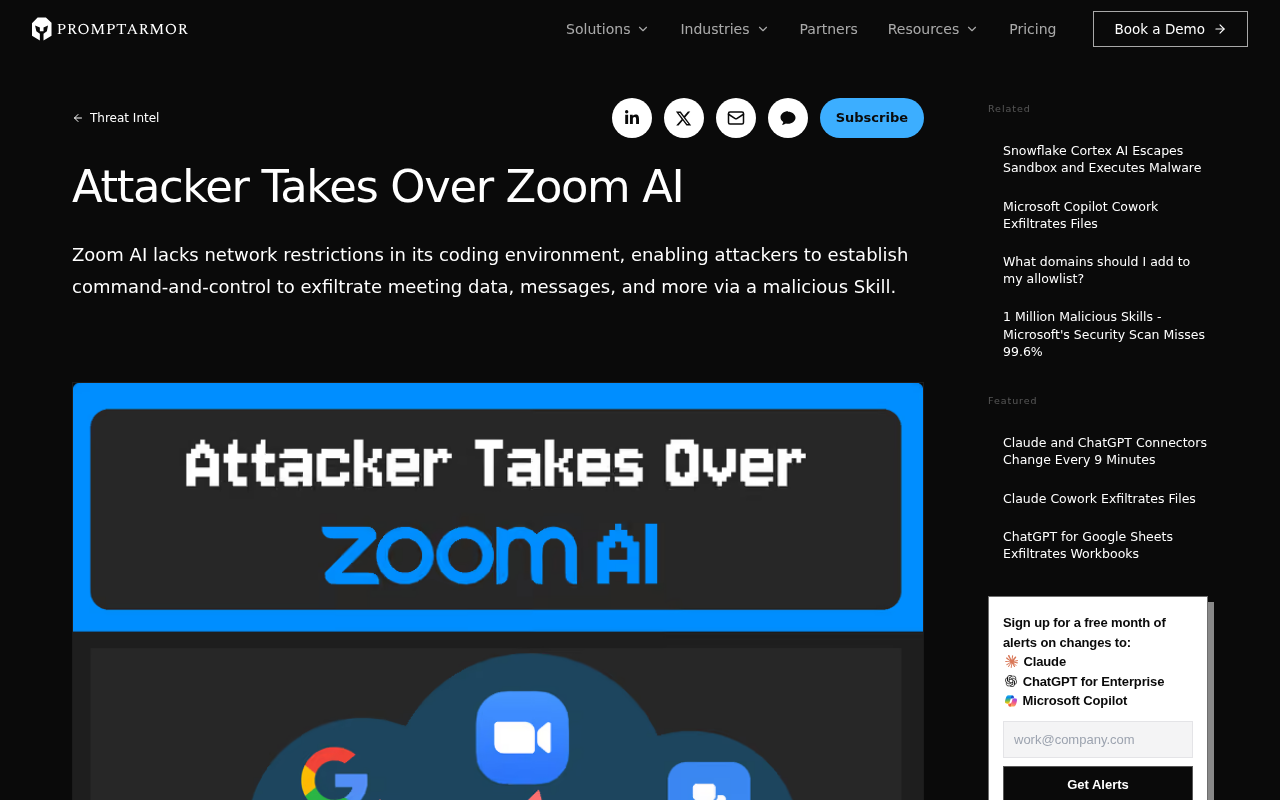
Zoom AI assistant hijacked, revealing critical security risks in enterprise AI integrations.
Attackers successfully hijacked Zoom's AI Companion, highlighting the growing security risks of enterprise AI integration. The incident exposes vulnerabilities including prompt injection attacks and AI privilege escalation. This article analyzes the expanded attack surface LLMs create, and provides practical defense strategies including input validation, permission isolation, and AI-specific security audits.
Incident Overview: Zoom AI Assistant Taken Over by Attackers
A recent security discussion on Hacker News has drawn widespread attention — attackers successfully hijacked Zoom's AI assistant functionality. While the publicly available technical details remain limited, this incident once again thrusts the security risks of enterprise-grade AI integration into the spotlight. As more collaboration tools deeply embed large language models (LLMs) into their core products, the attack surface expands dramatically.
For a video conferencing platform like Zoom, with hundreds of millions of daily active users, its AI Companion feature has already permeated multiple high-frequency scenarios including meeting summary generation, real-time captions, and content digests. Once these AI capabilities are exploited maliciously, the scope of impact cannot be underestimated.
Why AI Integration Dramatically Expands the Attack Surface
Novel Security Risks Introduced by Large Language Models
Traditional software has relatively clear security boundaries, but things get complicated when AI assistants are introduced. AI features typically require access to sensitive data such as meeting content, chat histories, and shared documents — meaning that once an AI component is compromised, attackers may directly access vast amounts of private information.
More critically, LLM-based systems inherently face novel attacks like Prompt Injection. Attackers can craft carefully constructed input content to trick the AI into performing unintended operations — such as leaking system prompts, bypassing content filters, or even invoking internal tool chains to execute sensitive actions.
From Data Access to Privilege Escalation: The Double-Edged Sword of AI Agents
Modern AI assistants are no longer just passive Q&A tools — they are gradually acquiring "Agent" capabilities to call APIs, access external services, and execute workflows. This enhanced capability also means that once attackers gain control, they can potentially use the AI assistant as a pivot point to laterally infiltrate other systems integrated with it. This is precisely where the "principle of least privilege" that AI security researchers repeatedly emphasize is often overlooked in practice.
Practical Strategies for Enterprises to Defend Against AI Security Threats
Input Validation and Output Filtering: Building the First Line of Defense
For AI integration scenarios, the most fundamental — and most easily overlooked — line of defense is strict control over AI inputs and outputs. Any external content entering the LLM context (such as meeting transcripts or uploaded documents) should be treated as a potentially untrusted data source, subjected to necessary sanitization and isolation to prevent indirect prompt injection.
Strict AI Permission Isolation Mechanisms
The permissions granted to AI assistants should follow the principle of least privilege. What data they can access and what operations they can invoke must be explicitly defined and audited. Sandboxing AI components from core business systems can effectively limit the blast radius when the AI is compromised.
Establishing AI-Specific Security Audit Processes
AI features often iterate faster than security reviews can keep pace. Enterprises need to establish dedicated security testing processes for AI components, including adversarial testing (red team exercises) and anomalous behavior monitoring, to promptly identify weaknesses exposed during real-world usage.
Deeper Implications for the Industry
This Zoom AI hijacking incident is essentially a microcosm of the contradiction between the rapid expansion of AI capabilities and the relative lag in security measures. As the entire tech industry races to "stuff" AI features into products, security often becomes the sacrificed element.
What's particularly concerning is that AI security issues are fundamentally different from traditional software vulnerabilities. They involve not only code-level defects but also the unpredictability of model behavior, the risk of training data contamination, and the inherent ambiguity of natural language as an "attack vector." This makes defensive work significantly more challenging.
For users and enterprises, while embracing the convenience AI brings, it's essential to stay clear-headed: assess how much data access the AI tools you use actually have, and what commitments vendors have made regarding security. For vendors, treating security as the first principle of AI product design — rather than an afterthought patch — is the only sustainable approach.
Conclusion: AI Integration Security Cannot Be Ignored
Although the complete technical details of this incident await official disclosure, the signal it sends is unmistakable: AI integration is becoming the new frontline of cybersecurity. As AI Agent capabilities continue to strengthen, security incidents of this nature are unlikely to remain isolated. Whether you're a platform provider or a user, a more cautious attitude toward the hidden security costs behind AI features is warranted.
Related articles

Apple HomeView Hands-On Review: Is the $300 Smart Home Hub Worth It?
Apple HomeView hands-on: a $300 smart home hub with facial recognition for quick account switching, but no App Store or voice recognition. Is the wall-mounted version worth it? Should you buy the first generation?

Meta Muse Wonder Launch: What It Means for Meta's Return to the Frontier AI Race
Meta releases Muse Wonder and WonderFull, benchmarks reach the frontier, community feedback is polarized. An in-depth look at Meta's return to the frontier AI race, its personal agent strategy, and Zuckerberg's different path.

Apple Home Smart Home Lineup Leaked: LG and Schneider Team Up, UWB Door Lock on Board
Apple Home ecosystem gains new LG and Schneider devices: UWB smart lock with proximity unlock, 2.5K dual-camera doorbell, privacy indoor camera, and AirPods-like seamless pairing.