#AI agent communication standard
924 related articles

·1 min
MCP Protocol Explained: The Unified Standard for AI Agent-Tool Communication
Deep dive into MCP (Model Context Protocol): architecture, communication mechanisms, security, and how it differs from Function Calling as the new standard for AI agent-tool communication.
Read more →
 Deep Dives
·2 min
ACP Protocol Explained: A New Open-Source Protocol Standardizing Communication Between IDEs and Coding Agents
Deep dive into ACP (Agent-Client Protocol): how Zed and Google Gemini standardize IDE-to-coding-agent communication, its architecture, and how it complements MCP.
Read more →
 Tutorials
·3 min
MCP Protocol Explained: The New Agent Communication Standard Replacing Function Calling
Deep dive into MCP (Model Context Protocol): its core concepts, three communication mechanisms, and ecosystem. Learn how MCP replaces Function Calling with Streamable HTTP and SDK 2.0.
Read more →
 Deep Dives
·4 min
A2A Protocol Explained: Complementing MCP to Build a Standard Communication Layer for Multi-Agent Collaboration
Deep dive into Google's A2A protocol core mechanisms (Agent Card, Task, Transport), comparing A2A vs MCP roles, and tracing the evolution from tool calling to multi-agent team collaboration.
Read more →

·4 min
Getting Started with Claude Code: Environment Setup, Common Commands, and Git Workflow in Practice
A detailed guide to Claude Code installation, domestic model switching, project analysis commands, and Git workflow practice to help developers quickly master this AI programming collaboration tool.
Read more →

·2 min
Can 45 Yes/No Questions Let an LLM Identify 16 Cards? An Information Theory Perspective on AI Reasoning
Analyzing whether LLMs can identify 16 cards through 45 yes/no questions from an information theory perspective. Exploring AI reasoning capabilities in constraint-based multi-turn tasks.
Read more →

·2 min
Google's Beyond Zero: An Enterprise Security Framework That Goes Beyond Zero Trust for the AI Era
Deep dive into Google's Beyond Zero security concept, exploring how enterprises can move beyond traditional Zero Trust models in the AI era to address prompt injection, data poisoning, and other emerging threats.
Read more →
·4 min
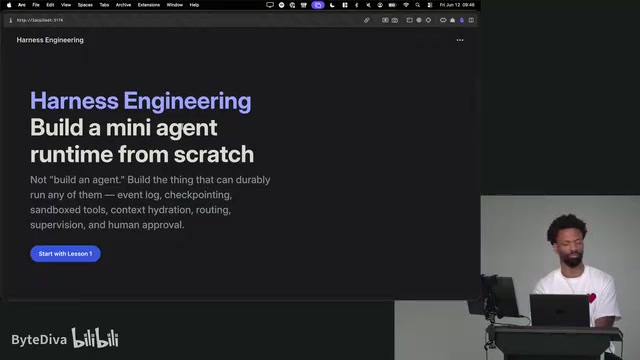
Harness Engineering: The Core Infrastructure for Taking AI Agents from Demo to Production
Deep dive into Harness Engineering: why AI Agents need memory management, durable execution, guardrails & approvals to go from demo to production.
Read more →

·4 min
Harness Engineering: The Core Infrastructure for Taking AI Agents from Demo to Production
Deep dive into Harness Engineering: why AI Agents need memory management, durable execution, guardrails & approvals to reach production. Based on Scott Moss's workshop.
Read more →

·5 min
Loop Engineering Explained: The New Programming Paradigm Where AI Prompts Itself
Loop Engineering is a paradigm shift in AI usage. Learn how to build automated loops where agents explore, execute, and verify tasks autonomously, with a hands-on e-commerce case study.
Read more →

·6 min
Harness Engineering: From Context Engineering to the Third Phase of AI Programming
Explore Harness Engineering: the next evolution beyond context engineering for AI programming. Learn how to build enterprise-grade Skill systems and deliver real projects with mid-tier models.
Read more →

·5 min
Opus 5 Builds a No Man's Sky-Style Exploration Game in One Day: MCP and Sub-Agent Architecture Explained
A developer used Anthropic's Opus 5 model to build a No Man's Sky-style space exploration game in one day using Blender MCP and sub-agents. Deep dive into the technical architecture and industry implications.
Read more →

·2 min
How Gamma Uses AI to Reinvent Presentations: A Complete Revolution from Product to Workflow
Gamma CEO Grant Lee shares how the company deeply integrates OpenAI technology to drive presentation innovation with AI—from image generation to content creation and internal development workflows.
Read more →

·5 min
Running GPT-5.6 Inside Claude Code: Best Practices for Subagent Orchestration and System Prompts
Deep dive into running OpenAI GPT-5.6 inside Claude Code: comparing Codex vs Claude Code on subagent orchestration, workflow design, and system prompt quality, revealing how harness engineering determines model output.
Read more →

·4 min
Fable 5 vs GPT-5.6: An In-Depth Head-to-Head Comparison of Two Top-Tier Coding Models
In-depth comparison of Fable 5 vs GPT-5.6 (Sol) for AI coding. Covering token efficiency, code quality, design, cost, and safety based on $10K+ real usage data.
Read more →

·4 min
Fable 5 vs GPT-5.6: An In-Depth Head-to-Head Comparison of Two Top-Tier Coding Models
In-depth comparison of Fable 5 vs GPT-5.6 (Sol) for AI coding. Real-world data on token efficiency, code quality, design capability, and cost from $10K+ testing.
Read more →

·3 min
SeaTicket: An AI Agent That Automatically Resolves GitHub and Discord Issues
SeaTicket is an AI Agent that automatically resolves GitHub Issues and Discord questions. This article analyzes its architecture, use cases, challenges, and value for open-source maintenance.
Read more →

·3 min
SeaTicket: An AI Agent That Automatically Resolves GitHub and Discord Issues
SeaTicket is an AI Agent that automatically resolves GitHub Issues and Discord questions. This article analyzes its architecture, use cases, challenges, and value for open-source maintenance.
Read more →

·4 min
WebMCP in Practice: How MakeMyTrip Is Reshaping the Travel Booking Experience
India's largest OTA platform MakeMyTrip uses WebMCP to standardize AI Agent interactions with web apps, replacing fragile DOM scraping with natural language-driven test automation and simplified complex booking scenarios.
Read more →

·5 min
WebMCP in Practice: Building Browser AI Agent Tools & DevTools Debugging Guide
A detailed guide to Google's WebMCP standard proposal, covering imperative and declarative tool building, smart home and car configuration demos, and Chrome DevTools debugging for AI agent tools.
Read more →