#AI coding agents
2133 related articles
 Tutorials
·4 min
A Practical Guide for QA Engineers: Building 18 AI Agents with 5 Essential Tools
Learn how QA engineers can build 18 AI Agents using Coze, LangChain, Dify, Cursor, and Skills — covering requirements analysis, test case generation, script writing, and regression testing with up to 10x efficiency gains.
Read more →
 Product Reviews
·3 min
How to Choose an AI Agent Framework in 2026? Pros and Cons of Four Leading Solutions
Compare four leading AI Agent frameworks in 2026: Coze, AutoGen, CrewAI, LangChain, and AutoGen Studio — covering coding requirements, private deployment, and commercialization.
Read more →
 Product Reviews
·3 min
Multi-Agent Orchestration Framework: A Super AI Development Team of 98 Expert Agents
Deep dive into a trending GitHub multi-agent framework with 98 expert agents, swarm collaboration, HNSW vector memory, autonomous learning, and Claude Code plugin support for full-lifecycle development.
Read more →
 Product Reviews
·4 min
AI Agent Framework Selection in 2025: Pros and Cons of Coze, AutoGPT, LangChain, and AutoGen
2025 comparison of four major AI Agent frameworks: Coze for beginners, AutoGPT/LangChain/MetaGPT for developers, Microsoft AutoGen for enterprise self-hosted deployment. A practical selection guide.
Read more →
 Product Reviews
·2 min
Roo Code Arena Mode and Plan Mode Explained: New Ways to Use Your AI Coding Assistant
Roo Code launches Arena Mode for blind AI model comparison and Plan Mode for plan-first coding workflows, enhancing AI-assisted programming control and evaluation.
Read more →
 Tutorials
·3 min
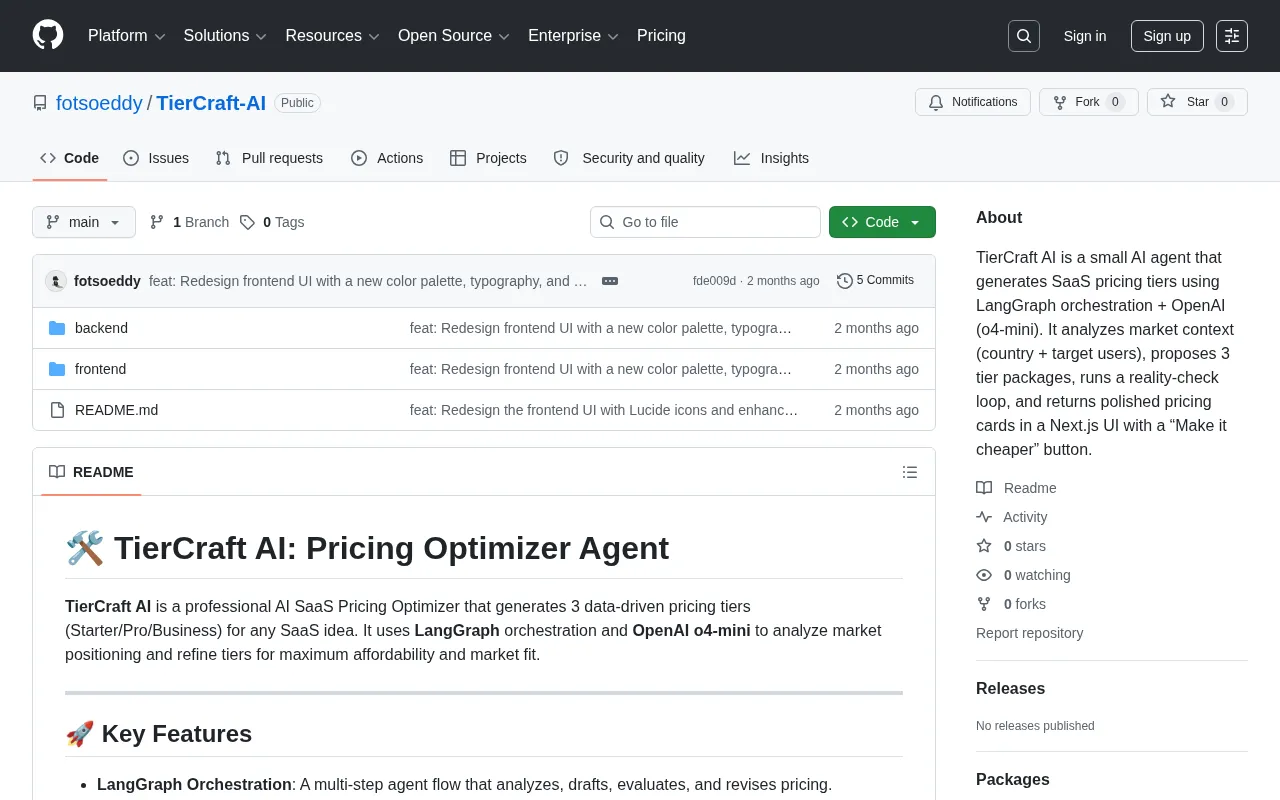
TierCraft AI: A Practical Deep Dive into Auto-Generating SaaS Pricing Plans with LangGraph + OpenAI
Deep dive into the TierCraft AI open-source project: using LangGraph to orchestrate AI Agent workflows with OpenAI o4-mini to auto-generate three-tier SaaS pricing plans, featuring Reality-Check loops and context-aware pricing.
Read more →
 Tutorials
·4 min
Coze AI Agent Tutorial: A Complete Guide to Building AI Agents from Scratch
Complete guide to building AI agents on Coze from scratch, covering LLM configuration, prompt writing, plugin integration, knowledge base setup, and memory systems.
Read more →
 Tech Frontiers
·3 min
GitLab's Major Restructuring: Layoffs, Flattening, and a Bold Bet on the AI Agent Era
GitLab announces Act 2 restructuring: cutting 30% of operating countries, removing three management layers, splitting R&D into 60 autonomous teams. A deep dive into GitLab's Jevons Paradox bet on the AI agent era.
Read more →
 Product Reviews
·3 min
awesome-LLM-resources: A Comprehensive Analysis of the 8,200-Star LLM Learning Resource Repository on GitHub
In-depth analysis of the 8,200-star GitHub project awesome-LLM-resources, covering multimodal generation, Agents, model training, MCP protocol, and more — a one-stop LLM learning guide.
Read more →
 Deep Dives
·2 min
Deep Dive into Cursor's Security Review Feature: A New Standard for AI Code Security
Deep dive into Cursor's Security Review feature: two AI security agents for PR-level review and codebase vulnerability scanning, enabling shift-left security for enterprise DevSecOps.
Read more →
 Tech Frontiers
·2 min
SWE-bench Opens Evaluation Environments and Training Recipes: Dramatically Lowering the Barrier to AI Coding Agent Development
SWE-bench opens evaluation environments, task sets, trajectories, and training recipes, dramatically lowering the barrier to AI coding agent development.
Read more →
 Tech Frontiers
·3 min
Cursor Auto-Fixes CI Failures: How Always-On AI Agents Are Changing the DevOps Workflow
Cursor launches automatic CI failure repair with an always-on AI Agent that monitors GitHub repos, analyzes CI logs, identifies root causes, and submits fix PRs.
Read more →
 Tech Frontiers
·2 min
Cursor Comes to Microsoft Teams: How an AI Coding Assistant Is Changing Team Collaboration
Cursor officially integrates with Microsoft Teams, enabling @Cursor AI agent invocation in channels for task delegation and code info retrieval. Analysis of features, strategy, and team impact.
Read more →
 Expert Opinions
·3 min
The Blurring Line Between Vibe Coding and Agentic Engineering: Simon Willison's Deep Reflection
Django co-creator Simon Willison finds Vibe Coding and Agentic Engineering converging in practice. As AI tools grow reliable, where should engineers draw the line on trust and responsibility?
Read more →
 Tech Frontiers
·3 min
SWE-bench Official Blog Launches: AI Coding Evaluation Enters a New Phase
SWE-bench launches its official blog for in-depth content on AI coding evaluation, AI Agents, and toolchains—signaling a new phase of maturity and standardization in AI programming benchmarks.
Read more →
 Tech Frontiers
·2 min
Qwen Continues to Lead on SWE-bench: The Rise of Open-Source AI Coding Models
Qwen team leads open-source models on SWE-bench, demonstrating strong software engineering capabilities. This article analyzes SWE-bench standards, Qwen's progress, and the value of open-source AI coding tools.
Read more →
 Expert Opinions
·3 min
Zig Language Bans AI Code Contributions: A Deep Debate on Open Source Principles
Zig founder Andrew Kelley rejects LLM-assisted PRs, introducing the concept of AI code's "digital smell." A deep analysis of the open source philosophy, code quality, and trust issues behind Zig's ban on AI contributions.
Read more →
 Deep Dives
·4 min
Context Engineering Explained: The AI Paradigm Shift from Prompt to Context Engineering
Deep dive into Context Engineering: its core principles and practices. From Prompt Engineering to context design, orchestration, and optimization—exploring how Karpathy's new AI paradigm reshapes LLM app development and AI Agent construction.
Read more →
 Tutorials
·3 min
GitHub 8K Stars: Deep Dive into the Most Comprehensive LLM Resource Repository
Deep analysis of the GitHub project awesome-LLM-resources with 8,200+ Stars, covering multimodal AI, Agents, MCP protocol, model training, inference optimization, and coding assistants.
Read more →
 Tech Frontiers
·3 min
Kimi-Writer: An Open-Source AI Novel Writing Agent Powered by Deep Reasoning
Deep dive into the Kimi-Writer open-source project — an AI novel writing Agent built on Kimi-K2-Thinking with deep reasoning, autonomous planning, and long-form narrative capabilities.
Read more →