#AI mathematics breakthrough
109 related articles

·3 min
Next-Gen GPT Model Cracks 10 Open Math Problems for Just $2,000
OpenAI's next-gen model reportedly solves 10 long-standing open math problems for just $2,000 in token costs, evolving from knowledge carrier to knowledge producer.
Read more →

·2 min
Why Is DeepMind Falling Behind on Math Benchmarks? The Clash Between Specialized Systems and General-Purpose Models
DeepMind has top math AI systems like AlphaGeometry and AlphaProof but trails OpenAI on general math benchmarks. We analyze the specialized vs. general-purpose model divide and what benchmarks miss.
Read more →

·2 min
OpenAI's Internal Model Astra Allegedly Solves 10 Math Problems — How Credible Is It?
OpenAI's internal model codenamed Astra reportedly solved 10 major open math problems. We examine the claim's credibility, AI math reasoning capabilities, and a rational evaluation framework.
Read more →

·2 min
Mathematics Under AI's Impact: A Mathematician's Late-Night Self-Reflection
When AI starts proving theorems, how do mathematicians view their own value? Exploring the existential anxiety AI brings to mathematics and the future of human-AI collaboration.
Read more →

·3 min
GPT-5.6 Dominates Math but Stumbles on Puzzle Games? Two API Settings Unlock 3x Performance
GPT-5.6 Sol conquers frontier math but struggles on ARC-AGI-3 puzzles. The fix? Not a smarter model, but two API settings that tripled scores and cut token costs 6x.
Read more →

·3 min
OpenAI's Internal Model 'Astra' Leaked: Ten Advances in Mathematics Spark Heated Discussion in the AI Community
Reddit leaks OpenAI's internal model codenamed Astra, claiming ten advances in math and theoretical CS. We analyze the rumor's credibility and its implications for AI reasoning.
Read more →

·2 min
Decoding the OpenAI Astra Rumors: Can AI Conquer Frontier Mathematics?
OpenAI's internal model Astra reportedly achieved 10 breakthroughs in math and theoretical CS. We analyze the rumors, compute infrastructure trends, real AI research assistant experiences, and AI's limits in original research.
Read more →

·3 min
Ten Breakthroughs in Mathematics and Theoretical Computer Science and Their Far-Reaching Impact
An in-depth look at ten major advances in mathematics and theoretical computer science, covering complexity theory, combinatorics, and derandomization, and how they impact cryptography, AI training, and quantum computing.
Read more →

·4 min
OpenAI Allegedly Constructs First Nonsofic Group: A Core Problem in Group Theory May Be Resolved
OpenAI has allegedly completed the first construction of a nonsofic group in mathematical history. If proven valid, this would resolve a core open problem in group theory that has stood for over twenty years.
Read more →

·3 min
GPT-5.6 Luna Review: Outperforms Google's Flagship at a Lower Price
GPT-5.6 Luna tops Google's flagship on the Artificial Analysis Intelligence Index while priced below Google's entry-level model. A deep dive into what this performance-cost breakthrough means.
Read more →

·3 min
Maxwell Conjecture Disproven: GPT Produces Counterexample That Shakes the Math World
GPT 5.6 allegedly constructed a counterexample disproving the long-standing Maxwell Conjecture. We analyze the conjecture, what the AI counterexample means, and the math community's cautious response.
Read more →

·3 min
AI Proves the Collatz Conjecture? Actually, a Lean Kernel Bug Was Exploited
An AI-generated Collatz Conjecture proof passed Lean's verifier by exploiting a kernel bug, not real math. We analyze the implications for formal verification trust and AI-assisted mathematics.
Read more →

·2 min
AI Cracks a 35-Year-Old Math Problem: Discovering an Unexpected New Term
The Theo Conjecture, unsolved for 35 years, has been cracked with an unexpected new term discovered. Exploring AI's evolving role in pure math research.
Read more →

·4 min
How Much Math Do You Need for Machine Learning? Finding the Balance Between Preparation and Practice
How much math do you really need before starting ML projects? This article analyzes the 'bottomless pit' trap, proposes a minimum viable math framework, and offers project-driven learning strategies.
Read more →

·2 min
Kimi 3 Added to Pro Subscription: Accelerating Commercialization of Chinese LLMs
Kimi 3 joins the Pro subscription plan, giving paying users direct access to the latest flagship model. Analysis of Kimi 3's upgrades, Moonshot AI's subscription strategy, and China's evolving LLM landscape.
Read more →

·2 min
Kimi 3 Included in Pro Subscription: Accelerating Commercialization of Chinese LLMs
Kimi 3 is now included in the Pro subscription plan, giving paying users direct access to the latest flagship model. This article analyzes Kimi 3's upgrades, Moonshot AI's subscription strategy, and shifts in China's LLM competitive landscape.
Read more →

·2 min
How Gamma Uses AI to Reinvent Presentations: A Complete Revolution from Product to Workflow
Gamma CEO Grant Lee shares how the company deeply integrates OpenAI technology to drive presentation innovation with AI—from image generation to content creation and internal development workflows.
Read more →

·4 min
Faithfulness of the Burau Representation at n=4 Proven: A Key Breakthrough on a Classical Problem
The faithfulness of the Burau representation of braid groups at n=4 has been unresolved for nearly ninety years. Recent research finally proves it faithful, with deep implications for knot theory, topological quantum computing, and cryptography.
Read more →

·4 min
Faithfulness of the Burau Representation at n=4 Proven: A Key Breakthrough on a Classical Problem
The faithfulness of the Burau representation of braid groups at n=4 has been unresolved for nearly 90 years. A recent proof finally settles this critical case, with implications for knot theory, topological quantum computing, and cryptography.
Read more →
·3 min
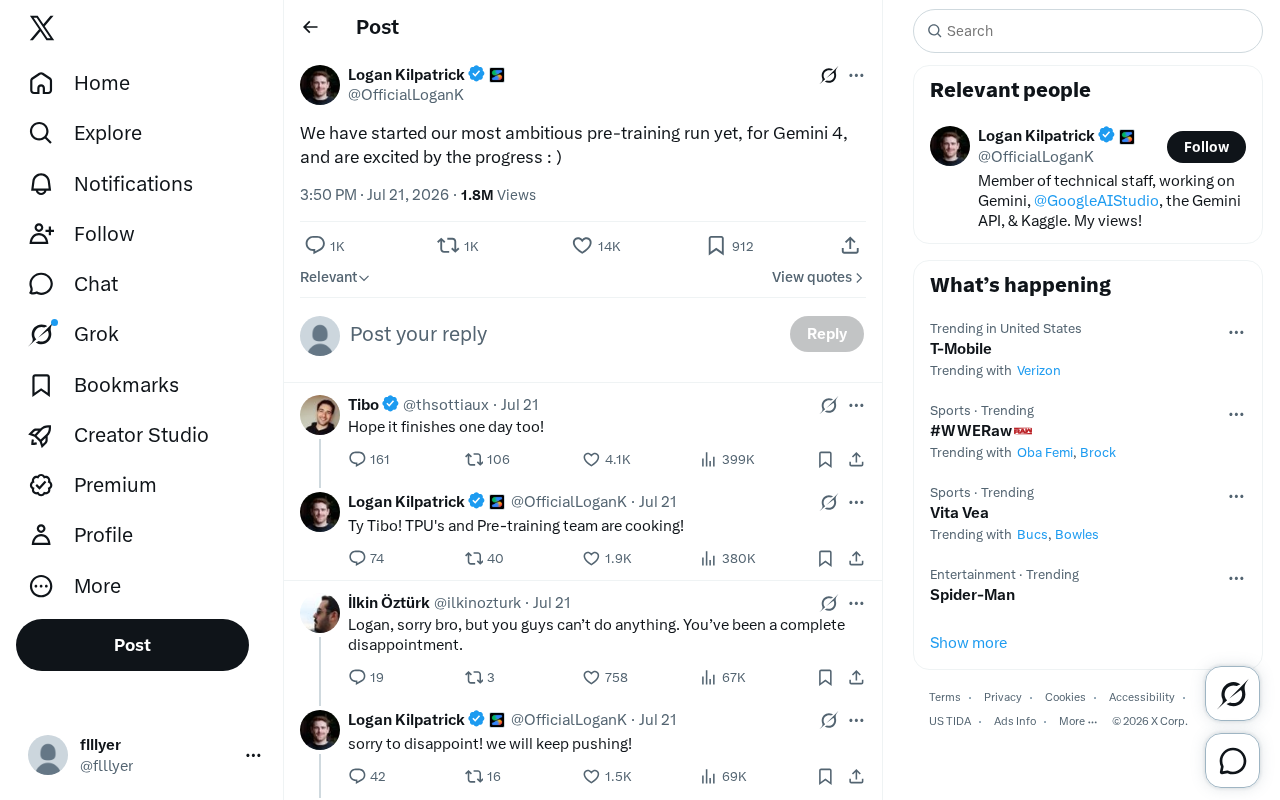
Google Launches Gemini 4 Pre-training: Its Most Ambitious AI Model Training Yet
Google DeepMind announces Gemini 4 pre-training has begun, calling it their most ambitious training yet. A deep dive into its technical direction, compute scale, multimodal breakthroughs, and competitive impact.
Read more →