#Claude Code
4727 related articles
 Expert Opinions
·2 min
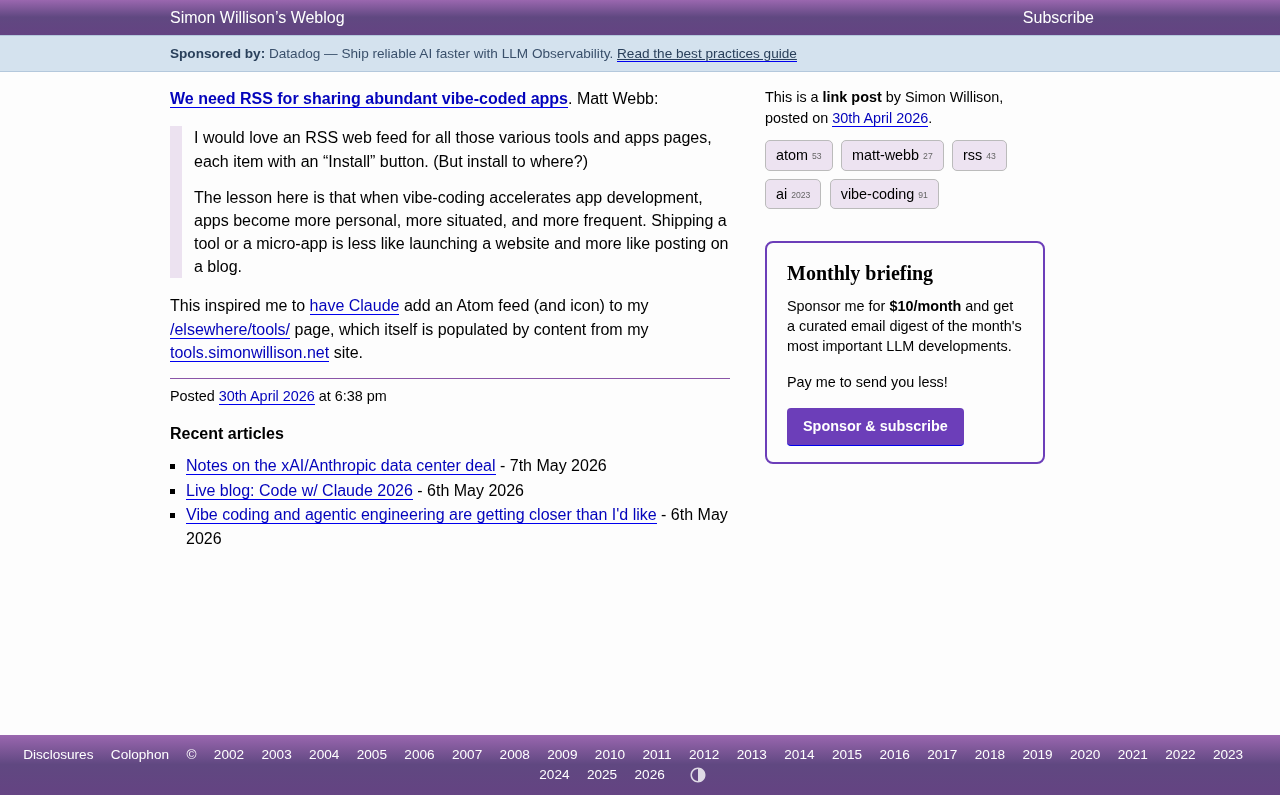
In the Vibe Coding Era, Why RSS Is the Best Solution for Sharing Personal Apps
Vibe Coding makes building apps as easy as blogging, but how are these personal micro-apps discovered? Matt Webb proposes RSS for distributing vibe-coded apps, and Simon Willison has already implemented it.
Read more →
 Tech Frontiers
·3 min
LLM 0.32 Refactoring Explained: How Message Sequences and Streaming Chunks Are Reshaping This Python LLM Library
Simon Willison releases LLM library 0.32 alpha with message sequences and typed streaming chunks, replacing the old text-in-text-out model to fully support multi-turn dialogue, multimodal output, and tool calling.
Read more →
 Product Reviews
·4 min
Chatbox Open-Source AI Client In-Depth Review: A Cross-Platform Desktop Tool for Multi-Model Aggregation
In-depth review of Chatbox, an open-source AI client supporting unified access to GPT-4, Claude, Gemini and more. Covers core features, tech architecture, and comparisons with alternatives.
Read more →
 Product Reviews
·3 min
LibreChat: An Open-Source AI Chat Platform Integrating GPT-5/Claude/Gemini
Deep dive into LibreChat, an open-source self-hosted AI chat platform supporting GPT-5, Claude, Gemini, and more. Covers MCP protocol, AI Agents, code interpreter, Docker deployment, and enterprise use cases.
Read more →
 Product Reviews
·3 min
TalkToFigma MCP: An Open-Source Tool That Lets AI Directly Manipulate Figma Designs
TalkToFigma is an open-source MCP tool that lets AI agents like Cursor and Claude Code directly read and modify Figma designs. Supports design-to-code, batch styling, and design system maintenance.
Read more →
 Product Reviews
·3 min
CC-Connect: The Open-Source Tool That Bridges Local AI Coding Assistants to Feishu, DingTalk, and Other IM Platforms
CC-Connect is an open-source Go tool that bridges local AI coding assistants like Claude Code and Cursor to Feishu, DingTalk, Slack, and other IM platforms. No public IP needed. 7,500+ GitHub Stars.
Read more →
 Product Reviews
·3 min
claude-skills: 232+ Skill Plugins That Transform AI Coding Agents into Full-Stack Experts
claude-skills offers 232+ skill plugins for 12 AI coding agents including Claude Code, Cursor, and Gemini CLI. With 14K GitHub Stars, it covers engineering, marketing, product, and compliance.
Read more →
 Product Reviews
·3 min
Figma-Context-MCP: The Open-Source Tool That Lets Cursor Understand Figma Designs
Figma-Context-MCP is an open-source MCP server that injects Figma design data into AI coding assistants like Cursor, enabling precise design-to-code conversion. 14,000+ GitHub Stars.
Read more →
 Product Reviews
·3 min
The Complete Guide to AnythingLLM: A Privacy-First AI Tool with 60K Stars on GitHub
In-depth guide to AnythingLLM, a privacy-first open-source AI tool covering local deployment, RAG document chat, multi-model support, and more for building a secure private AI workbench.
Read more →
 Product Reviews
·3 min
Chatbox Open-Source AI Client: A Complete Review of This Cross-Platform Desktop Tool with Multi-Model Support
In-depth review of Chatbox, an open-source AI client supporting GPT-4, Claude, Gemini and more. Covers core features, technical architecture, use cases, and comparisons with similar tools.
Read more →
 Product Reviews
·4 min
LibreChat: A Complete Guide to the Open-Source Multi-Model AI Chat Platform
In-depth guide to LibreChat, an open-source AI chat platform covering multi-model aggregation, MCP protocol, Agents, code interpreter, deployment tutorials, and comparisons with alternatives.
Read more →
 Product Reviews
·3 min
The Complete DeepSeek API Integration Ecosystem: Deep Dive into a 37K-Star Open Source Project
Deep analysis of DeepSeek's official awesome-deepseek-integration project with 37K GitHub stars. Covers IDE tools, chat clients, knowledge management, and Agent frameworks in the DeepSeek API ecosystem.
Read more →
 Product Reviews
·5 min
awesome-LLM-resources: A Deep Dive into GitHub's 8K-Star Comprehensive LLM Resource Repository
Deep analysis of the GitHub project awesome-LLM-resources covering LLM training, inference, Agent, MCP, multimodal, small language models, o1 reasoning and more — an 8200+ Star one-stop LLM resource guide.
Read more →
 Product Reviews
·3 min
Serena MCP Toolkit: The Open-Source Powerhouse Giving AI Agents IDE-Level Programming Capabilities
A comprehensive look at Serena MCP toolkit's core capabilities including semantic retrieval, AST-level code editing, and agentic coding support. Discover how this 23,800+ star open-source project gives AI Agents IDE-level code understanding.
Read more →
 Expert Opinions
·2 min
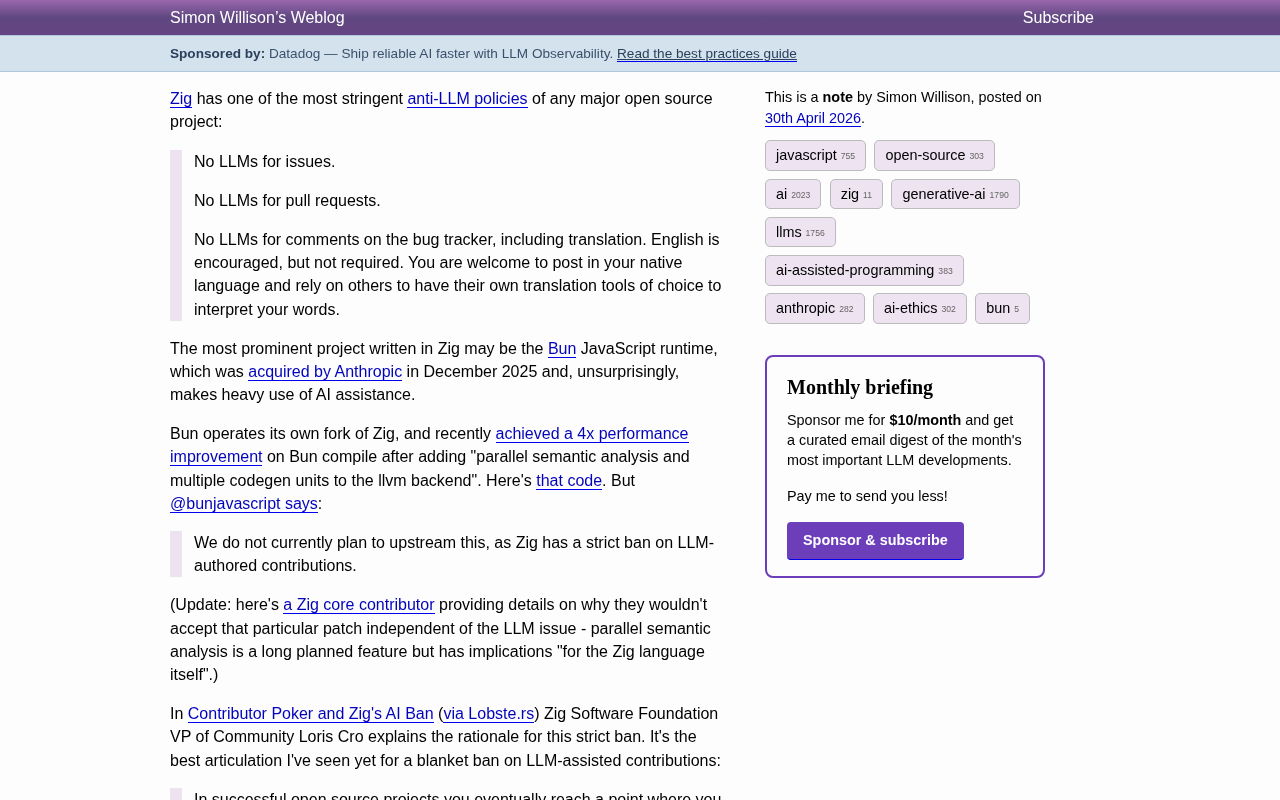
Why Zig Completely Bans AI Contributions: An Open Source Philosophy of Investing in People, Not Code
Zig enforces the strictest anti-LLM policy in open source, banning all AI-generated PRs and Issues. Its "Contributor Poker" philosophy invests in people over code output.
Read more →
 Expert Opinions
·5 min
In the Age of Vibe Coding, How Does RSS Become the Best Distribution Solution for Personal Micro-Apps?
Vibe Coding makes building apps as simple as blogging, but how to distribute the flood of micro-apps? Matt Webb proposes RSS as the ideal protocol for sharing vibe-coded tools. Deep analysis inside.
Read more →
 Deep Dives
·2 min
LLM 0.32 Refactoring Deep Dive: Message Sequences and Multimodal Streaming Event Design
Deep dive into LLM 0.32a0 alpha: a major refactoring from text conversations to message sequences and typed streaming events, supporting multimodal output, tool calls, and flexible serialization.
Read more →
 Tech Frontiers
·2 min
LLM CLI Tool 0.32a1 Released: Fixes Tool-Calling Conversation Storage and Restoration Bug
Simon Willison releases LLM CLI tool 0.32a1 alpha, fixing a critical bug where tool-calling conversations couldn't be correctly restored from SQLite, ensuring data integrity in AI Agent workflows.
Read more →
 Tech Frontiers
·3 min
LLM 0.32 Refactoring Explained: Message Sequence API and Typed Streaming Responses
Deep dive into Simon Willison's LLM Python library 0.32 refactoring: new message sequence API, typed streaming responses, and universal serialization for multimodal AI and tool calling.
Read more →
 Expert Opinions
·2 min
In the Vibe Coding Era, Share Your AI-Built Personal Apps via RSS
Vibe coding makes building apps as simple as blogging. Matt Webb proposes using RSS to distribute vibe-coded micro-apps, and Simon Willison puts it into practice. Exploring open protocols' new potential in the AI programming era.
Read more →