#DDD
30 related articles

·2 min
Vibe Coding Beginner's Guide: A Complete Learning Path to Master AI Programming from Scratch
A deep dive into the Vibe Coding learning path covering Cursor, Claude Code, Codex and more—from foundational AI programming thinking to hands-on projects for complete beginners.
Read more →

·3 min
Yadda 3.0: A New BDD Testing Paradigm for the AI Agent Era
Explore how Yadda 3.0 combines BDD with AI Agents, using natural language test specs as human-AI acceptance contracts and redefining BDD's role in the AI era.
Read more →

·3 min
Java Backend to AI: A Practical Guide to Multi-Agent Collaboration with Spring AI
How can Java backend engineers transition to AI Agent development? This guide covers the evolution from Chat to Agentic AI, ReAct decision-making, MCP tool calling, and multi-Agent orchestration with Spring AI.
Read more →

·3 min
Object Identity in Software: Core Principles of Interface, ECS, and Component Design
Exploring the core principle of separating object identity from representation in software design, covering interfaces, ECS, DDD, and distributed systems.
Read more →

·3 min
Domain Event Modeling: Redesigning Business Systems Through the Separation of Facts and Reactions
Explore Domain Events modeling: how separating facts from reactions reduces coupling, improves extensibility, with practical implementation advice and DDD community debates.
Read more →

·4 min
Burning Through 80 Billion Tokens: Why Vibe Coding Is Doomed to Fail
A creator spent 40 days and 80 billion tokens testing the real limits of Vibe Coding. This article dissects why AI programming crashes in production: complexity, context limits, and compression loss.
Read more →

·3 min
Enterprise Long-Running Agent Engineering: A Complete Guide from Demo to Production
A deep dive into enterprise Agent engineering: long-running execution, HITL safety approvals, and event sourcing — with two real-world commercial projects for content ops and SRE.
Read more →

·5 min
AI Coding Getting Worse With Every Edit? Skills v1.1 Reveals the Real Cause and Solution
AI code getting messier with edits? The root cause isn't weak model capability but a lack of context and process. A deep dive into Matt Pocock's Skills v1.1: grilling, vertical-slice tickets, TDD, and WebFinder.
Read more →

·3 min
Code Written for Humans: Maintainability Is the Core of Software Development
Code is read far more than it's written. This article explores the core principles of maintainability — clarity, naming, consistency, and how to evaluate AI-generated code quality.
Read more →

·3 min
Programs as Data Flow: Rethinking Architecture Paradigms Through Building a 3D Editor in C++
A developer builds a 3D editor from scratch in C++, modeling programs as dataflow graphs rather than object collections. Exploring dataflow vs. OOP, Greenspun's Tenth Rule, and the debugging dividend of visual programming.
Read more →

·6 min
Escaping AI Agent Skill Hell: A Complete 4-Step Guide to Writing High-Quality Skills
Matt Pocock's 4-step framework for AI Agent Skill design: Trigger, Structure, Steering, Pruning. Escape skill hell, tell good skills from bad, and master leading words to make Agents follow your intent.
Read more →

·6 min
Escaping AI Agent Skill Hell: A Complete 4-Step Guide to Writing High-Quality Skills
Matt Pocock's 4-step framework for AI Agent Skill design: Trigger, Structure, Steering, Pruning. Escape skill hell and learn to write high-quality skills.
Read more →

·2 min
OpenCQRS 2.0: Write Tests in Business Domain Language and Let the Code Speak for Itself
OpenCQRS 2.0 introduces a testing DSL that aligns with business domain language. Explore how Given-When-Then maps to CQRS/Event Sourcing and enables living documentation.
Read more →

·4 min
Deep Dive: How Palantir Agents Interact with the Ontology
A deep dive into Palantir's five-layer Agent-Ontology architecture: how Context, Query, Logic, Action, and Governance layers work together to enable governed enterprise AI Agents, with a live demo.
Read more →

·3 min
Deep Module Architecture in Practice: Fixing a Codebase Wrecked by AI
Is AI-assisted coding making your codebase messier? Learn deep modules, seams, and adapters from A Philosophy of Software Design to systematically fix your architecture.
Read more →

·4 min
Claude Code Workflow in Practice: From Requirement Grilling to AFK Agent Auto-Coding
A detailed walkthrough of building real features with Claude Code: Grill Me requirement interrogation, auto-generated PRDs, AFK agent coding, and QA iteration loops with DDD and TDD strategies.
Read more →

·4 min
The Complete AI Agent Engineering Tech Stack: A Practical Guide to 100x Development Efficiency
Deep dive into the AI agent engineering stack: from Cursor framework, model selection to context engineering and automated review loops — a complete workflow guide to achieving 100x development efficiency.
Read more →
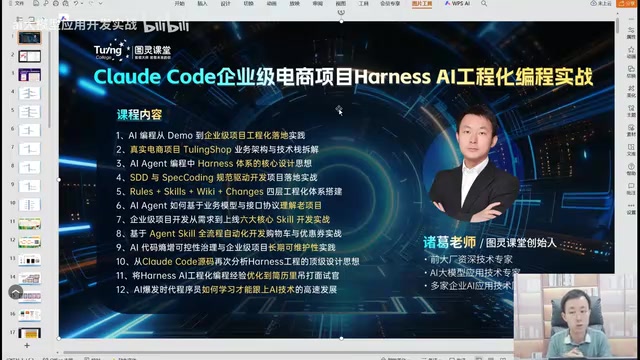
·3 min
Harness AI Engineering Programming: A Detailed Methodology for Enterprise-Level Project Development
Deep dive into Harness AI Engineering Programming methodology, covering SDD, Skill development patterns, and core practices for enterprise-level AI-assisted development.
Read more →

·3 min
OpenAI Codex Deep Dive: Core Capabilities and Engineering Best Practices Guide
Deep dive into OpenAI Codex's core capabilities including multi-task parallelism, Agent Loop mechanism, and Specification-Driven Development (SDD), with learning resources and advanced paths for mastering AI programming workflows.
Read more →

·3 min
Multi-Model Unified Orchestration Framework: Runtime Dynamic Switching Across Eight AI Services in Practice
Deep dive into a runtime AI chatbot integrator architecture covering unified orchestration of OpenAI, Claude, DeepSeek text models and 11Labs, Azure TTS services with latency testing and streaming synthesis.
Read more →