#Deterministic Attention Transformer
152 related articles

·3 min
Running the 1.56TB Kimi K3 Model on 8GB RAM with Pure C
A developer built a pure C99 inference engine that runs the 1.56TB Kimi K3 model on 8GB RAM using MoE sparsity and NVMe on-demand loading—no GPU, 176KB binary.
Read more →

·3 min
GPT-5.6 Sol Self-Optimization in Practice: How AI Cuts Its Own Costs and Boosts Its Own Efficiency
GPT-5.6 Sol achieves 20% GPU serving cost reduction and 15%+ token generation efficiency gains through self-optimization. A deep dive into AI recursive efficiency improvement.
Read more →

·3 min
Deep Dive into Gemini Robotics ER 2: Breakthroughs in Video Understanding and Multi-Robot Collaboration
Deep analysis of Google Gemini Robotics ER 2's three core breakthroughs: video understanding, tool orchestration, and multi-robot collaboration, exploring how embodied reasoning drives robots from passive execution to autonomous intelligence.
Read more →

·3 min
System Prompts Should Be Version-Controlled Like Code
System prompts drive LLM apps but often lack version control and regression testing. Learn how to manage them with versioning, structured separation, testing, and code review.
Read more →

·4 min
Cracking TSP: A Closure Theory for Identifying Critical "Exception Edges"
Exploring a mathematically precise definition of "exception edges" in TSP, using closure problem theory to identify critical non-local edges that determine optimal solutions, providing verifiable structural priors for RL and NCO solvers.
Read more →

·2 min
PlayingFild: A Smart Tab Management Chrome Extension Based on Page Content
PlayingFild is a Chrome extension that uses on-device ML to intelligently classify tabs by page content, separating work from leisure with focus timers, idle tab cleanup, and productivity analytics.
Read more →

·2 min
What to Do When AI Won't Listen? Understanding Why Models Go Off-Track and Practical Fixes
AI keeps giving irrelevant answers? This article explains the technical reasons behind AI "misbehavior" and provides practical tips including prompt optimization, system constraints, and conversation resets.
Read more →

·2 min
What to Do When AI Won't Listen? Understanding Why Models Go Off-Track and Practical Fixes
AI responses keep missing the mark? This article explains why AI models go off-track from a technical perspective and provides practical correction techniques including prompt optimization, system constraints, and conversation resets.
Read more →

·4 min
AI Agent Memory Systems: Genuine Technical Progress or RAG in Disguise?
In-depth analysis of AI agent memory systems: examining whether current improvements represent real progress or just RAG repackaged, and what architectural changes are truly needed.
Read more →

·3 min
TokenTown: A Visual Approach to Understanding How LLMs Predict the Next Token
TokenTown is an open-source visualization project that intuitively presents the internal token prediction process of LLMs using a town metaphor. Learn its design philosophy and educational value.
Read more →

·3 min
Long Documents Don't Work: Why AI Agents Can't Follow Your Rules
Analysis of why AI Agents can't reliably follow long policy documents, covering context dilution, rule conflicts, and soft constraint limitations, with more reliable governance architectures.
Read more →

·4 min
Transitioning from DevOps to MLOps: A Complete Learning Roadmap
How can DevOps engineers efficiently transition to MLOps? This guide covers MLOps core concepts, standard workflows, essential tools, and Azure practices with a progressive learning roadmap.
Read more →

·4 min
LangChain Guardrails Explained: Building Safe and Controllable AI Agents
A detailed guide to LangChain Guardrails covering layered ecosystem architecture, middleware implementation, deterministic and model-driven protection for building production-grade secure AI Agents.
Read more →

·5 min
Learn AI Agent Development from Scratch: A 3-Step Practical Path to Get Started Quickly
How to learn AI Agent development from scratch? This article outlines a clear 3-step path: Python crash course, LLM theory & practice, and LangChain framework project implementation.
Read more →

·4 min
GPT-5.6 Value Maxing Practical Guide: From Token Stacking to Output Optimization Methodology
Deep dive into OpenAI GPT-5.6 Value Maxing strategies covering Sol/Terra/Luna model selection, KV cache optimization, Prompt compression, and programmatic tool calling to help developers achieve more output with fewer Tokens.
Read more →

·2 min
Gemini Always Crashes on the 16th Turn? Error 1076 Root Cause Analysis and Workarounds
Google's Gemini consistently triggers Error 1076 on the 16th conversation turn, regardless of context size. Analysis points to a session state management defect, with three workarounds provided.
Read more →

·3 min
Three Essential Hard Skills Traditional Product Managers Need to Transition into AI PM
How can traditional product managers transition to AI PM? This article analyzes the essential differences and details three must-have skills: AI product cognition, advanced Prompt engineering, and large model technical logic.
Read more →

·3 min
Deconstructing Agents: Task Decomposition, Context Compression, and the Case Against Heavy Frameworks
A deep engineering analysis of Agent internals: how LLMs decompose tasks via tool calling, why context compression and memory are essential, and why solo developers should avoid heavy frameworks.
Read more →
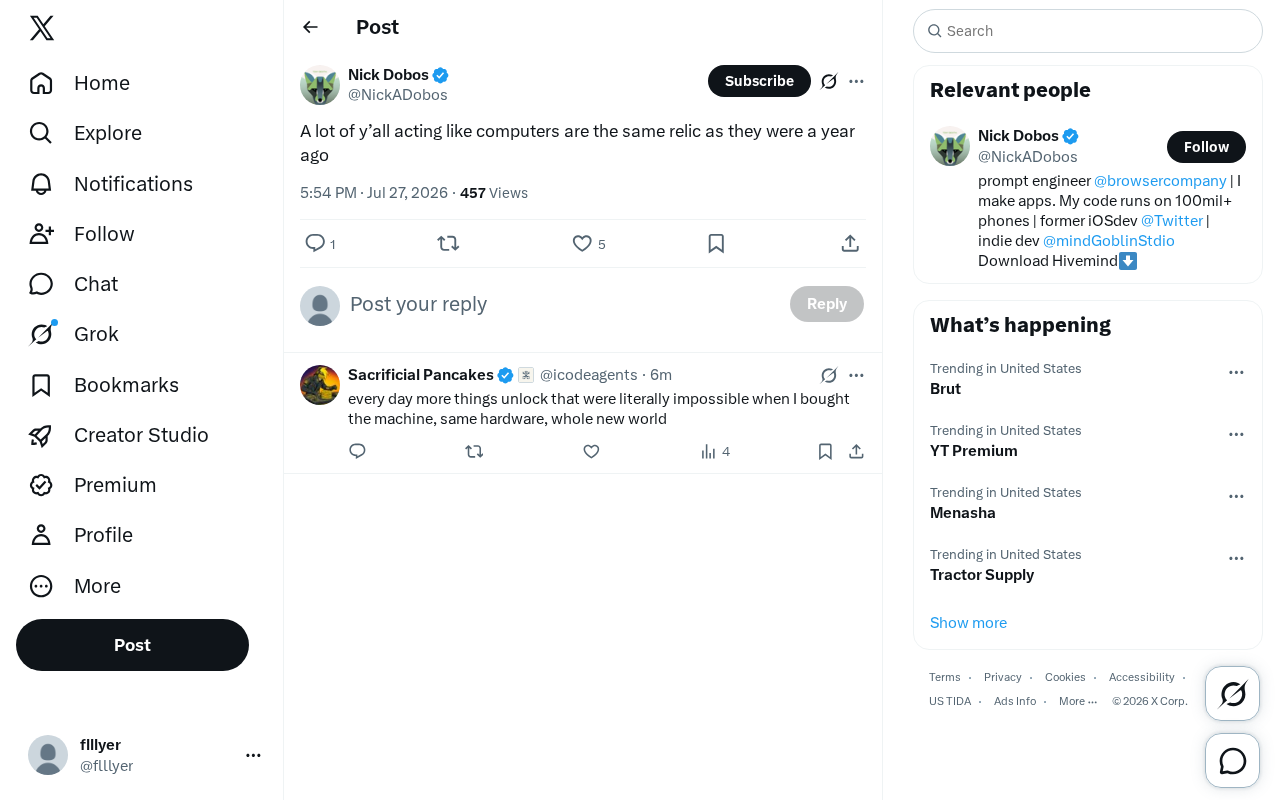
·3 min
The Computer Is Being Redefined in the AI Era — Has Your Understanding Kept Up?
Generative AI is profoundly redefining the personal computer — from passive tool to intelligent collaborator. This article examines the core shifts of the AI PC era and the productivity gap created by cognitive lag.
Read more →

·3 min
Gemini Can Generate a PDF One Moment but Claims It Can't the Next? Here's Why
Analysis of why Gemini and other AI LLMs exhibit capability drift, including tool-calling mechanisms, context window limits, and safety policy triggers, plus practical strategies for PDF generation failures.
Read more →