#FIRST Robotics
145 related articles

·3 min
U.S. Ban Targets Chinese Humanoid Robots: A New Front in the AI Race
Analysis of the U.S. ban on Chinese humanoid robots: data security concerns, industrial protection motives, and how the AI race extends into Physical AI and robotics hardware.
Read more →

·3 min
U.S. Ban on Chinese Humanoid Robots: A New Front in the AI Race
Analysis of the U.S. ban on Chinese humanoid robots: data security concerns, industrial protection motives, and how the AI race extends into Physical AI and robotics hardware.
Read more →

·2 min
Transformer²: Achieving Co-Design of Robot Morphology and Control with a Unified Architecture
Deep dive into how Transformer² uses a unified Transformer architecture to integrate robot morphology design and motion control into one model, enabling task-driven end-to-end co-design for embodied AI.
Read more →

·4 min
GPT-6 Reportedly Completed, Claude Opus 5 Leaked: The AI Model Race Accelerates
GPT-6 may be completed, Anthropic's Claude Honeycomb appears to be an early Opus 5 version, Kimi K3 is imminent, and Google Gemini faces further delays. Deep analysis of the latest AI model competition.
Read more →

·4 min
GPT-6 Reportedly Completed, Claude Opus 5 Leaked: The AI Model Race Accelerates
GPT-6 may be complete, Anthropic's mysterious Claude Honeycomb appears to be an early Opus 5 version, Kimi K3 is imminent, and Google Gemini continues to delay. Deep analysis of the latest AI model competition.
Read more →

·5 min
Open-Source STEM Education Robot: Smart Ball-Fetching Interaction Powered by Edge AI Object Detection
An open-source STEM education robot using Edge Impulse edge AI for local object detection, teaching kids computer vision and ML through an engaging ball-fetching game with anthropomorphic design.
Read more →
·3 min
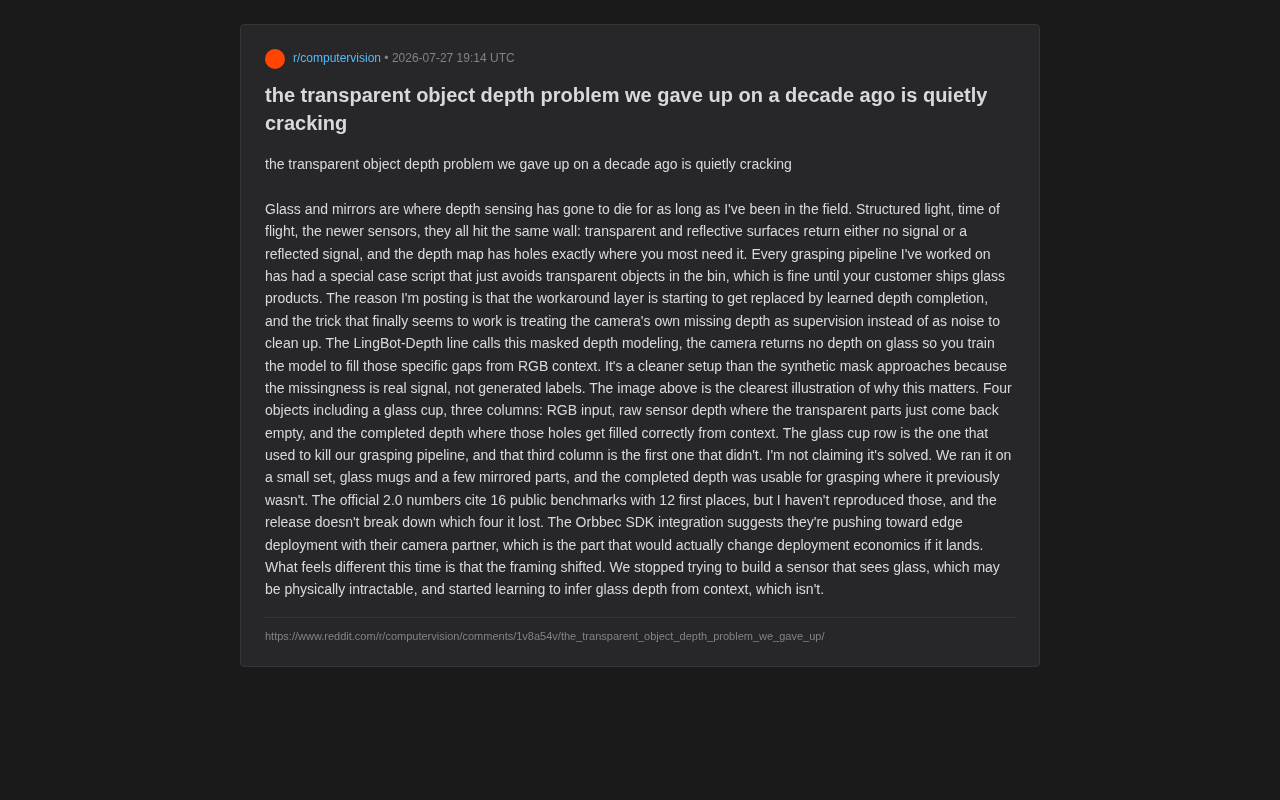
The Depth Perception Challenge for Transparent Objects: How LingBot-Depth Breaks Through with Masked Depth Modeling
Depth perception for transparent and reflective objects has long been a core challenge in robotic grasping. LingBot-Depth uses masked depth modeling to turn sensor failure into supervisory signals, inferring glass depth from RGB context.
Read more →
·3 min
The Depth Perception Challenge for Transparent Objects: How LingBot-Depth Breaks Through with Masked Depth Modeling
Transparent and reflective object depth perception is a core challenge in robotic grasping. LingBot-Depth uses masked depth modeling to turn sensor failure into supervision, inferring glass depth from RGB context.
Read more →
·3 min
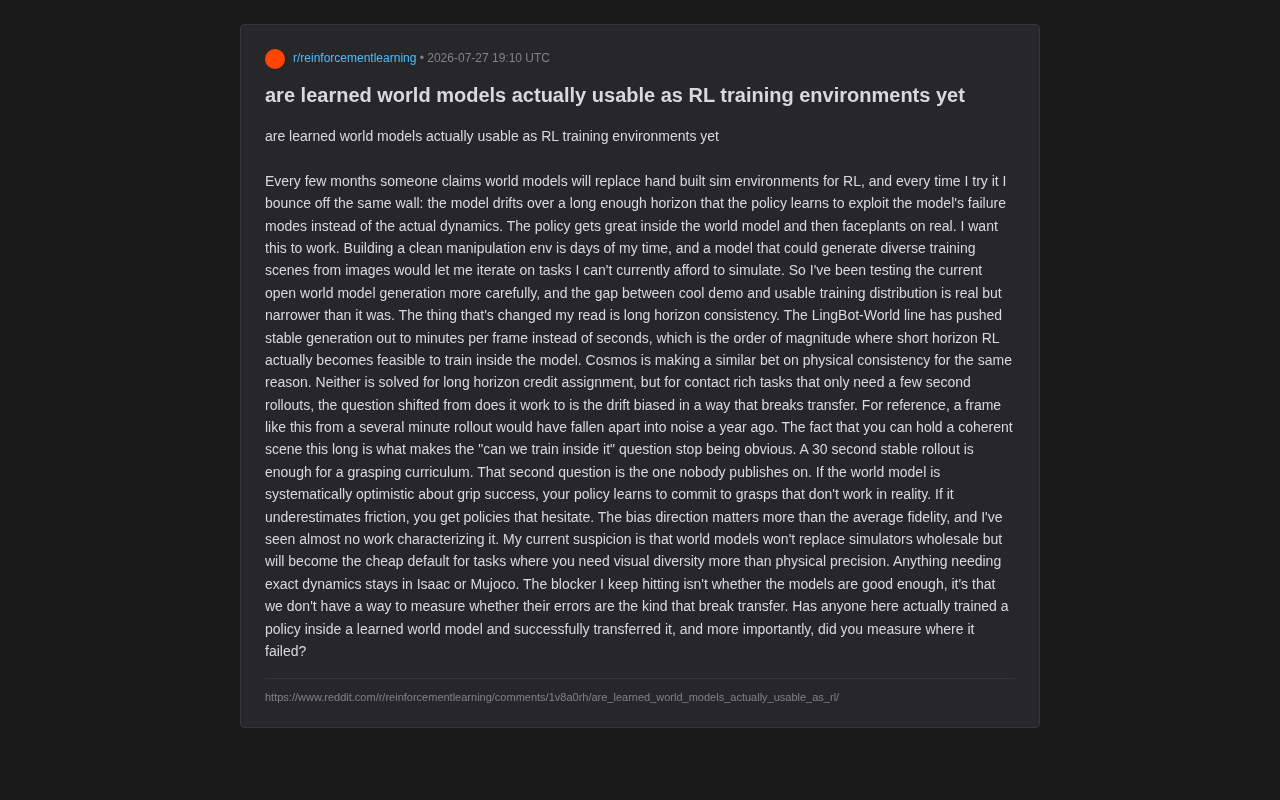
Can World Models Replace RL Training Environments? The Key Lies in the Direction of Error Bias
Analysis of world models as RL training environments: long-horizon consistency progress, how systematic error bias poisons policy transfer, and the emerging division of labor with traditional simulators.
Read more →

·4 min
15-Year-Old DIY Maker Builds High-Torque Precision Joint: $200 vs. $2000 Industrial-Grade
A 15-year-old maker builds a robotic arm shoulder joint for $200 using timing belts, cycloidal drive, and capstan drive with 480:1 total reduction, challenging $2000 industrial joints.
Read more →

·3 min
How Student Robotics Programs Are Igniting Passion for Future Manufacturing Careers
How student robotics programs use CAD, computer vision, CNC machining, and full tech stacks to spark youth interest in manufacturing and automation careers, bridging STEM education and industry needs.
Read more →

·4 min
15-Year-Old DIY Maker Builds High-Torque Precision Joint: $200 vs. $2,000 Industrial-Grade
A 15-year-old maker built a $200 robotic arm shoulder joint using a multi-stage reduction drivetrain (timing belt + cycloidal drive + capstan drive) with a 480:1 ratio, challenging $2,000 industrial joints.
Read more →

·4 min
Robot Valet Parking at Gatwick Airport: How the AGV Automated Parking System Works
London Gatwick launches UK's first robot valet parking using AGV technology, boosting parking capacity by 30-60%. Learn how the system works, its challenges, and the business case for automated parking.
Read more →

·7 min
DIY Companion Robot: Building Your AI Desktop Buddy with Jetson Orin
A maker builds a DIY companion robot with NVIDIA Jetson Orin and 4S LiPo battery. Explore the full development journey from first power-up to AI interaction, including edge computing, power design, and companion robot trends.
Read more →

·2 min
GPT-5.6 Goes Live with Dual Quota Reset as AI Models Update Rapidly
GPT-5.6 fully launches with enhanced coding, computer operation, and long-horizon agent tasks, plus a dual quota reset. Meanwhile, ByteDance opens its C-Dance 2.5 API and Mistral debuts a single-RGB-camera natural language navigation model.
Read more →

·3 min
A Practical Guide for Java Developers Transitioning to AI Application Development
Facing the AI wave, how can Java developers transition from traditional CRUD backend work to AI application development? This article breaks down the AI+ national strategy, China's AI catch-up logic, and offers a practical path.
Read more →

·5 min
DeepSeek's Five-Step Ladder to AGI: A Restrained Roadmap Built on Twenty Thousand GPUs
DeepSeek founder Liang Wenfeng reveals a five-step AGI roadmap from chain-of-thought to embodied intelligence. How does TileLang crack domestic GPU substitution under a 20,000-card constraint?
Read more →

·5 min
DeepSeek's Five-Step Ladder to AGI: A Restrained Roadmap Built on 20,000 GPUs
DeepSeek founder Liang Wenfeng reveals a five-step AGI roadmap—from chain-of-thought to embodied intelligence—under a 20,000-GPU constraint, using the TileLang compiler to break domestic substitution challenges while API cash flow backs AGI exploration.
Read more →
·6 min
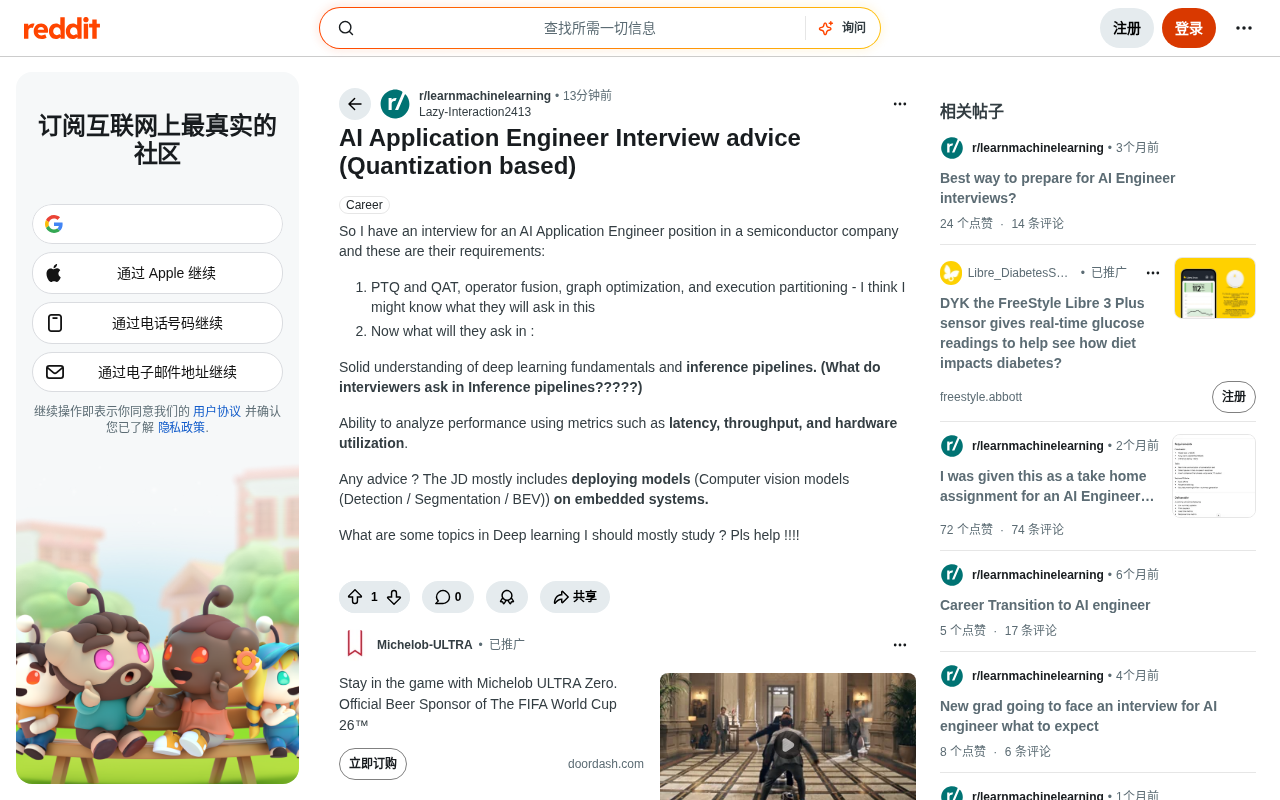
AI Application Engineer Interview Guide: Core Topics in Model Quantization and Inference Deployment
A systematic review of must-know topics for AI Application Engineer interviews: PTQ/QAT quantization, operator fusion, inference pipelines, latency/throughput analysis, and edge deployment of detection/segmentation/BEV models.
Read more →
·6 min
AI Application Engineer Interview Guide: Core Topics on Model Quantization and Inference Deployment
A systematic guide to must-know AI application engineer interview topics: PTQ/QAT quantization, operator fusion, inference pipelines, latency/throughput analysis, and edge deployment of detection/segmentation/BEV models.
Read more →