A Practical Guide for Java Developers Transitioning to AI Application Development

A practical guide for Java developers to transition from CRUD backend work to AI application development.
As AI reshapes technology and entrepreneurship, Java developers face pressure to move beyond routine CRUD work. This article explores the AI+ national strategy, China's AI catch-up driven by DeepSeek, and offers a concrete transformation path—solidifying backend fundamentals while mastering prompt engineering, RAG, and Agents.
Introduction: An Approaching Era of Opportunity
If you're a Java developer who has spent three to five years doing CRUD (Create, Read, Update, Delete) business logic, you might have recently been wrestling with a question: Is it still worth digging deeper into traditional web development? The answer is that you need a transformation—upgrading from a "backend code laborer" to an "AI application developer."
It's worth first clarifying what CRUD actually means. CRUD is the acronym for Create, Read, Update, and Delete—the four basic database operations—representing the most fundamental data management logic in enterprise applications. The vast majority of traditional web systems—from e-commerce backends to management systems—are essentially wrappers around these four types of operations on database tables. Taking the Java ecosystem as an example, developers typically build this workflow around Spring Boot, MyBatis, and MySQL, with highly patterned work content. Precisely because the pattern is fixed and the barrier to entry is relatively manageable, such positions have been in high demand over the past decade, cultivating a large pool of "backend code laborers." But as low-code platforms, code generation tools, and even AI coding assistants have matured, pure CRUD work is being rapidly standardized and automated, and the premium for relying solely on these skills is shrinking. This is precisely the technical backdrop for transformation: it's not about dismissing backend fundamentals, but about upgrading them into a foundation that can carry higher-value AI capabilities.
This isn't just a matter of personal career choice—it's an opportunity to ride the wave of the times. There's an interesting angle for observation: each year, the sponsors of the Spring Festival Gala often foreshadow the current emerging trend. In earlier years it was internet companies, food and beverage brands, but in the past couple of years, AI products like "Doubao" have appeared among the sponsors—this itself is a signal: AI has moved from being a topic within tech circles into the mainstream consumer view.
Facing the New Wave, Your Attitude Determines Your Opportunity
Toward any new thing, people generally fall into three types of attitudes: resistance, skepticism, and embrace.
Many people's first reaction to AI is skepticism: "This thing must have a bunch of flaws" or "I'll wait and see after others have used it." It seems clear-headed, but in reality, opportunities often quietly slip away during this kind of "hesitant wait-and-see." An even worse attitude is complete resistance—if you reject it from the very start, then even if there's an opportunity hidden within, it's destined to have nothing to do with you.

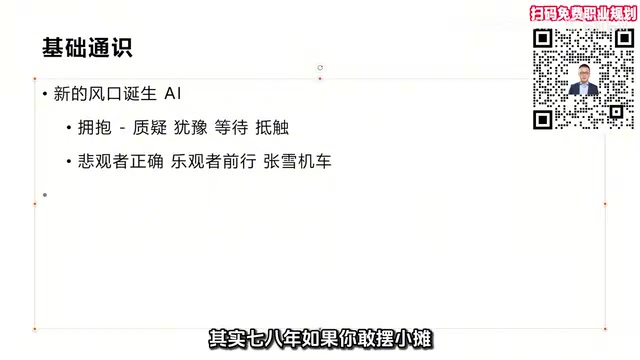
There's a saying worth savoring repeatedly: Pessimists are often right, but optimists are the ones who move forward. In the process of moving forward, optimists may make mistakes, fall into pits, and get battered and bruised—but only they can truly seize opportunities. Everything has two sides—stare only at the flaws and the opportunity slips away; view it dialectically, and you can find your place amid the chaos.
Facing the AI wave, the correct posture should be: actively embrace it, absorb it critically. New things inevitably come with various problems in their early stages, but precisely because there are problems and some people don't dare to jump in, this is the window of opportunity left for you.
AI Plus Everything: This Is Not a Small Tool
Why do we say AI is a "big wave" rather than an ordinary technological iteration?
Looking back at history, our society experiences a wave of opportunity every so often: those who dared to set up street stalls in the late 1970s and dared to run small factories in the 1980s pulled ahead of those around them; later came the internet and real estate. And today, this wind is AI.
Some say AI is still far from changing our lives—that's certainly true, disruption won't happen overnight. But the trend is already set. From robots joining battles and AI participating in warfare, to how we increasingly get used to asking AI directly rather than searching Baidu in daily work; from postal self-driving vehicles on the streets to unmanned mining trucks automating excavation sites (driving themselves, loading themselves, transporting themselves, saving substantial driver costs)—AI is subtly permeating every industry.
So please don't simply view AI as just another "technical tool like the Spring framework." It's on a completely different order of magnitude from a framework—it's something that will disrupt everything.
The "AI+" Initiative at the National Strategy Level
From a policy perspective, AI's status has already been elevated to the level of national strategy. On August 26, 2025, the State Council issued the "Opinions on Deeply Implementing the 'Artificial Intelligence+' Initiative."
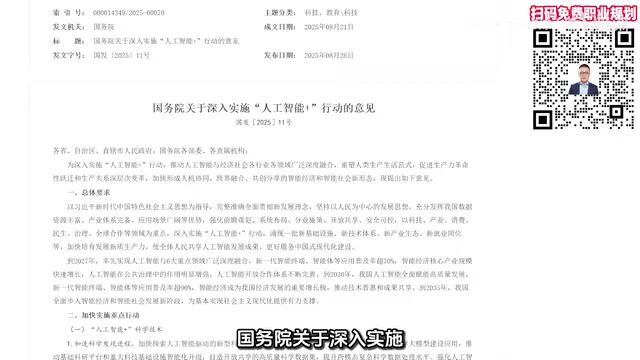
The scope covered by "Artificial Intelligence+" in the document is extremely broad:
- Science and Technology: AI is already widely applied in the medical field
- Industrial Development: robotics, smart manufacturing
- Transportation and Logistics: autonomous driving, intelligent scheduling
- Information and Finance: AI risk control, robo-advisors
- Consumer Systems: an increasing number of consumer products with AI concepts
- People's Livelihood and Governance Capacity: AI traffic managers; some city government service windows have already introduced AI receptionists
For individuals, the most direct opportunity is the rise of the "one-person company." For example, Alibaba's latest AI product (launched first in English, targeting Alibaba International): as long as you have an idea to open an online store, just tell the AI, and it can automatically generate your store pages, product images, and layouts for you—all those tedious foundational setup tasks are completed automatically. Opportunities in the foreign trade field are equally vast.
Behind this "one-person company" phenomenon lies the trend of productivity democratization brought by AI. In the past, starting an online store or doing foreign trade required collaboration across multiple roles—graphic design, copywriting, page building, operations, and promotion—with high labor costs and a high startup barrier. But with AI e-commerce tools launched by companies like Alibaba and ByteDance, users only need to describe their needs in natural language, and the AI can automatically complete product image generation, page layout, multilingual copy translation, and even marketing material creation. This means individual developers or entrepreneurs can run an entire business workflow with an AI "team" at extremely low cost. This model has already become a trend in cross-border e-commerce, content creation, and indie hacker circles, confirming the earlier judgment: AI is not just a tool for improving efficiency—it's reshaping organizational forms and entrepreneurship barriers, opening a new path to independent monetization for developers who master AI application skills.
China's AI Catch-Up and the "Low-End Devours High-End" Logic
AI is also a commanding height in national competition. There was a time when we pessimistically believed China's AI lagged far behind the U.S.—that we could only trail behind others, eating dust, and could only buy their computing power and tokens in the future.
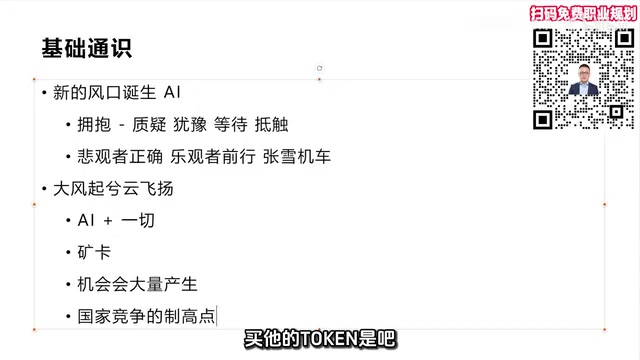
But ever since DeepSeek was born, China's AI has caught up strongly. DeepSeek is a series of large language models developed by a Chinese team, which drew global attention from late 2024 to early 2025 with DeepSeek-V3 and DeepSeek-R1. Its breakthrough lies in achieving reasoning capabilities close to or even partially surpassing the GPT-4 level at training costs far lower than comparable Western products, especially excelling in mathematics, coding, and logical reasoning tasks. DeepSeek also adopted an MoE (Mixture of Experts) architecture and a reinforcement-learning-driven reasoning training approach, opening up to the market through open source and low-priced APIs, directly lowering the industry's barrier for computing power and API-call costs. This event is regarded as a landmark moment because it shattered the pessimistic notion that "China's AI can only buy American computing power and tokens," verifying the feasibility of catching up through engineering and algorithmic innovation under conditions of limited computing power.
An interesting phenomenon: internationally, those "high-end" clients (enterprises willing to spend money and maintain long-term partnerships with Western companies) tend to procure the American stack; while clients who value cost, want to save money and still use AI, are increasingly procuring Chinese tokens and solutions.
Countless historical cases prove: the probability of the low-end devouring the high-end is far higher than the high-end devouring the low-end. We focus heavily on the broad market of "applications" and cost-sensitive customers, while the other side focuses on a small number of high-end clients. In this landscape, China's AI opportunities are actually greater.
Once the AI industry gains a solid foothold, it brings more than just technological dividends: cultural confidence will return, and cooperation opportunities with neighboring countries will increase. Even if you just use AI to create animation, make games, or go abroad to do Chinese-related business, you'll find that your standing and opportunities have grown considerably.
Transformation Advice for Java Developers
All things considered, whether from a technical perspective or from the standpoint of entrepreneurial opportunities for ordinary people, the opportunities AI brings far exceed those of the past. For a Java developer, the transformation path can be understood as follows:
1. Solidify Your Foundation, But Don't Stop at CRUD
Solid Java backend fundamentals (Spring, microservices, databases) remain the chassis, but you should treat them as a "carrier" for integrating AI capabilities, not the endpoint.
2. Fill the Gap in AI Application Development Skills
Learn how to integrate large models (whether domestic ones like DeepSeek and Doubao, or international models) into your business systems, and master application-layer skills like prompt engineering, RAG (retrieval-augmented generation), and Agents.
These three skills deserve further breakdown. Prompt engineering refers to techniques for guiding large models to produce more accurate results that better match expectations through carefully designed input instructions, including role setting, few-shot examples, and chain-of-thought guidance—it's the first threshold for integrating large models. RAG (Retrieval-Augmented Generation) solves the pain points of large models being "out of date" and "confidently spouting nonsense (hallucinations)"—it first retrieves relevant materials from an enterprise's private knowledge base or vector database, then feeds these materials as context to the model, thereby generating well-grounded answers. It's the most mainstream architecture for deploying enterprise-grade AI applications. Agents go a step further, giving large models the ability to plan tasks, call tools (such as querying databases, sending emails, and executing code), and make multi-step autonomous decisions—the key to "AI autonomously completing complex business tasks." The three build progressively upon one another, forming the core arsenal of an AI application developer.
3. Maintain a Critically Embracing Mindset
Toward the endless stream of AI books and tool information on the market, actively absorb it with a "there's benefit in every book you open" attitude, while maintaining independent thinking—neither blindly following nor rejecting.
4. View Opportunities from a Bigger Picture
Don't treat AI as an optional little tool. It's an underlying variable that will reshape ways of working, entrepreneurial models, and even the landscape of national competition. Only by viewing it from a higher dimension can you truly seize this wave of opportunity.
Conclusion: Attitude Determines Whether You Can Get On Board
When the great wind rises, the clouds fly high. The AI wave has arrived, and your attitude determines whether you can get on board. Embrace it, learn it critically, and combine traditional development skills with AI application skills—this is the survival strategy for Java developers to weather the cycles.
Key Takeaways
Related articles

LynnReal-Omni: 32B Unified Video Diffusion Model Goes Open Source with Multi-Task Coverage in Four Steps
LynnReal-Omni is a 32B unified video diffusion model on MiniMax H3, covering text-to-video, pose guidance, style transfer, restoration in 4 steps. Flash version generates 540p video in 377ms on one H100.

Anthropic Co-Founder: AI 'Kill Switch' May Need to Be Mandatory by Law
Anthropic's co-founder tells the BBC that AI 'kill switches' may need to be legally mandated. We analyze the industry logic, technical challenges, and the tension between regulation and innovation.

The AI Data Center Boom Is Colliding With Cities Scarred by Heavy Industry
The AI data center boom is clashing with post-industrial communities. Philadelphia's case reveals structural conflicts between AI growth, energy use, water, and environmental justice.