#LLM inference capacity
395 related articles

·3 min
Can Talking Like a Caveman Save 65% on Tokens? An In-Depth Analysis
Can caveman-style minimal prompts save 65% on Tokens? We analyze task quality, hidden cost transfers, and model robustness to reveal the right Token optimization strategies.
Read more →

·3 min
Can Talking Like a Caveman Save 65% on Tokens? An In-Depth Analysis
Can caveman-style minimal prompts save 65% on Tokens? We analyze task quality, hidden cost transfers, and model robustness to reveal the right Token optimization strategies.
Read more →

·3 min
LLM Inference Speed Formula: Memory Bandwidth Determines Your tokens/sec
Why memory bandwidth (GB/s), not VRAM size, determines local LLM inference speed. Includes tokens/sec formula, GPU bandwidth comparison, and a practical card selection framework.
Read more →

·3 min
LLM Inference Speed Formula: Memory Bandwidth Determines Your tokens/sec
Learn why memory bandwidth (GB/s)—not VRAM size—determines local LLM inference speed. Get the tokens/sec formula, GPU bandwidth comparisons, and a practical card selection hierarchy.
Read more →

·2 min
GPT-5.6 Released: Redefining the Price-Performance Boundary of AI Models
OpenAI releases GPT-5.6, targeting the price-performance frontier. Analysis of how architectural optimization and inference efficiency reduce costs, and how LLM competition shifts from capability to cost efficiency.
Read more →

·3 min
Jina v3 Matryoshka Embeddings in Practice: Cut Vector Storage Costs by 75%
Use Jina v3 Matryoshka embeddings to truncate 1024-dim vectors to 256-dim, cutting Pinecone storage costs by 75% while maintaining retrieval quality with task-specific LoRA adapters and circuit breakers.
Read more →

·3 min
Jina v3 Matryoshka Embeddings in Practice: Cut Vector Storage Costs by 75%
Use Jina v3's Matryoshka embeddings to truncate 1024-dim vectors to 256-dim, cutting Pinecone storage costs by 75%. Covers dimension truncation, task-specific LoRA adapters, and circuit breakers for reliable RAG systems.
Read more →

·2 min
Tackly: An AI-Powered Note Tool That Draws Mind Maps in Real Time, Designed for People with ADHD
Tackly is an AI-powered note tool that maps voice and text to 20 thought node types in real time, auto-generating visual mind maps. Designed for ADHD users, it supports meetings, voice memos, and text structuring.
Read more →

·2 min
Tackly: An AI-Powered Note Tool That Draws Mind Maps in Real Time, Designed for People with ADHD
Tackly is an AI-powered note tool that maps voice and text to 20 thought node types in real time, auto-generating visual mind maps. Designed for ADHD users, it supports meetings, voice memos, and text structuring.
Read more →

·3 min
Is LLM Inference Really That Expensive? Breaking Down the Cost Reduction Logic of GPU Compute and Inference Frameworks
Analyzing real LLM inference costs: from B200 GPU compute gains, vLLM framework optimization to MTP multi-token prediction, explaining why serving costs are widely overestimated.
Read more →

·3 min
Self-Hosting Kimi K3: Is Spending 20% More on Hardware Worth a 20% Improvement in Task Performance?
Analysis of whether spending 20% more on hardware for self-hosting Kimi K3 to gain 20% task performance improvement is worthwhile, covering inference precision, VRAM optimization, and tiered deployment.
Read more →

·3 min
AI Fact-Checking Tools Explained: How Agent Skills Automatically Detect Misinformation
Deep dive into how AI fact-checking tools like Bullshit Detector work, exploring how Agent Skills extract claims, retrieve evidence, and cross-validate to automatically detect online misinformation.
Read more →

·3 min
Is LLM Inference Actually Profitable? Breaking Down the Cost Structure and Business Logic of Large Model Inference
A deep dive into LLM inference cost structure and profitability models—from GPU throughput, MoE architecture, and KV Cache to scale effects—revealing the business logic behind API price wars.
Read more →

·2 min
AI Bubble Fears Intensify: The Logic Behind Chip Stocks Selling Off Across U.S. and Asian Markets
Chip stocks fall simultaneously across U.S. and Asian markets as AI bubble fears intensify. Analysis of the drivers, sustainability of AI capex, and the balance between short-term volatility and long-term trends.
Read more →

·2 min
AI Bubble Fears Intensify: The Logic Behind Chip Stocks Selling Off Across US and Asian Markets
Chip stocks decline simultaneously across US and Asian markets as AI bubble fears intensify. Analysis of the logic behind the selloff, sustainability questions around AI capex, and the relationship between short-term volatility and long-term trends.
Read more →

·3 min
Can ChatGPT Read Unsent Text? The Technical Truth and Privacy Implications
A Reddit user claimed ChatGPT read their unsent input, sparking privacy fears. This article explains the technical architecture behind LLMs, revealing why AI appears to "read minds" through pattern matching, hallucination, and statistical inference.
Read more →

·2 min
What AI Developers Can Learn from Bukowski: Authenticity, Restraint, and the Philosophy of Slowness
Exploring Bukowski's creative philosophy for AI developers: avoid over-engineering, fight hallucinations, stay humble. Authenticity and patience are key to building reliable AI systems.
Read more →
·3 min
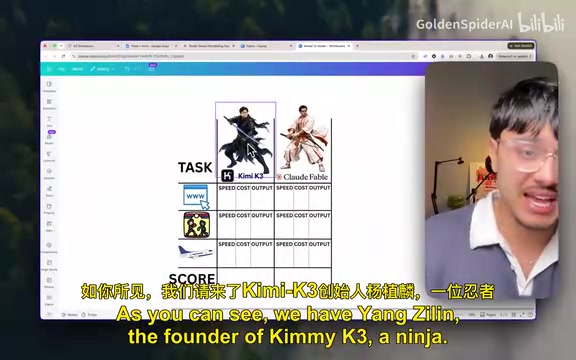
Kimi K3 vs Claude Real-World Test: Near-Equal Performance at 1/8 the Price
Real-world comparison of Kimi K3 vs Claude flagship across e-commerce pages, 3D fighting games, and flight simulators. Kimi K3 delivers 90% output quality at 1/8 the price with faster speeds and local deployment support.
Read more →

·3 min
Kimi K3 Reaches 2.5T Parameters, MiniMax M3 Pro Brewing Simultaneously: China's LLM Arms Race Escalates
Kimi K3 adopts new architecture with 2.5T parameters and 1M token context. MiniMax M3 Pro targets 2.7-3T. OpenAI surpasses 7M users, HY-OCR 1.5 achieves SOTA, Amap launches world model.
Read more →

·2 min
Claude Paid Subscription Down for Over a Week with No Response: The Pain Points of AI Service Support
Claude AI paid subscription down for over a week with no support response, exposing systemic gaps in AI service customer support. Analysis of impact, industry shortcomings, and user strategies.
Read more →