#MLA attention
70 related articles

·3 min
DeepSeek Plans Significant Price Hikes: Is the Era of Cheap AI Coming to an End?
DeepSeek plans significant API price hikes, signaling the end of ultra-cheap AI. We analyze the drivers, developer impact, and industry shift from price wars to rational pricing.
Read more →

·3 min
Self-Interrogation: A Novel Approach to Reverse Engineering DeepSeek by Interviewing the AI
Exploring an innovative approach to reverse engineering DeepSeek by directly interviewing the AI assistant, analyzing system prompt leakage, hallucination issues in model self-descriptions, and implications for AI transparency and prompt injection security.
Read more →

·3 min
Latent Space Reasoning: How DeepSeek-V4 Lets AI Think in Hidden Layers
Deep dive into DeepSeek-V4's latent space reasoning technology — how AI shifts from explicit chain-of-thought to implicit vector space reasoning, its efficiency gains, and challenges in interpretability.
Read more →

·3 min
SAM3 + RTMPose Zero-Shot on 1950s Factory Footage: A Real-World Test of Foundation Model Generalization
A developer applied SAM3 and RTMPose to 1950s black-and-white factory footage with zero fine-tuning and got accurate results. We analyze the technical logic and implications.
Read more →

·2 min
Why Are Users Demanding Kimi K3? A Reddit Rant Reveals the Truth About China's LLM Competition
A Reddit post sparks debate: users demand Kimi K3, citing DeepSeek's low prices. Deep analysis of Chinese LLM iteration speed, pricing strategies, and user loyalty.
Read more →

·3 min
P.D.E Experiment Nº5: Deep Dive into the TouchDesigner Open-Source Multi-Source Video Playback System
Deep analysis of P.D.E Experiment Nº5 open-source multi-source video playback system, covering frame-accurate switching, multi-source scheduling, and TouchDesigner + generative AI workflows.
Read more →

·3 min
Comparing China's Four Major AI Labs: Strategic Analysis of Qwen, DeepSeek, Moonshot, and Ling
An insider's analysis of China's four AI labs — Qwen, DeepSeek, Moonshot, and Ling — revealing their distinct strategic bets on distribution, architecture, long-termism, and serving cost.
Read more →

·2 min
antirez Strikes Again: ds4, a Pure C Local Inference Engine for DeepSeek 4
Redis creator antirez open-sources ds4, a pure C local inference engine for DeepSeek 4 Flash and PRO with native Metal, CUDA, and ROCm support, earning nearly 20K GitHub stars.
Read more →

·3 min
DeepSeek V4 Flash Released: Performance Approaching Claude at Just $0.18 per Million Tokens
DeepSeek V4 Flash launches with benchmark scores approaching Claude Opus 4.8 at just $0.18 per million output tokens. Deep analysis of performance, pricing, and industry impact.
Read more →

·3 min
Reasoning Capabilities Unmatched, Pricing Still Too High: The Dilemma of AI Model Competition
Deep analysis of the dilemma in AI model competition where reasoning gaps and pricing imbalances force vendors to excel at either capability or cost-effectiveness to survive.
Read more →

·5 min
The Complete Learning Path to Understanding the Kimi K3 Technical Report
A systematic learning path for understanding the Kimi K3 technical report, covering MoE, MLA, distributed training, and modern post-training techniques.
Read more →

·2 min
DeepSeek-V4-Flash Model Analysis: A New Lightweight AI Choice Prioritizing Efficiency
In-depth analysis of DeepSeek-V4-Flash model's positioning and technical path. Exploring the lightweight trend behind the Flash naming, MLA attention, MoE architecture, and its significance for open-source AI.
Read more →

·2 min
DeepSeek-V4-Flash Model Analysis: A New Lightweight AI Choice Prioritizing Efficiency
In-depth analysis of DeepSeek-V4-Flash model's product positioning and technical approach. Examining lightweight trends through the Flash naming, MLA attention mechanism, MoE architecture evolution, and implications for the open-source AI ecosystem.
Read more →

·3 min
DeepSeek V4 Flash Analysis: The Three-Dimensional Balance of Intelligence, Performance, and Price
Deep analysis of DeepSeek V4 Flash 0731 across intelligence, performance, and price dimensions, exploring how this Chinese LLM delivers extreme cost-performance to reshape the AI industry.
Read more →

·2 min
Why Top AI Startups Are No Longer Publishing Research: The Deep Reasons Behind the Shift from Openness to Secrecy
Exploring why top AI startups shifted from open research to secrecy, analyzing how commercial competition and talent pressure drive this change, and its impact on academia, innovation, and open source.
Read more →

·4 min
150,000 Flights in a Single Day Sets Global Record: Deep Dive into Data Tracking and Airspace Challenges
Global airlines operated over 150,000 flights in a single day, setting a civil aviation record. This article analyzes the drivers, ADS-B tracking technology, high-density airspace challenges, and AI applications in air traffic optimization.
Read more →

·4 min
Colibri: Running a 744-Billion-Parameter LLM on an Ordinary Laptop
Colibri uses MoE hot-cold separation and 4-bit quantization to run 744B-parameter models like GLM 5.2 on consumer hardware. Learn about its three-tier memory architecture and speculative decoding.
Read more →
·3 min
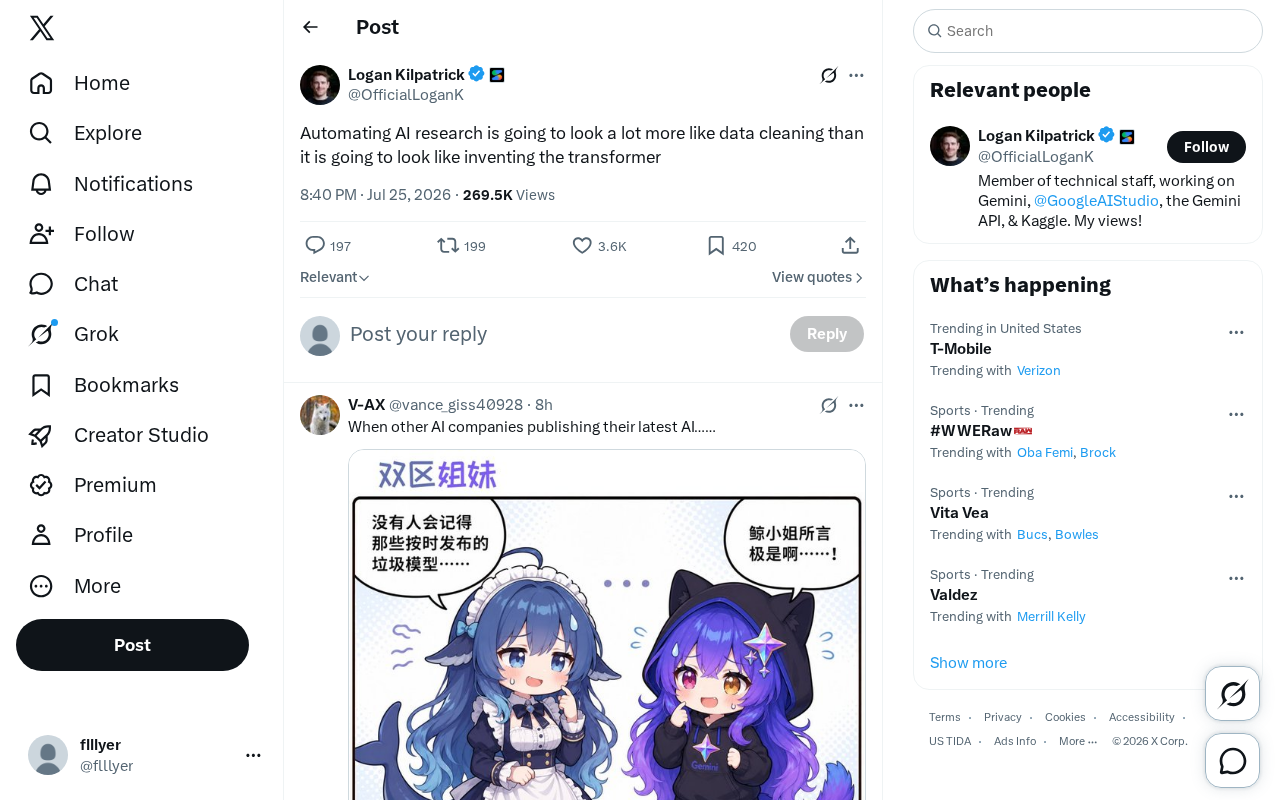
AI Research Automation: More Like Data Cleaning Than Inventing the Transformer
AI research automation will look more like data cleaning than inventing the Transformer. Explore how automating 60%-80% of repetitive research work reshapes the AI research paradigm.
Read more →
·3 min
AI Research Automation: More Like Data Cleaning Than Inventing the Transformer
Why AI research automation looks more like data cleaning than inventing the Transformer. Exploring the value of automating 60%-80% of repetitive research work and how human-AI collaboration reshapes the research paradigm.
Read more →

·3 min
Kimi K3 Launch: Performance Rivaling Claude at One-Third the Price, US-China AI Gap Narrows to 3 Months
Moonshot AI launches Kimi K3 reasoning model with performance rivaling Claude and OpenAI's top models at one-third the price. The US-China AI gap narrows from 6-12 months to just 3 months.
Read more →